
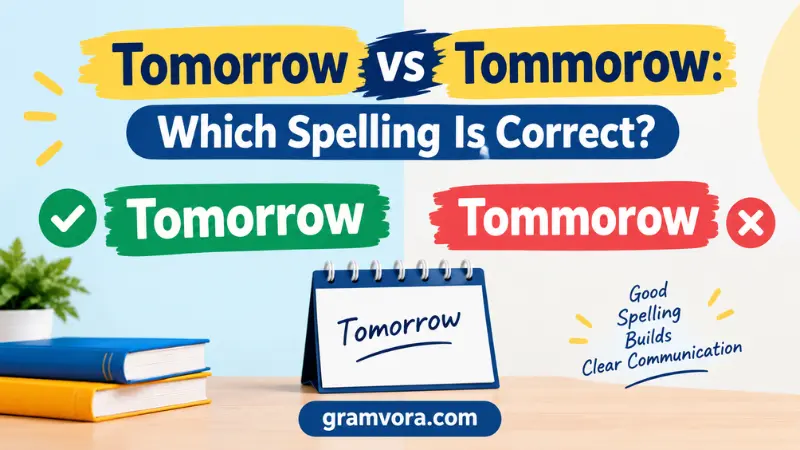
Tomorrow and tommorow are often confused because they look almost identical. The difference is only a few letters, but one spelling is standard and the other is not.
The correct spelling is tomorrow.
The spelling tommorow is a misspelling. It does not represent a separate American or British spelling of the word. Standard English dictionaries use tomorrow, not tommorow. Cambridge Dictionary lists tomorrow as an English word meaning the day after today and also as a word that can refer more generally to the future.
This spelling mistake is understandable because the word contains repeated letters and several vowels. When people write quickly, they may accidentally put an extra m in the middle and produce tommorow.
The good news is that the correction is simple:
Tomorrow = correct
Tommorow = incorrect
There is no US-versus-UK spelling difference here. American English and British English both use tomorrow.
Quick Answer
If you are wondering whether to write tomorrow or tommorow, always choose tomorrow.
| Spelling | Status | Use |
|---|---|---|
| tomorrow | Correct | Standard English |
| tommorow | Incorrect | Misspelling |
Tomorrow means the day after today.
For example:
I will call you tomorrow.
You should not write:
I will call you tommorow.
The second sentence contains a spelling error.
The correct form has one m after the first “to”:
to + morrow → tomorrow
A useful way to see the spelling is:
T O M O R R O W
There is one m and two r’s.
A common mistake is to write:
T O M M O R O W
That version has two m’s, so it is incorrect.
Why People Confuse Them
The spelling of tomorrow can be difficult because its pronunciation does not make every letter easy to identify.
In American English, Cambridge gives the pronunciation approximately as /təˈmɔr.oʊ/.
When people hear the word, they may not clearly notice where one sound ends and the next begins. This can make it difficult to remember whether the middle contains one m or two.
Another reason is the visual pattern of the word.
Compare:
tomorrow
tommorow
At first glance, the two forms look very similar. A writer who knows the word but types quickly may accidentally add an extra m.
The mistake can also happen because English contains many words with doubled consonants. Learners sometimes assume that tomorrow follows a similar spelling pattern.
However, the standard spelling is fixed:
tomorrow
It does not become tommorow in American English, British English, formal writing, or casual writing.
Key Differences At A Glance
The most important point is that this is not a comparison between two accepted spellings.
| Context | Best Choice | Why |
|---|---|---|
| American English | tomorrow | Standard spelling |
| British English | tomorrow | Standard spelling |
| School writing | tomorrow | Correct dictionary spelling |
| Professional writing | tomorrow | Standard form |
| Text messages | tomorrow | Correct standard form |
| Emails | tomorrow | Correct spelling |
| Academic writing | tomorrow | Standard English |
| Informal writing | tomorrow | Still the Correct spelling |
Spelling comparison
- Tomorrow: correct standard spelling.
- Tommorow: misspelling caused by adding an extra m.
There is no change in meaning between the two forms because tommorow is not a separate standard word.
Are They the Same Word?
They are intended to represent the same word, but they do not have the same status.
Tomorrow is the standard word.
Tommorow is an incorrect spelling of that word.
The standard word tomorrow has two common grammatical roles. It can function as an adverb, as in “I will see you tomorrow,” and as a noun, as in “Tomorrow will be busy.” Cambridge Dictionary identifies both uses.
As an adverb, tomorrow tells us when something will happen.
We are leaving tomorrow.
As a noun, tomorrow refers to the day after today.
Tomorrow is another opportunity.
It can also have a broader future meaning.
The decisions we make today can affect tomorrow.
Cambridge’s American English entry also identifies tomorrow as both a noun and an adverb and gives “the day after today” and “the future” among its meanings.
The incorrect spelling tommorow does not acquire a different meaning or grammatical function. It is simply a spelling error.
US vs UK Preference
There is no meaningful US-versus-UK spelling distinction between tomorrow and tommorow.
American English uses:
tomorrow
British English also uses:
tomorrow
The extra m in tommorow is not a British alternative.
This is important because English has many genuine regional spelling differences. For example, some words can appear with different spellings in American and British English. Tomorrow is not one of those cases.
So if you are writing for an American audience, use tomorrow.
If you are writing for a British audience, use tomorrow.
The same applies to Canadian, Australian, and many other forms of standard English.
The pronunciation can vary somewhat between accents, but the spelling remains tomorrow. Cambridge provides separate US and UK pronunciation information while retaining the same spelling.
Which Spelling Should You Use?
Use tomorrow every time you need the standard word.
You should use it in:
- emails
- text messages
- school assignments
- essays
- reports
- business communication
- websites
- social media posts
- applications
- professional documents
- formal correspondence
For example:
I will send the document tomorrow.
The meeting is scheduled for tomorrow morning.
Please call me tomorrow afternoon.
Tomorrow is the final day to submit the application.
In each case, tomorrow is the correct spelling.
Avoid writing:
I will send the document tommorow.
The sentence has a spelling error even though the intended meaning is easy to understand.
When proofreading, look specifically at the middle of the word. The correct sequence is:
tomorrow
not:
tommorow
A simple visual check can prevent this mistake.
When One Spelling Looks Wrong
Tommorow looks wrong because the word does not contain two m’s together.
The correct spelling is:
to-mor-row
This is not a formal syllable rule that you need to apply to every English word, but it can be a useful memory aid.
Look at the spelling letter by letter:
t o m o r r o w
There is:
- one m
- two r’s
- one w
The common error reverses the pattern in the middle:
t o m m o r o w
That creates the incorrect form tommorow.
A useful memory trick is:
One M, two R’s: tomorrow.
You can also remember the word by focusing on the middle:
to + morrow
The form morrow is an English noun meaning the next day or tomorrow, although it is now mainly literary. Cambridge Dictionary lists morrow as a literary word.
This can help explain why tomorrow has the spelling it does, although you do not need to use morrow in everyday American English.
Common Mistakes (and Quick Fixes)
Mistake 1: Adding an extra M
Incorrect:
I will finish it tommorow.
Correct:
I will finish it tomorrow.
Remember: one M.
Mistake 2: Removing an R
Incorrect:
I will see you tomorow.
Correct:
I will see you tomorrow.
Remember: two R’s.
Mistake 3: Mixing the two errors
Some writers may produce forms such as:
tommorow
or
tomorow
Neither is correct.
The standard spelling is:
tomorrow
Mistake 4: Using the wrong spelling in professional communication
A spelling error in a text message may be harmless, but repeated errors in a resume, email, report, or application can make the writing look careless.
Always check tomorrow before submitting important writing.
Mistake 5: Assuming pronunciation determines spelling
English spelling is not always perfectly predictable from pronunciation.
You should not try to spell tomorrow only from the sounds you hear. Instead, learn its standard written form:
tomorrow
Quick Fix
When you are unsure, remember:
Tomorrow has one M and two R’s.
That is the easiest practical way to avoid tommorow.
Everyday Examples
Here are natural American English examples using the correct spelling.
Example 1: Everyday plans
I’ll see you tomorrow.
This means the speaker will see the person on the day after today.
Example 2: Work
I have a meeting tomorrow morning.
The meeting is scheduled for the next day.
Example 3: School
The assignment is due tomorrow.
The deadline is the following day.
Example 4: Business
We can discuss the proposal tomorrow.
The discussion will happen the next day.
Example 5: Travel
Our flight leaves tomorrow evening.
The flight is scheduled for the next evening.
Example 6: Family
My parents are visiting tomorrow.
The visit is planned for the next day.
Example 7: Future meaning
Today’s choices can shape tomorrow.
Here, tomorrow has a broader sense referring to the future.
Example 8: Tomorrow’s
The possessive form is also common:
Tomorrow’s meeting starts at nine.
Here, tomorrow’s means “of tomorrow” or “belonging to tomorrow.”
Incorrect examples
These sentences contain the common spelling mistake:
I will call you tommorow.
The test is tommorow.
See you tommorow morning.
Correct versions:
I will call you tomorrow.
The test is tomorrow.
See you tomorrow morning.
The mistake does not change what the writer intended to say, but it is still incorrect standard spelling.
Dictionary-Style Word Details
Verb
Tomorrow is not normally used as a verb in standard English.
Tommorow is also not a standard verb.
The word is primarily used as a noun and adverb. Cambridge Dictionary identifies tomorrow as a noun and adverb rather than a verb.
So you should not invent a verb meaning for either spelling.
Noun
Tomorrow: a noun referring to the day after today or, in some contexts, the future.
Examples:
Tomorrow is a new day.
We have a big presentation tomorrow.
Tommorow: not a standard noun spelling. It is a misspelling of tomorrow.
The noun tomorrow can also appear in possessive constructions:
Tomorrow’s weather should be better.
Tomorrow’s meeting was canceled.
Synonyms
Because tomorrow has a specific time reference, it does not always have a perfect one-word synonym.
Closest plain alternatives include:
- the next day
- the following day
- the day after today
These expressions can replace tomorrow in many contexts, although they may sound less natural in casual conversation.
For example:
I’ll call you tomorrow.
can become:
I’ll call you the next day.
However, the second sentence can depend on the surrounding context and does not always sound identical.
Tommorow has no separate synonyms because it is simply an incorrect spelling of tomorrow.
Example Sentences
Tomorrow:
I need to leave early tomorrow.
We can finish the project tomorrow.
Tomorrow’s appointment starts at 10 a.m.
She is flying home tomorrow.
The store opens tomorrow morning.
Let’s talk about it tomorrow.
Tommorow:
There are no standard examples because tommorow is not the accepted spelling.
If you see it in a sentence, correct it to tomorrow.
Word History
The modern spelling tomorrow is established in standard English. The word is connected historically with the idea of the following day.
The related word morrow means the next day and is now mainly literary. Cambridge Dictionary lists morrow as a literary noun meaning the next day or tomorrow.
For modern writers, however, the important point is simple: standard English uses tomorrow.
There is no need to create a complicated historical explanation for the incorrect spelling tommorow. The extra m is simply a spelling error rather than evidence of a separate historical or regional form.
Phrases Containing
Tomorrow appears in many common expressions and constructions.
Examples include:
- tomorrow morning
- tomorrow afternoon
- tomorrow evening
- tomorrow night
- tomorrow’s meeting
- tomorrow’s weather
- the day after tomorrow
- see you tomorrow
- until tomorrow
- by tomorrow
- from tomorrow
Examples:
I’ll finish the report by tomorrow.
We are leaving tomorrow morning.
I’ll see you tomorrow.
The package should arrive by tomorrow afternoon.
She will return the day after tomorrow.
The spelling remains tomorrow in each expression.
FAQs
Is “tomorrow” or “tommorow” correct?
Tomorrow is the correct spelling. Tommorow is a common misspelling and should not be used in standard English.
How do you spell tomorrow correctly?
The correct spelling is T-O-M-O-R-R-O-W: tomorrow.
Does “tomorrow” have one M or two?
Tomorrow has one M and two R’s. A simple memory tip is: one M, two R’s — tomorrow.
Is “tommorow” an accepted spelling?
No. Tommorow is not an accepted standard spelling. It is an incorrect version of tomorrow.
Is “tommorow” correct in American English?
No. American English uses tomorrow. The spelling tommorow is considered a misspelling.
Is “tommorow” correct in British English?
No. British English also uses tomorrow. There is no standard British spelling tommorow.
Why do people spell “tomorrow” as “tommorow”?
The mistake usually happens because the middle of the word is easy to misremember. Writers may accidentally add an extra m and write tommorow instead of tomorrow.
What does “tomorrow” mean?
Tomorrow usually means the day after today. It can also refer more generally to the future.
Is “tomorrow” a noun or an adverb?
Tomorrow can function as both a noun and an adverb. For example, “I will call you tomorrow” uses it as an adverb, while “Tomorrow is another day” uses it as a noun.
Is “tomorow” correct?
No. Tomorow is also a misspelling because it has only one r. The correct spelling is tomorrow, with two R’s.
Conclusion
The answer to “Tomorrow vs Tommorow: Which spelling is correct?” is straightforward:
Tomorrow is correct.
Tommorow is incorrect.
The two forms should not be treated as competing US and UK spellings. Tommorow is simply a common misspelling of the standard word tomorrow.
The easiest way to remember the correct spelling is:
Tomorrow = one M + two R’s.
Write:
I will see you tomorrow.
Not:
I will see you tommorow.
The word tomorrow can work as a noun or an adverb and can refer to the day after today or, in broader contexts, the future.
Whether you are writing an email, school assignment, business document, text message, or website article, tomorrow is the spelling you should use.


