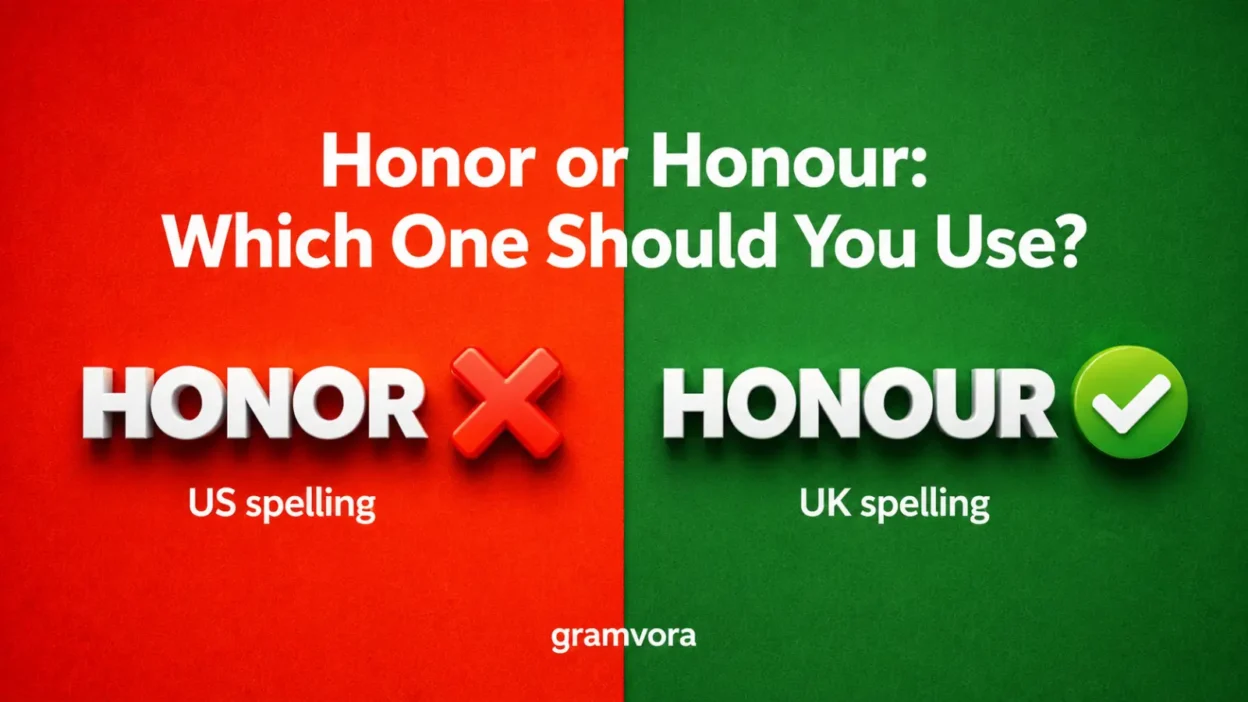
The choice between honor or honour is mostly a spelling choice, not a meaning choice. Both words refer to respect, integrity, recognition, or a special privilege. The difference is where and for whom you are writing.
For a US audience, honor is the standard spelling. For British English and many Commonwealth audiences, honour is the standard spelling. The safest rule is simple: match the spelling style of your audience, school, company, or publication.
Quick Answer
Use honor in American English.
Use honour in British English and in many Commonwealth forms of English.
They mean the same thing. The spelling changes by region, not by grammar or meaning. In a US article, email, school paper, business page, or invitation, honor is normally the better choice.
Why People Confuse Them
People confuse these words because both spellings look correct, and both appear in real English. A US reader usually sees honor in school, news, legal writing, and everyday text. A British reader is more likely to see honour in the same kinds of writing.
The confusion also grows online. A person may read a British article one minute and an American article the next. Spellcheck settings can also change the suggested spelling depending on whether the document uses US or UK English.
Key Differences At A Glance
Core comparison:
Honor: American spelling; used as a noun and a verb.
Honour: British/Commonwealth spelling; used as a noun and a verb.
Meaning: The same basic meaning in both spellings.
Best rule: Pick one spelling style and stay consistent.
Meaning and Usage Difference
Honor and honour both can mean respect, moral integrity, public recognition, or a privilege.
As a noun, the word can describe respect or distinction. For example, “It was an honor to speak at the event.”
As a verb, it means to respect, celebrate, recognize, or fulfill something. For example, “We honor our veterans every year.”
The spelling does not create a new meaning. Honor is not more casual, and honour is not automatically more formal. The real difference is regional spelling.
Pronunciation does not need much focus here. In normal speech, both forms sound almost the same to most learners.
Tone, Context, and Formality
In American English, honor sounds natural in both casual and formal writing. It works in school papers, wedding invitations, speeches, legal titles, and business messages.
In British English, honour fills the same role. It can sound formal or everyday depending on the sentence, not because of the extra “u.”
For US readers, honour may look foreign, old-fashioned, or intentionally British. For British readers, honor may look American. Neither spelling is wrong by itself. The “right” choice depends on the English variety you are using.
Which One Should You Use?
| Context | Best Choice | Why |
|---|---|---|
| US blog post, school paper, or email | honor | Standard American spelling |
| British article or UK audience | honour | Standard British spelling |
| US wedding invitation | honor | Expected American form |
| British wedding invitation | honour | Expected British form |
| Addressing a US judge | Your Honor | Standard US legal title |
| Addressing a British judge | Your Honour | Standard British form |
| Quoting an official name | Keep the original spelling | Proper names should not be changed |
| Writing for a global brand | Follow the brand style guide | Consistency matters most |
When One Choice Sounds Wrong
Honour can sound wrong in a US sentence if the rest of the writing uses American spelling. For example, “The school held an honour roll ceremony” looks inconsistent for a US school page.
Honor can sound wrong in a British sentence if the rest of the writing uses British spelling. For example, “The charity held a dinner in honor of its founder” may look American in a UK article.
The main issue is not meaning. It is consistency. Mixing honor with British spellings like “colour” and “favour” can look careless unless you are quoting text or using a proper name.
Common Mistakes (and Quick Fixes)
One common mistake is using both spellings in the same article.
Weak: “It was an honor to receive this honour.”
Better for US English: “It was an honor to receive this honor.”
Better for British English: “It was an honour to receive this honour.”
Another mistake is changing official names. If an organization, award, book, school, or legal title uses one spelling, keep that spelling.
Also remember the related forms. In US English, use honored, honoring, and honorable. In British English, use honoured, honouring, and honourable.
Everyday Examples
US English: “It was an honor to meet your family.”
British English: “It was an honour to meet your family.”
US English: “The city will honor the firefighters at a public ceremony.”
British English: “The city will honour the firefighters at a public ceremony.”
US English: “She served as maid of honor at her sister’s wedding.”
British English: “She served as maid of honour at her sister’s wedding.”
US English: “The judge said, ‘Please address the court as Your Honor.’”
British English: “The judge said, ‘Please address the court as Your Honour.’”
Dictionary-Style Word Details
Verb
Honor: Commonly used as a verb in American English. It means to show respect, give recognition, celebrate someone, or fulfill an agreement. Example: “We honor the contract.”
Honour: Commonly used as a verb in British English. It has the same meaning. Example: “We honour the contract.”
Noun
Honor: Commonly used as a noun in American English. It can mean respect, integrity, distinction, or a privilege. Example: “It was an honor to be invited.”
Honour: Commonly used as a noun in British English. It has the same meaning. Example: “It was an honour to be invited.”
Synonyms
Honor: Closest plain alternatives include respect, integrity, recognition, dignity, and privilege. For the verb, close alternatives include respect, recognize, celebrate, and fulfill.
Honour: The same alternatives apply because the meaning is the same.
Clear antonyms depend on the sentence. For moral integrity, a useful opposite can be dishonor. For respect, possible opposites include disrespect or shame.
Example Sentences
Honor: “The team brought honor to the school.”
Honour: “The team brought honour to the school.”
Honor: “Please honor the deadline in the agreement.”
Honour: “Please honour the deadline in the agreement.”
Honor: “The award was given in honor of her service.”
Honour: “The award was given in honour of her service.”
Word History
Honor and honour come from older forms connected to French and Latin. Over time, English kept different spelling habits in different regions.
Modern American English usually uses honor. Modern British English usually uses honour. The history explains the spelling difference, but it does not create a separate meaning in modern use.
Phrases Containing
Honor: guest of honor, maid of honor, in honor of, honor roll, honor system, Your Honor, on my honor.
Honour: guest of honour, maid of honour, in honour of, honours degree, Your Honour, on my honour.
Use the spelling that fits your audience unless the phrase is part of an official title or name.
FAQs
Is honor or honour correct?
Both are correct. Honor is the standard spelling in American English, while honour is the standard spelling in British English and many Commonwealth countries. The meaning is the same.
Which spelling should I use in the USA?
Use honor in the USA. It is the normal American spelling in school papers, emails, articles, invitations, legal writing, and business content.
Is honour wrong in American English?
Honour is not wrong as a word, but it usually looks British or non-American. In US writing, honor is the expected spelling unless you are quoting a title, name, or source that uses honour.
Do honor and honour mean the same thing?
Yes. Honor and honour mean the same thing. Both can refer to respect, integrity, recognition, or a special privilege. The difference is spelling, not meaning.
Is it “maid of honor” or “maid of honour”?
In American English, write maid of honor. In British English, write maid of honour. The role is the same; only the spelling changes.
Is it “Your Honor” or “Your Honour”?
In the United States, the standard form is Your Honor. In British English, Your Honour may be used. Legal titles should match the country and court style.
Is it “in honor of” or “in honour of”?
Use in honor of in American English. Use in honour of in British English. For example, a US event page would usually write, “The dinner was held in honor of her service.”
Should I use honored or honoured?
Use honored in American English and honoured in British English. Example: “I am honored to receive this award” is the standard US spelling.
Should I use honorable or honourable?
Use honorable in American English and honourable in British English. Both forms describe someone or something worthy of respect.
Can honor be used as a verb?
Yes. In American English, honor can be a verb. It means to respect, recognize, celebrate, or fulfill something. Example: “We honor our promises.”
Can honor be used as a noun?
Yes. Honor can be a noun in American English. It can mean respect, integrity, distinction, or privilege. Example: “It was an honor to meet you.”
Which spelling is better for a US blog?
For a US blog, honor is better. It matches American spelling and feels more natural to US readers.
Should I change honour to honor when quoting someone?
No. Keep the original spelling when quoting someone, naming an organization, or using an official title. Do not change quoted text just to match your spelling style.
Why does honour have a “u”?
Honour keeps a spelling pattern common in British English. American English often uses shorter spellings, such as honor, color, and favor.
What is the easiest way to remember honor vs honour?
Remember this simple rule: honor is American, and honour is British. For US writing, use honor almost every time.
Conclusion
For American English, choose honor. For British English and many Commonwealth contexts, choose honour. The words mean the same thing and work as both nouns and verbs.
The best choice is the one that matches your audience and stays consistent across the full piece. For a US reader, honor is the clear, natural, and expected spelling.