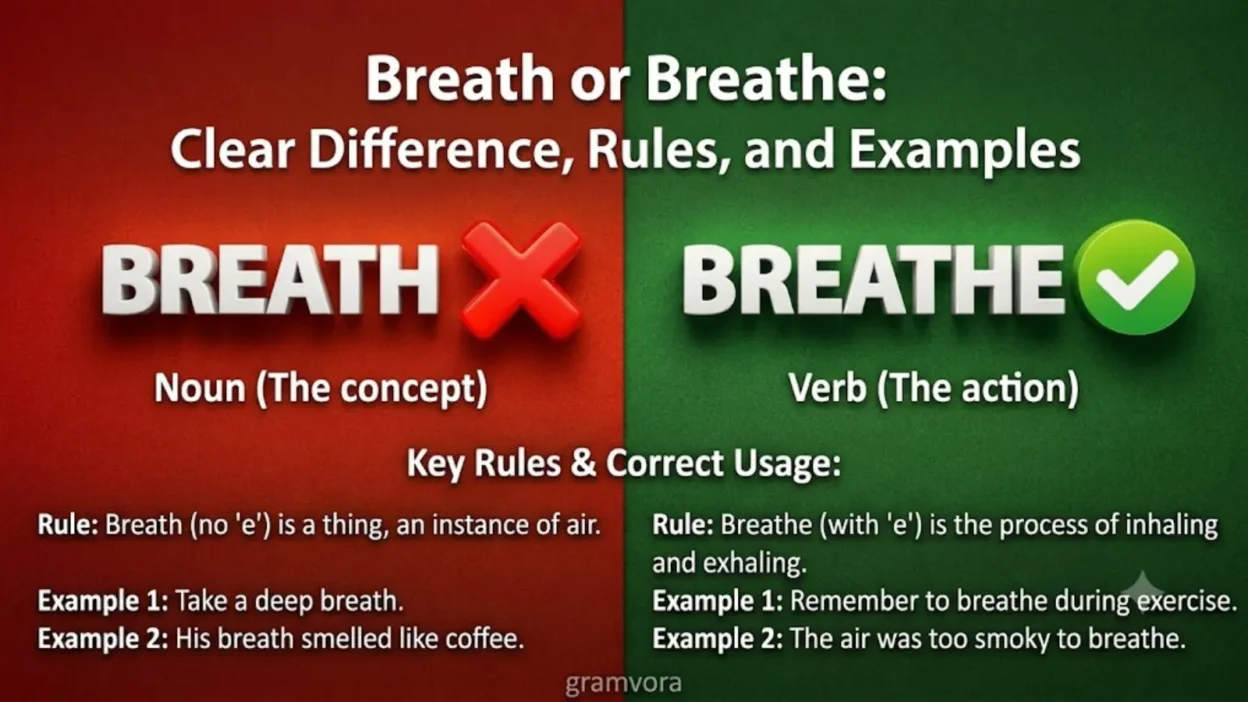
Breath or breathe is a common word-choice problem because the two words look almost the same. The difference is simple, but it matters.
Breath is a noun. It names the air you take in or let out, one act of breathing, or your ability to breathe.
Breathe is a verb. It means to take air into your lungs and send it out again.
So, you take a breath, but you breathe deeply. You can hold your breath, but you cannot “hold your breathe.” You can say, “I can’t breathe,” but not “I can’t breath.”
The extra e at the end changes both the grammar and the sound. Breath sounds like “breth,” rhyming with death. Breathe sounds like “breeth,” rhyming with seethe.
Quick Answer
Use breath when you need a noun.
Use breathe when you need a verb.
| Context | Best Choice | Why |
|---|---|---|
| I need to take a ___ before speaking. | breath | You need a noun for one act of breathing. |
| Please ___ slowly. | breathe | You need a verb for the action. |
| She was out of ___. | breath | This phrase uses the noun. |
| I can’t ___ in this smoky room. | breathe | The sentence needs an action verb. |
| His ___ smelled like coffee. | breath | This refers to air from the mouth. |
| The doctor told me to ___ in. | breathe | “Breathe in” is a verb phrase. |
A fast test helps: if you can put a, one, my, your, or his before the word, you probably need breath. If the word shows an action, you probably need breathe.
Why People Confuse Them
People confuse breath and breathe because they share the same base idea: air moving in and out of the body. They also differ by only one letter.
The sound adds to the confusion. In fast speech, some people do not notice the final sound clearly. In writing, the final e is easy to miss.
Another reason is that English often uses related noun and verb pairs that look close but sound different. Breath names the thing. Breathe names the action.
Think of this simple pair:
I took a breath.
Then I began to breathe.
The first sentence names one breath. The second sentence shows the action of breathing.
Key Differences At A Glance
| Feature | breath | breathe |
| Main role | Noun | Verb |
| Plain meaning | Air taken in or sent out; one act of breathing | To take air in and send it out |
| Pronunciation | “breth” | “breeth” |
| Common pattern | take a breath, hold your breath | breathe deeply, breathe in, breathe out |
| Example | Take a deep breath. | Breathe through your nose. |
The main difference is not tone, style, or formality. It is grammar. Breath and breathe do different jobs in a sentence.
Meaning and Usage Difference
Breath means the air connected with breathing or one act of breathing.
Examples:
Take a deep breath before you answer.
Her breath was visible in the cold air.
He paused to catch his breath after the stairs.
In these sentences, breath acts like a thing. You can take it, hold it, lose it, smell it, or catch it.
Breathe means to do the action of breathing.
Examples:
Try to breathe slowly.
The room was so crowded that it felt hard to breathe.
She breathed in, counted to four, and breathed out.
In these sentences, breathe acts like an action. A person, animal, or living thing can breathe. The word can also be used in figurative phrases, such as breathe life into a plan or give someone room to breathe.
Tone, Context, and Formality
Breath and breathe are both normal words in everyday US English. Neither one is more formal by itself.
The choice depends on sentence structure.
Use breath in regular, medical, fitness, speech, and emotional contexts when you mean the noun:
bad breath
shortness of breath
a deep breath
a sharp intake of breath
a breath of fresh air
Use breathe when describing the action:
breathe normally
breathe through your nose
breathe deeply
breathe in and out
breathe easier
Pronunciation is useful here because the sounds are different. Breath has a short vowel sound. Breathe has a long “ee” sound. The final sound also feels different: breath ends with a sharper th, while breathe ends with a voiced sound.
Which One Should You Use?
Choose breath when the word is something you can count, hold, smell, take, or lose.
Correct:
Take one breath and relax.
I could smell mint on her breath.
He held his breath underwater.
Choose breathe when the word is something someone does.
Correct:
Please breathe slowly.
I can finally breathe again.
The baby is breathing normally.
Here is the easiest memory trick:
Breath is a thing.
Breathe is something you do.
The sentence “You breathe a breath” sounds a little awkward, but it shows the difference clearly. The first word is the action. The second word is the noun.
When One Choice Sounds Wrong
Some mistakes sound wrong right away because the sentence needs a verb, not a noun.
Wrong: I can’t breath.
Correct: I can’t breathe.
Wrong: Try to breath through your nose.
Correct: Try to breathe through your nose.
Other mistakes happen because the sentence needs a noun, not a verb.
Wrong: Take a deep breathe.
Correct: Take a deep breath.
Wrong: She was out of breathe.
Correct: She was out of breath.
A simple way to check is to look at the word before it. If you see a, the, my, your, his, or her, you likely need breath.
Examples:
a breath
your breath
his breath
the breath
If the word follows to, you usually need breathe.
Examples:
to breathe
to breathe in
to breathe easier
Common Mistakes (and Quick Fixes)
One common mistake is using breath after to.
Wrong: I need to breath.
Correct: I need to breathe.
Another common mistake is adding e when the noun is needed.
Wrong: Hold your breathe.
Correct: Hold your breath.
Writers also mix them up in health or exercise sentences.
Wrong: Take three slow breathes.
Correct: Take three slow breaths.
Wrong: She could barely breath after the run.
Correct: She could barely breathe after the run.
Notice the plural form: breaths. The noun breath becomes breaths when you mean more than one.
Correct:
Take three slow breaths.
Do not write breathes unless you mean the verb form for he, she, or it.
Correct:
She breathes slowly when she feels stressed.
Everyday Examples
Here are natural examples that show the difference.
Breath examples:
Take a breath before you start the presentation.
His breath smelled like coffee.
I was out of breath after carrying the boxes upstairs.
She held her breath during the final shot.
A walk outside felt like a breath of fresh air.
Breathe examples:
Breathe in through your nose and out through your mouth.
The office was so stuffy that I needed to step outside and breathe.
He breathed deeply before making the call.
Plants need the right conditions to breathe and grow.
The new schedule gave the team room to breathe.
Mixed examples:
Take a breath, then breathe slowly.
He lost his breath because he was breathing too fast.
When you feel tense, pause for one breath and breathe out slowly.
Dictionary-Style Word Details
Verb
breath: Not commonly used as a verb in standard US English. Use breathe for the action.
Correct: I need to breathe.
Incorrect: I need to breath.
breathe: A verb meaning to take air into the lungs and send it out again. It can be intransitive or transitive.
Intransitive: She can breathe more easily now.
Transitive: He breathed cold air into his lungs.
It also appears in figurative uses.
The coach breathed confidence into the team.
The redesign gave the room space to breathe.
Noun
breath: A noun. It can mean air taken in or sent out, one act of breathing, breathing ability, a short pause, a slight breeze, or a small hint of something.
Examples:
Take a breath.
His breath was warm in the cold air.
She was short of breath.
There was not a breath of wind.
breathe: Not used as a noun in standard US English. Use breath for the noun.
Correct: Take a breath.
Incorrect: Take a breathe.
Synonyms
breath: Exact synonyms depend on the meaning. Closest plain alternatives include air, inhalation, exhalation, respiration, pause, break, hint, or whiff.
Examples:
breath of air = air
one breath = one inhalation or exhalation cycle
a breath of scandal = a hint of scandal
A clear general antonym for breath does not fit every use.
breathe: Closest plain alternatives include respire, inhale, exhale, pant, gasp, or live, depending on context.
Respire is more technical. Inhale means breathe in. Exhale means breathe out.
Useful opposites for breathe include suffocate, choke, or smother, but only in contexts where breathing is blocked or difficult.
Example Sentences
breath:
Take a deep breath before you speak.
I could see my breath in the cold morning air.
He stopped at the top of the hill to catch his breath.
Please do not say that under your breath.
breathe:
Try to breathe slowly during the test.
The doctor asked her to breathe in and hold it.
I can breathe easier now that the project is done.
The old windows let the house breathe.
Word History
breath: The word has old roots connected with air, smell, vapor, and exhaled air. In modern English, it is the noun form readers use for air from breathing or one act of breathing.
breathe: The verb is also old and is used for the action of taking air in and sending it out. The detailed history is more complex than most readers need, but the modern split is stable: breath is the noun, and breathe is the verb.
Phrases Containing
breath:
take a breath
hold your breath
catch your breath
out of breath
bad breath
short of breath
under your breath
a breath of fresh air
in the same breath
breathe:
breathe in
breathe out
breathe deeply
breathe easy
breathe easier
breathe life into
room to breathe
live and breathe something
Conclusion
The difference between breath and breathe is clear once you focus on grammar.
Breath is the noun. Use it for air, one act of breathing, breathing ability, or common phrases like take a breath, hold your breath, and out of breath.