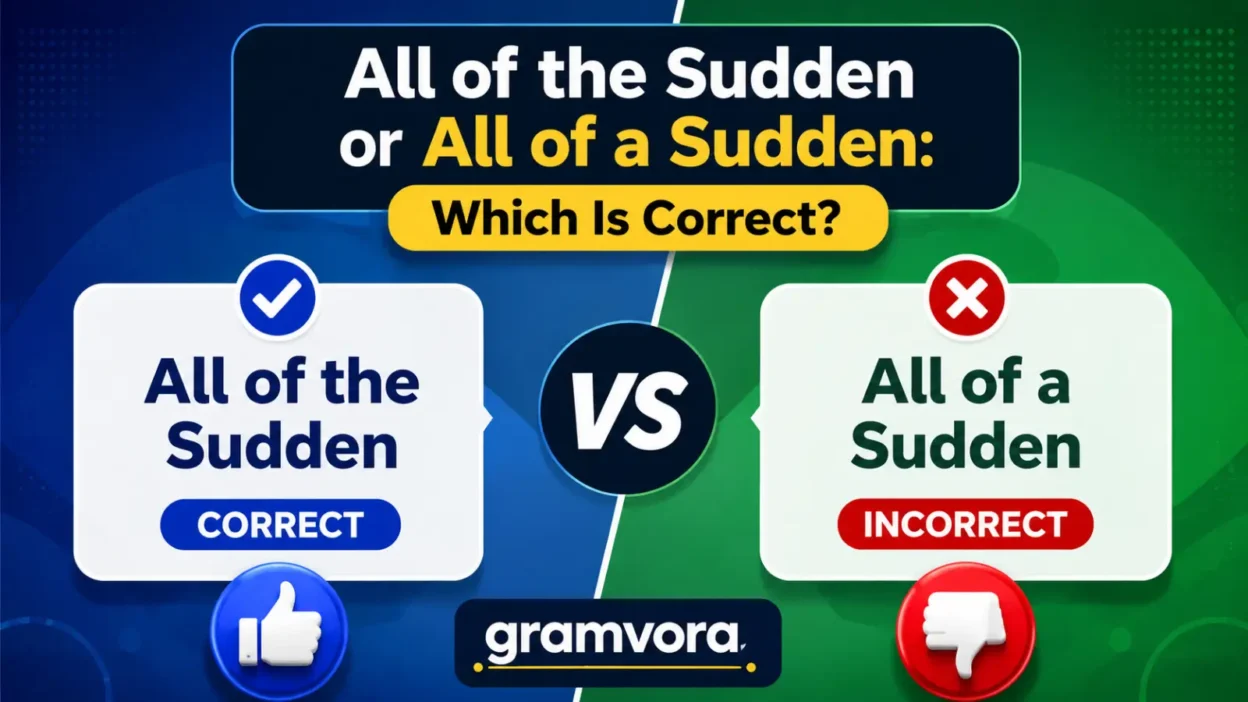
Use all of a sudden in standard US English. It means “suddenly,” “unexpectedly,” or “without warning.” For example, “All of a sudden, the lights went out” is correct and natural.
All of the sudden means the same thing when people use it, but standard dictionaries and usage guides treat it as a mistake. The issue is not a deep meaning difference. The real difference is that all of a sudden is the accepted idiom, while all of the sudden is a common nonstandard form.
Quick Answer
All of a sudden is correct. All of the sudden is not recommended in edited US writing. Use all of a sudden when something happens quickly and unexpectedly: “All of a sudden, my phone died.” The phrase works like an adverbial phrase, similar to suddenly or without warning.
Why People Confuse Them
People confuse these phrases because a and the are both common articles. In many sentences, switching between them changes the meaning but still creates a grammatical phrase.
However, idioms do not always follow a rule you can rebuild word by word. All of a sudden is a fixed expression. That means readers expect those exact words in that order.
Another reason for the mistake is sound. In fast speech, all of a sudden can sound blurred. A listener may hear it as all of the sudden, especially if they already expect a more familiar article pattern.
Key Differences At A Glance
| Context | Best Choice | Why |
|---|---|---|
| Standard writing | all of a sudden | This is the accepted idiom. |
| School essays | all of a sudden | It is the safer edited form. |
| Business writing | all of a sudden | It avoids a common usage error. |
| Casual texting | all of a sudden | Still the better choice, even in informal writing. |
| Dialogue showing a character’s speech | all of the sudden | Use only if you intentionally want nonstandard speech. |
| Replacing “suddenly” | all of a sudden | It means quickly and unexpectedly. |
Meaning and Usage Difference
All of a sudden means that something happened quickly, unexpectedly, or without warning.
• All of a sudden, the room went quiet.
• The meeting was normal, and then all of a sudden, everyone started laughing.
• I was walking home when it started raining all of a sudden.
All of the sudden tries to express the same idea, but it is not the accepted form in standard US English.
Incorrect or nonstandard example:
• All of the sudden, the room went quiet.
Better:
• All of a sudden, the room went quiet.
The phrase usually works as an adverbial phrase. It tells how or when something happened. It can appear at the beginning, middle, or end of a sentence.
Tone, Context, and Formality
All of a sudden is standard, natural, and widely understood. It fits casual speech, stories, essays, articles, emails, and everyday conversation.
Still, it has a slightly dramatic feel because it highlights surprise. In very formal writing, suddenly, unexpectedly, or without warning may sound cleaner.
Use this compact comparison:
| Feature | all of the sudden | all of a sudden |
|---|---|---|
| Standard status | Nonstandard | Standard |
| Meaning intended | Suddenly | Suddenly |
| Best use | Only intentional informal dialogue | Normal US writing and speech |
| Edited writing | Avoid | Use |
| Reader reaction | May look like an error | Sounds natural |
Which One Should You Use?
Use all of a sudden almost every time.
Choose it when you want to describe a quick, surprising change:
• All of a sudden, my laptop shut down.
• She was calm, and then all of a sudden, she started crying.
• The dog was sleeping, then all of a sudden, it jumped up.
Use all of the sudden only if you are quoting someone exactly or writing dialogue where a nonstandard phrase fits the speaker’s voice.
For clean writing, the choice is simple: all of a sudden.
When One Choice Sounds Wrong
All of the sudden sounds wrong because the idiom has settled as all of a sudden. The words of the sudden may look logical to some readers, but idioms depend on accepted usage, not just article rules.
Wrong:
• All of the sudden, the app stopped working.
Correct:
• All of a sudden, the app stopped working.
Wrong:
• We were driving, and all of the sudden, traffic stopped.
Correct:
• We were driving, and all of a sudden, traffic stopped.
The mistake becomes more noticeable in polished writing because readers expect the familiar phrase.
Common Mistakes (and Quick Fixes)
Mistake 1: Using the instead of a
Wrong:
• All of the sudden, I remembered the appointment.
Correct:
• All of a sudden, I remembered the appointment.
Mistake 2: Dropping of
Wrong:
• All a sudden, the alarm went off.
Correct:
• All of a sudden, the alarm went off.
Mistake 3: Writing all the sudden
Wrong:
• All the sudden, the baby started laughing.
Correct:
• All of a sudden, the baby started laughing.
Mistake 4: Overusing the phrase
Weak:
• All of a sudden, I woke up. All of a sudden, I heard a noise. All of a sudden, I ran downstairs.
Better:
• I woke up suddenly. Then I heard a noise downstairs, so I ran to check it.
Everyday Examples
• All of a sudden, my Wi-Fi stopped working.
• The movie was slow, and then all of a sudden, the ending got intense.
• I was fine in the morning, but all of a sudden, I felt dizzy.
• All of a sudden, everyone in the group chat went silent.
• The kids were playing quietly, and then all of a sudden, someone yelled.
• It looked sunny, but all of a sudden, dark clouds rolled in.
• All of a sudden, the store got crowded.
• He was joking around, then all of a sudden, he got serious.
• The car was running fine, and all of a sudden, the engine light came on.
• All of a sudden, I understood what the teacher meant.
Dictionary-Style Word Details
Verb
• all of the sudden: Not used as a verb in standard US English. It is a nonstandard version of an idiomatic phrase.
• all of a sudden: Not used as a verb. It works as an adverbial phrase that modifies an action or event.
Noun
• all of the sudden: Not used as a noun phrase in modern standard English.
• all of a sudden: The whole expression is not a noun phrase. However, sudden reflects an older noun use inside the fixed idiom. Modern speakers usually treat the full phrase as meaning suddenly.
Synonyms
• all of the sudden: No separate standard synonyms because it is not the recommended form. The intended meaning is the same as all of a sudden.
• all of a sudden: Closest plain alternatives include suddenly, unexpectedly, without warning, abruptly, and all at once.
Clear opposites are limited, but useful contrast phrases include gradually, slowly, over time, and little by little.
Example Sentences
• all of the sudden: “All of the sudden, the lights went out” is understandable, but standard writing should change it to all of a sudden.
• all of a sudden: All of a sudden, the lights went out.
• all of the sudden: Avoid it in essays, reports, emails, and polished articles.
• all of a sudden: We were talking, and all of a sudden, the call dropped.
Word History
• all of the sudden: This form has appeared in use, especially in informal contexts, but modern usage references do not treat it as the standard idiom.
• all of a sudden: This is the form that survived as the accepted fixed expression. The older noun sense of sudden is mostly gone from everyday English, but it remains inside this phrase.
The safest explanation is simple: English kept all of a sudden as the recognized idiom, even though all of the sudden may seem logical to some writers.
Phrases Containing
• all of the sudden: No standard phrase pattern should be built from this form.
• all of a sudden: Common phrase patterns include:
• all of a sudden, something happened
• then all of a sudden
• just all of a sudden
• happen all of a sudden
• change all of a sudden
Examples:
• Then all of a sudden, the screen froze.
• It happened all of a sudden.
• She changed her mind all of a sudden.
FAQs
Is it “all of a sudden” or “all of the sudden”?
The correct phrase is all of a sudden. Use it when something happens quickly, unexpectedly, or without warning. All of the sudden is common in casual speech, but it is not the standard form for polished US writing.
Is “all of the sudden” ever correct?
In standard US English, all of the sudden is best avoided. People may understand it, but editors, teachers, and careful readers usually expect all of a sudden. Use the standard phrase in essays, emails, articles, and business writing.
What does “all of a sudden” mean?
All of a sudden means suddenly, unexpectedly, or without warning. For example, “All of a sudden, the lights went out” means the lights went out quickly and surprisingly.
Can I use “suddenly” instead of “all of a sudden”?
Yes. Suddenly is a shorter and more formal option. All of a sudden sounds more conversational and dramatic. Use suddenly when you want a cleaner sentence, and use all of a sudden when you want to stress surprise.
Why do people say “all of the sudden”?
People often say all of the sudden because the sounds natural in many English phrases. Also, fast speech can make all of a sudden sound unclear. Still, the accepted idiom is all of a sudden.
Should I put a comma after “all of a sudden”?
Use a comma when the phrase starts a sentence. Example: All of a sudden, the dog started barking. When the phrase appears later in the sentence, a comma is not always needed. Example: The dog started barking all of a sudden.
Conclusion
The correct choice is all of a sudden. Use it when something happens quickly, unexpectedly, or without warning. All of the sudden may appear in casual speech or online writing, but it is not the standard form.
For school, work, articles, emails, captions, and clear US writing, choose all of a sudden. When you want a shorter option, use suddenly.