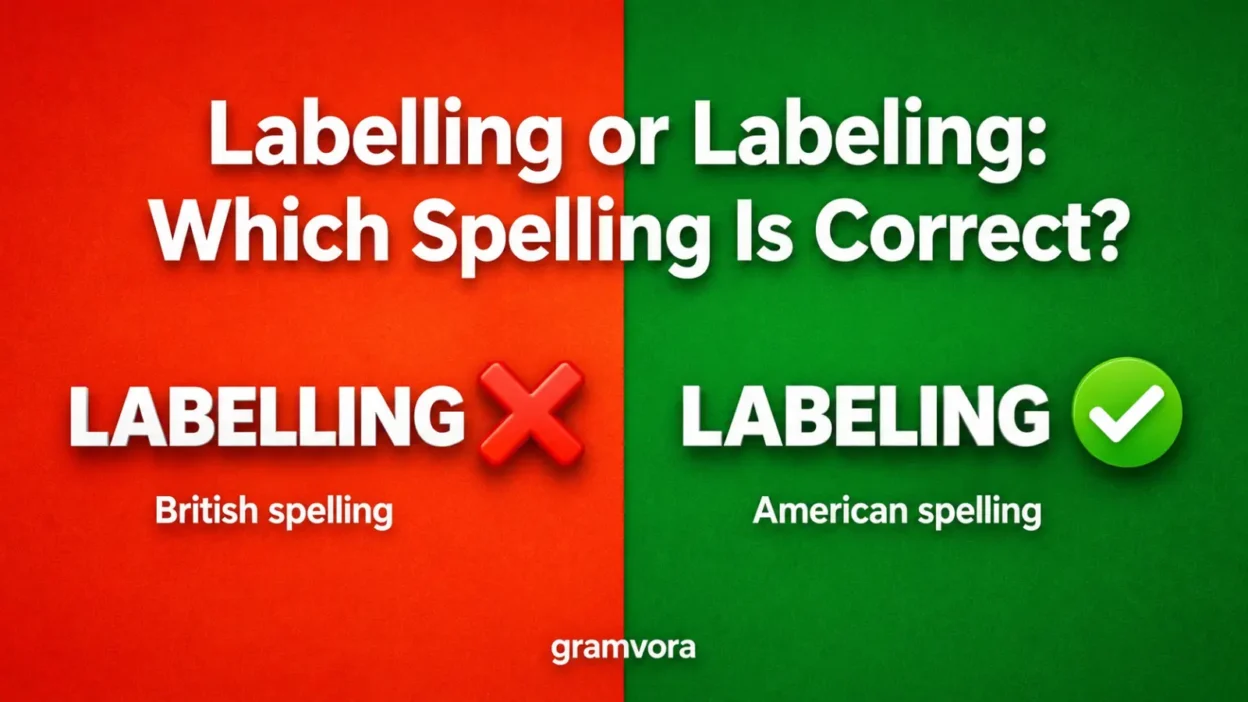
If you are writing for a US audience, labeling is the better choice. Labelling is also a correct English spelling, but it is mainly used in British English and other English varieties that often follow British spelling.
The two words do not have different meanings. They are spelling variants of the same form of the verb label. The real choice depends on your audience, your style guide, and the type of English you want to use consistently.
Quick Answer
Labeling is the standard spelling in American English. Labelling is the standard spelling in British English and is also common in some other English-speaking regions. For US writing, use labeling in schoolwork, business writing, product copy, website text, and everyday communication.
Why People Confuse Them
People confuse labelling and labeling because both spellings look natural. The base word label ends in -el, so writers often wonder whether the final l should double before -ing.
The confusion also comes from other British and American spelling pairs, such as traveling/travelling and canceling/cancelling. In many of these words, American English usually keeps one consonant, while British English often doubles it.
That pattern explains the difference here. In US writing, the common form is labeling. In British-style writing, labelling is expected.
Key Differences At A Glance
| Context | Best Choice | Why |
|---|---|---|
| American English | labeling | Standard US spelling |
| British English | labelling | Standard British spelling |
| US business writing | labeling | Matches American audience expectations |
| UK business writing | labelling | Matches British audience expectations |
| International writing | depends on style choice | Choose one English variety and stay consistent |
| Product packaging for US customers | labeling | Looks natural in American regulatory and consumer contexts |
| Quoting a British source | labelling | Keep the original spelling unless editing for house style |
The safest rule is simple: use labeling for American readers and labelling for British-style writing.
Meaning and Usage Difference
There is no meaning difference between labelling and labeling. Both refer to the act of putting a label on something, naming something, identifying something, or describing someone or something with a category.
Compact comparison:
• Labelling: British-style spelling of the present participle or gerund form of label.
• Labeling: American-style spelling of the same present participle or gerund form.
• Meaning: the same in both spellings.
• Grammar role: both can work as verb forms or noun-like gerunds.
• Main difference: region and spelling style, not meaning.
Examples:
The team is labeling all files before the audit.
The team is labelling all files before the audit.
Both sentences mean the same thing. The first fits US writing better. The second fits British-style writing better.
Tone, Context, and Formality
Neither spelling is more formal by meaning. The formality depends on the sentence, not the extra l.
In American English, labelling may look unusual or foreign to many readers. It is not wrong globally, but it may feel out of place in a US article, workplace email, school assignment, or product description.
In British English, labeling can look like an American spelling. Again, it is understandable, but it may not match the expected style.
Pronunciation does not create a useful distinction here. Both forms are pronounced the same in normal speech: LAY-buh-ling.
Which One Should You Use?
Use labeling if your readers are in the United States or if your writing follows American English.
Choose labeling in:
US blog posts
American school papers
US business emails
software menus for American users
product descriptions for US customers
marketing copy written in American English
Use labelling if your writing follows British English or a British-style house guide.
Choose labelling in:
UK articles
British school assignments
Commonwealth-style documents
UK product pages
British company reports
quoted British text
If your audience is global, pick one spelling style before you start. Then use it consistently throughout the page or document.
When One Choice Sounds Wrong
Labelling can sound wrong in US writing because American readers expect labeling. For example, a US product page that says “food labelling requirements” may still be understood, but it will look less American.
Labeling can sound wrong in British-style writing for the opposite reason. A UK article that says “food labeling rules” may look like it has switched into American spelling.
The biggest mistake is mixing both spellings in the same piece without a reason.
Less consistent:
The team started labeling the boxes after reviewing the labelling policy.
Better for US writing:
The team started labeling the boxes after reviewing the labeling policy.
Better for British-style writing:
The team started labelling the boxes after reviewing the labelling policy.
Common Mistakes (and Quick Fixes)
One common mistake is calling labelling incorrect. That is too broad. It is correct in British English, but it is not the usual US choice.
Another mistake is using both forms in one article. Readers may think the writing was not edited carefully.
A third mistake is changing the spelling inside a quoted title, law name, brand phrase, or official source. If the original uses labelling, keep it when accuracy matters.
Quick fixes:
Use labeling for a US audience.
Use labelling for a British-style audience.
Do not switch between the two forms unless you are quoting or comparing them.
Keep related forms consistent: labeled/labeling in US writing and labelled/labelling in British-style writing.
Everyday Examples
US English:
The intern is labeling folders for the new client files.
Clear labeling helps customers understand what is inside the package.
The teacher asked students to practice labeling the parts of the sentence.
We are labeling the boxes before the movers arrive.
British-style English:
The assistant is labelling the folders for the new client files.
Clear labelling helps customers understand what is inside the package.
The teacher asked students to practice labelling the parts of the sentence.
We are labelling the boxes before the movers arrive.
Same meaning, different spelling style.
Dictionary-Style Word Details
Verb
• Labelling: A British-style present participle of the verb label. It means putting a label on something, identifying something, or describing something with a name or category.
Example: She is labelling each file by date.
• Labeling: The American-style present participle of the verb label. It has the same meaning as labelling.
Example: She is labeling each file by date.
Noun
• Labelling: Can work as a gerund, which is a verb form used like a noun. In British-style writing, labelling can mean the act or process of labeling.
Example: Accurate labelling is important on medicine bottles.
• Labeling: Can also work as a gerund. In US writing, labeling often means the act, process, or written information used to identify something.
Example: Accurate labeling is important on medicine bottles.
Synonyms
• Labelling: closest plain alternatives include tagging, marking, identifying, naming, and categorizing.
• Labeling: closest plain alternatives include tagging, marking, identifying, naming, and categorizing.
These alternatives are not always exact. Tagging fits physical labels or digital tags. Categorizing fits grouping people or things. Marking fits signs, symbols, or written marks.
Clear antonyms do not always fit because labelling/labeling describes an action or process. In some contexts, possible opposites include removing labels, leaving unnamed, or not identifying.
Example Sentences
• Labelling: The UK team is labelling the samples before sending them to the lab.
• Labeling: The US team is labeling the samples before sending them to the lab.
• Labelling: The report warns against unfair labelling of students.
• Labeling: The report warns against unfair labeling of students.
• Labelling: Clear food labelling helps shoppers compare ingredients.
• Labeling: Clear food labeling helps shoppers compare ingredients.
Word History
• Labelling: This spelling follows the British-style pattern of doubling the final l before adding endings such as -ed or -ing in words like label.
• Labeling: This spelling follows the American-style pattern of usually keeping one l before endings such as -ed or -ing in this word.
The important point is practical, not historical: the spellings developed as regional spelling preferences, and both are recognized in modern English.
Phrases Containing
• Labelling: Common in British-style phrases such as food labelling, product labelling, data labelling, labelling requirements, and labelling process.
• Labeling: Common in American-style phrases such as food labeling, product labeling, data labeling, labeling requirements, and labeling process.
Use the phrase that matches your spelling style. For US readers, food labeling and product labeling look more natural. For British-style readers, food labelling and product labelling look more natural.
Conclusion
For a US audience, labeling is the correct choice. Labelling is not wrong, but it belongs mainly to British-style spelling.
The two words mean the same thing and are used the same way in sentences. The difference is regional spelling. If your article, assignment, email, or product page uses American English, write labeling. If it follows British English, write labelling. Above all, choose one form and stay consistent.