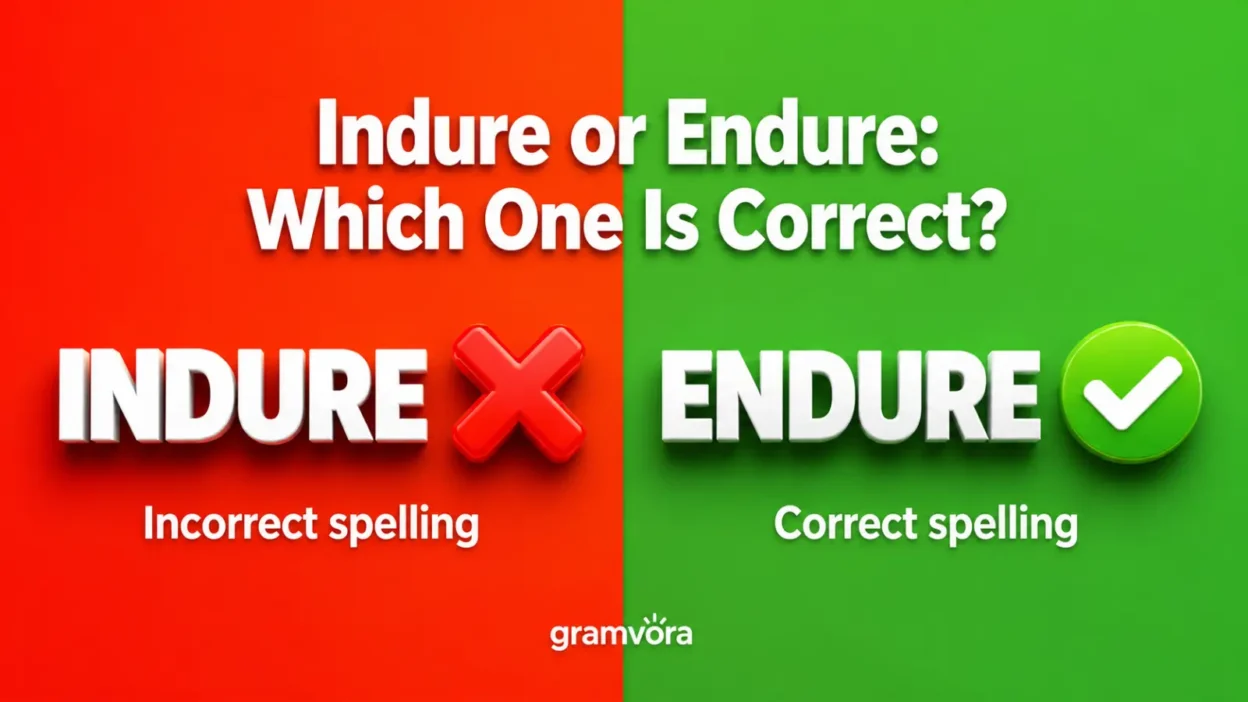
The correct word is endure.
Indure is not a standard spelling in modern US English. In everyday writing, schoolwork, business emails, essays, and published work, use endure.
The word endure means to suffer through something hard, tolerate something unpleasant, or continue to last over time.
Example:
Correct: She learned to endure long shifts at the hospital.
Incorrect: She learned to indure long shifts at the hospital.
Quick Answer
Use endure when you mean “to get through,” “to tolerate,” “to suffer through,” or “to last.”
Do not use indure in standard modern writing.
A simple way to remember it:
Endure begins with en-, like “enter into” a hard situation and keep going through it.
That memory trick is not a word origin rule. It is just a helpful way to spell the word correctly.
Why People Confuse Them
People confuse indure and endure because the beginning sound can be unclear in fast speech. In many accents, endure may sound close to “in-dure.”
That sound can lead people to write indure, especially when they have heard the word more often than they have seen it written.
The confusion is understandable, but the writing choice is simple: endure is the correct form.
Key Differences At A Glance
| Context | Best Choice | Why |
|---|---|---|
| Formal writing | endure | It is the standard spelling. |
| School essays | endure | Teachers and editors expect this form. |
| Business emails | endure | It looks polished and correct. |
| Talking about pain | endure | It means to suffer through something. |
| Talking about time | endure | It can mean to last or continue. |
| Modern US English | endure | Indure is not standard today. |
| Quoting old text | indure only if quoted exactly | Keep the original spelling only inside a direct quotation. |
Meaning and Usage Difference
Endure is a verb. It has two main uses.
First, it can mean to suffer through or put up with something difficult.
Examples:
She had to endure months of physical therapy.
The team endured a rough season but kept working.
Second, it can mean to last or continue over time.
Examples:
Their friendship endured for decades.
Some traditions endure even as cities change.
Indure does not have a separate modern meaning in standard US English. In normal writing, it is treated as a misspelling of endure.
Here is the core difference:
• Endure: correct standard word
• Indure: nonstandard spelling in modern use
Pronunciation can help: endure is commonly said like en-DOOR or en-DYOOR. The first syllable may sound like “in” in fast speech, but the spelling still starts with en.
Tone, Context, and Formality
Endure sounds serious, steady, and a little formal. It is common in writing about hardship, pain, patience, survival, and long-lasting value.
It fits well in:
• essays
• news writing
• workplace writing
• speeches
• personal stories
• serious descriptions of struggle
Examples:
The community endured weeks without power.
Her influence endured long after she retired.
In casual speech, people may use simpler words like handle, deal with, stand, or get through.
Example:
Casual: I can’t deal with this noise anymore.
More formal: I can’t endure this noise anymore.
Indure does not create a different tone. It simply looks wrong in modern standard writing.
Which One Should You Use?
Use endure every time you need the standard word.
Choose endure when the sentence means:
• suffer through pain or stress
• tolerate something unpleasant
• keep going through difficulty
• continue to exist
• last for a long time
Examples:
I don’t know how she endured that commute for three years.
The old theater has endured through fires, storms, and budget cuts.
No one should have to endure that kind of treatment at work.
Do not choose indure unless you are copying an old spelling exactly from a source. Even then, keep it only inside the quoted material.
When One Choice Sounds Wrong
Indure sounds wrong because modern readers expect endure. It may distract them from your meaning.
Wrong: We must indure this difficult moment.
Right: We must endure this difficult moment.
Wrong: The brand has indured for generations.
Right: The brand has endured for generations.
Wrong: I cannot indure another meeting like that.
Right: I cannot endure another meeting like that.
The mistake is not about tense or grammar. It is about spelling. The correct verb forms are:
endure
endures
endured
enduring
Not:
indure
indures
indured
induring
Common Mistakes (and Quick Fixes)
Mistake 1: Using indure because it sounds like “in-dure.”
Fix: Spell it endure, even if you pronounce the first syllable softly.
Mistake 2: Treating indure as a stronger version of endure.
Fix: Do not use indure for emphasis. It does not add meaning.
Mistake 3: Using endure when a simpler word would sound more natural.
Fix: In casual writing, consider handle, stand, or get through if the tone is lighter.
Example:
Stiff: I cannot endure this slow Wi-Fi.
Natural: I can’t deal with this slow Wi-Fi.
Mistake 4: Using endure only for pain.
Fix: Remember that endure can also mean “last.”
Example:
The building endured for more than a century.
Everyday Examples
Correct: Parents often endure sleepless nights with a newborn.
Incorrect: Parents often indure sleepless nights with a newborn.
Correct: The company endured a hard first year.
Incorrect: The company indured a hard first year.
Correct: Great songs can endure across generations.
Incorrect: Great songs can indure across generations.
Correct: I can endure a long wait if the service is good.
Incorrect: I can indure a long wait if the service is good.
Correct: Their friendship endured after college.
Incorrect: Their friendship indured after college.
Correct: No employee should endure harassment.
Incorrect: No employee should indure harassment.
Dictionary-Style Word Details
Verb
• Indure: Not commonly used as a verb in standard modern US English. In ordinary writing, it is a misspelling of endure.
• Endure: A verb meaning to suffer through, tolerate, withstand, or last.
Examples:
She endured the pain without giving up.
The policy endured for several years.
Noun
• Indure: Not commonly used as a noun in standard US English.
• Endure: Not commonly used as a noun. The related noun is endurance, which means the ability to keep going through difficulty or to last.
Example:
Running a marathon takes endurance.
Synonyms
• Indure: No useful modern synonyms because it is not the standard word.
• Endure: Closest plain alternatives include bear, stand, tolerate, withstand, survive, last, and get through.
These are not always exact matches.
Use “tolerate” when the meaning focuses on accepting or putting up with something unpleasant.
Choose “withstand” when the focus is on resisting force, pressure, stress, or damage.
Use “last” when you are talking about how long something continues over time.
Choose “survive” when the meaning involves getting through danger, difficulty, or hardship.
Clear opposites depend on the meaning. For endure as “last,” an opposite can be fade or end. For endure as “tolerate,” an opposite can be reject or refuse, depending on the sentence.
Example Sentences
• Indure: Avoid this spelling in modern standard writing.
Incorrect: She had to indure years of criticism.
• Endure: Use this spelling.
She had to endure years of criticism before gaining recognition.
The bridge endured heavy traffic for decades without major damage.
I can endure a little discomfort if the final result is worthwhile.
Their love of the game endured through every losing season.
Word History
• Indure: This spelling may appear in older or nonstandard material, but it is not the form modern US readers expect. Do not use it as a normal spelling today.
• Endure: The word has a long history in English and is connected with older forms meaning to make hard, last, or suffer through. For modern writers, the important point is practical: endure is the accepted standard spelling.
Phrases Containing
• Indure: No common modern standard phrases.
• Endure: Common phrases include:
endure hardship
endure pain
endure criticism
endure pressure
endure suffering
endure the wait
endure over time
built to endure
FAQs
1. Is “indure” a correct spelling?
No, “indure” is not the standard modern English spelling. The correct word is “endure,” which means to suffer something difficult, continue through a challenging situation, or last for a long time.
2. What is the difference between indure and endure?
The main difference is that “endure” is the accepted English word, while “indure” is considered obsolete or a rare historical variant. In everyday writing and speech, use endure.
3. How do you use “endure” in a sentence?
You can use endure when talking about tolerating hardship, pain, or difficulty.
Example: She endured many challenges before achieving her goal.
4. Why do people confuse indure and endure?
People often confuse these words because they sound similar and “indure” appeared in older forms of English. Modern dictionaries and writers generally recognize endure as the correct choice.
5. Is “indure” ever used in English today?
“Indure” may appear in historical texts or older literature, but it is rarely used today. For professional, academic, and everyday writing, endure is the correct option.
6. What are synonyms for endure?
Common synonyms for endure include tolerate, withstand, survive, bear, suffer, persist, and last.
7. Is “enduring” the correct form of endure?
Yes. Enduring is the correct adjective and present participle form of endure.
Example: Their friendship has an enduring quality.
Conclusion
Endure is correct. Indure is not standard in modern US English.
Use endure when you mean to suffer through something, tolerate something unpleasant, withstand difficulty, or last over time.