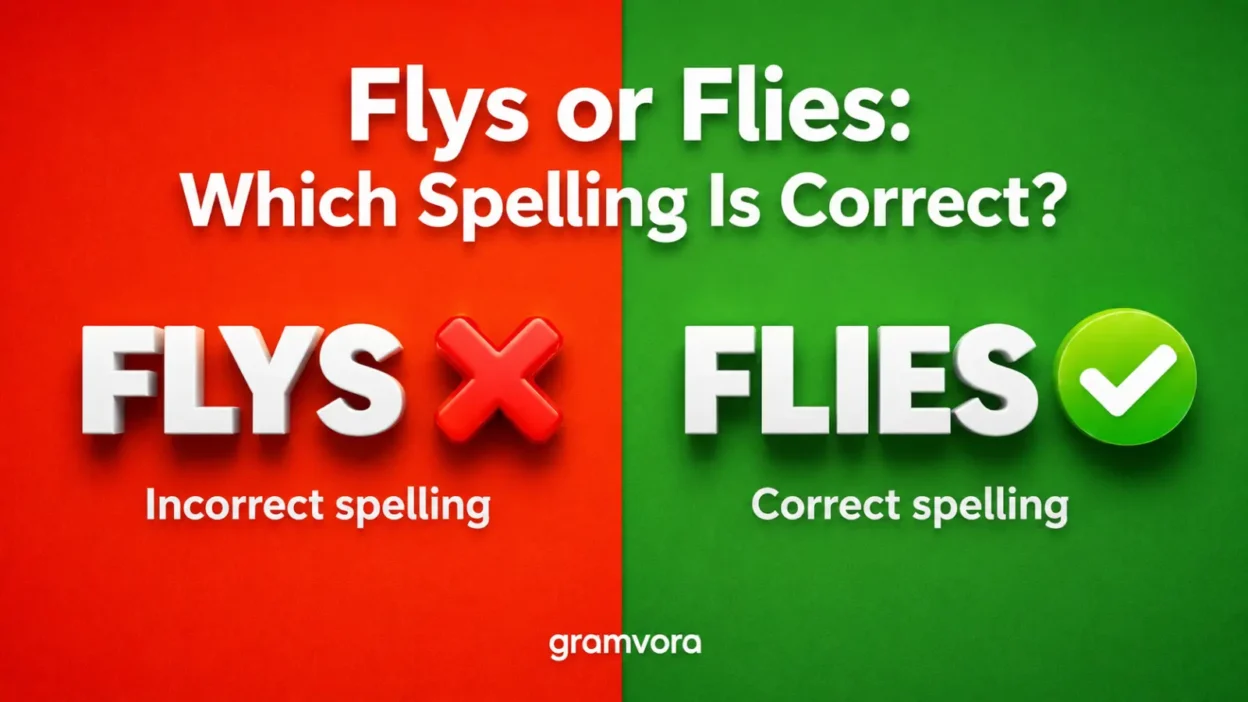
Flies is the correct choice in standard US English. Use flies when you mean more than one fly, as in “fruit flies,” and when you need the present-tense verb, as in “she flies.”
Flys is usually a spelling mistake. You may see it in a name, brand, or rare quoted term, but it is not the normal spelling for the insect or the verb.
So the safe answer is simple: in everyday writing, choose flies.
Quick Answer
Use flies in almost every normal sentence.
Correct:
“Three flies landed on the screen.”
“She flies to Chicago every month.”
“Time flies when school gets busy.”
Incorrect in standard writing:
“Three flys landed on the screen.”
“She flys to Chicago every month.”
“Time flys when school gets busy.”
The reason is that fly changes to flies in two common ways. As a noun, flies is the plural of fly. As a verb, flies is the form used with he, she, or it in the present tense.
Why People Confuse Them
People confuse flys and flies because many English plurals are made by adding s. For example, “dog” becomes “dogs,” and “car” becomes “cars.”
But fly ends in a consonant plus y. In common spelling patterns, that final y changes to ies.
That is why we write:
baby → babies
city → cities
fly → flies
The same spelling change appears in verbs:
cry → cries
try → tries
fly → flies
That pattern helps explain why flies looks different from fly.
Key Differences At A Glance
| Context | Best Choice | Why |
|---|---|---|
| More than one insect | flies | It is the standard plural of “fly.” |
| A person or thing moves through the air | flies | It is the present-tense verb form with he, she, or it. |
| The phrase “time flies” | flies | The subject “time” takes the verb “flies.” |
| A name, brand, or quoted spelling | flys | Use only when that spelling is part of the actual name or text. |
| Regular school, work, or business writing | flies | “Flys” will usually look like an error. |
Meaning and Usage Difference
Flies has two main uses.
First, it can be a noun. It means more than one fly, usually the insect.
Example:
“The trash can attracted flies.”
Second, it can be a verb. It means that someone or something moves through the air, travels by plane, or passes quickly.
Example:
“She flies home for Thanksgiving.”
“The drone flies over the field.”
“Time flies during summer break.”
Flys does not carry those standard meanings in normal US writing. In most cases, it is simply a misspelling of flies.
A reader may understand what you mean, but the spelling will still look wrong in school papers, emails, articles, reports, captions, and professional writing.
Pronunciation is not a major issue here. Both spellings would be read the same way: “flyz.” The real problem is spelling and grammar, not sound.
Tone, Context, and Formality
Flies is standard in every tone: casual, formal, academic, business, and creative.
You can use it in a text message:
“These flies are driving me crazy.”
You can use it in a report:
“The airline flies this route daily.”
You can use it in a headline:
“Time Flies During the Final Week of School.”
Flys looks informal only because it looks mistaken. It does not create a casual tone in a useful way. It usually makes the sentence look unedited.
There is one careful exception. If Flys is part of a proper name, username, product name, team name, or quoted wording, keep the exact spelling.
Example:
“The sign said ‘City Flys,’ so I copied the name exactly.”
That is not a grammar choice. It is a matter of preserving a name or quotation.
Which One Should You Use?
Use flies when you are writing your own sentence.
Choose flies for insects:
“Fruit flies appeared near the bananas.”
Choose flies for travel:
“My dad flies to Denver for work.”
Choose flies for movement through the air:
“The ball flies over the fence.”
Choose flies for quick passing:
“The weekend flies by.”
Use flys only when you are copying an exact name or unusual fixed spelling. For most writers, that situation is rare.
Compact comparison:
• flies: correct plural noun and present-tense verb
• flys: usually incorrect in standard US English
• flies: right for “fruit flies,” “he flies,” and “time flies”
• flys: acceptable only when it is part of an exact name or quoted spelling
When One Choice Sounds Wrong
Flys sounds wrong to many readers because it breaks the expected spelling pattern.
Wrong:
“The pilot flys every weekend.”
Better:
“The pilot flies every weekend.”
Wrong:
“There are flys near the trash.”
Better:
“There are flies near the trash.”
Wrong:
“Time flys when we are having fun.”
Better:
“Time flies when we are having fun.”
The mistake is easy to make because fly is short and familiar. Still, the correct written form is flies.
Common Mistakes (and Quick Fixes)
Mistake:
“House flys got into the kitchen.”
Fix:
“House flies got into the kitchen.”
Mistake:
“She flys out Monday morning.”
Fix:
“She flies out Monday morning.”
Mistake:
“The kite flys higher when the wind picks up.”
Fix:
“The kite flies higher when the wind picks up.”
Mistake:
“Time flys during vacation.”
Fix:
“Time flies during vacation.”
A simple way to check yourself is to replace fly with try. You would not write “she trys.” You would write “she tries.” In the same pattern, write “she flies.”
Everyday Examples
“Fruit flies showed up after we left peaches on the counter.”
“He flies from Dallas to New York twice a month.”
“The flag flies outside the school every morning.”
“Time flies when the game goes into overtime.”
“The bird flies back to the same tree each day.”
“She flies economy when she travels for work.”
“Those tiny flies keep getting through the screen door.”
“The baseball flies into the parking lot.”
“The company flies staff to training once a year.”
“Summer always flies by too fast.”
Dictionary-Style Word Details
Verb
• flys: Not commonly used as a verb in standard US English. Use flies with he, she, or it.
Example:
“She flies to Miami every spring.”
• flies: The present-tense verb form used with a singular third-person subject. It can mean moves through the air, travels by plane, or passes quickly.
Examples:
“The plane flies over our neighborhood.”
“Time flies after lunch.”
Noun
• flys: Not the standard plural noun for the insect. In ordinary US writing, avoid it unless it is part of an exact name or quoted spelling.
Example:
“The username is spelled ‘FlysFast,’ so leave it as written.”
• flies: The standard plural of fly, especially the insect.
Examples:
“Flies gathered near the open trash can.”
“Fruit flies are common in kitchens.”
Synonyms
• flys: No useful standard synonyms, because it is usually a misspelling rather than a separate word.
• flies:
For the insect meaning, closest plain alternatives depend on the type: houseflies, fruit flies, gnats, or flying insects. These are not always exact matches.
For the verb meaning, useful alternatives include soars, glides, hovers, travels, or moves through the air, depending on the sentence.
Clear opposites for the verb can include lands, stays, or remains, depending on context.
Example Sentences
• flys:
“Flys” should usually be corrected to flies.
Incorrect:
“The flys are everywhere.”
Correct:
“The flies are everywhere.”
Possible exact-name use:
“The logo spells the name as ‘Flys,’ so the designer kept that spelling.”
• flies:
“She flies to Phoenix for the conference.”
“The bird flies low over the lake.”
“Flies got inside when the door was left open.”
“Time flies during a busy school week.”
Word History
• flys: There is no need to treat flys as a normal modern form in everyday US English. Some older or specialized uses may appear in dictionaries or historical writing, but they do not change the regular choice for today’s common sentences.
• flies: Flies comes from fly plus the common spelling change used when a word ends in a consonant plus y. The y changes to ies in forms like flies, tries, and cries.
Phrases Containing
• flys: Not common in standard phrases. If it appears in a title, brand, username, or quoted line, keep the exact spelling.
• flies:
time flies
fruit flies
house flies
flies in the kitchen
flies under the radar
flies off the shelf
flies by
Use these with flies, not flys.
Conclusion
Avoid flys unless you are copying an exact name, label, or quoted spelling. In normal US English, flies is the form readers expect.