
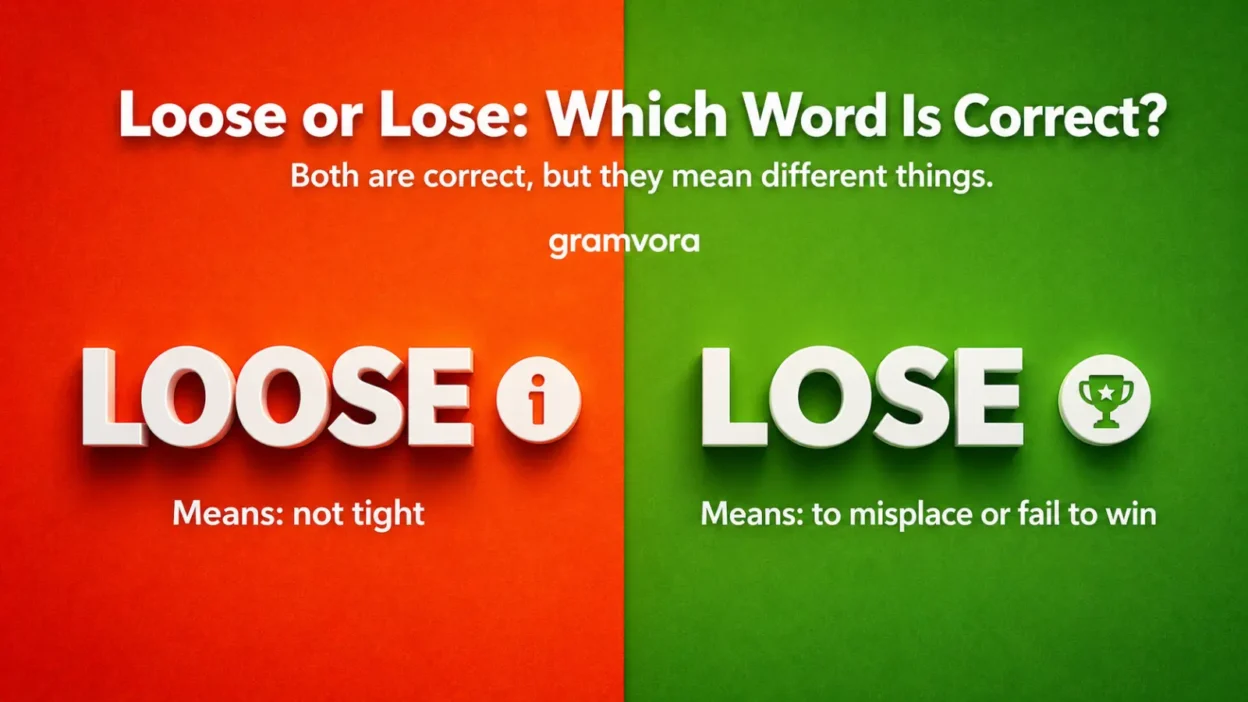
Both words are correct, but they do not mean the same thing.
Use lose when you mean misplace, fail to win, or no longer have something. Use loose when you mean not tight, not secure, or free from restraint.
So the correct choice depends on the sentence:
You lose your keys.
Your shoelace is loose.
That one-letter difference changes the meaning.
Quick Answer
Lose is usually a verb. It shows an action or result.
Examples:
I don’t want to lose my phone.
The team might lose tonight.
She wants to lose weight.
Loose is usually an adjective. It describes a thing or condition.
Examples:
This screw is loose.
He wore a loose hoodie.
The dog got loose.
The fastest rule: lose is about loss; loose is about looseness.
Why People Confuse Them
People confuse loose and lose because the spellings are close. They also look almost the same on a screen.
Pronunciation adds to the problem. Loose sounds like “loos,” with an s sound at the end. Lose sounds like “looz,” with a z sound at the end.
The difference is small when spoken fast, but it matters in writing.
Key Differences At A Glance
- Loose: usually describes something that is not tight, not fixed, or free.
- Lose: usually names the action of misplacing, failing to win, or no longer having something.
- Loose ends with an “s” sound.
- Lose ends with a “z” sound.
- Loose can sometimes be a verb meaning “release,” but that use is not common in everyday US writing.
- Lose is not used as an adjective in standard US English.
Meaning and Usage Difference
Loose describes a state. A loose shirt does not fit tightly. A loose tooth is not firmly attached. Loose change means coins that are separate and easy to carry.
Lose describes an action or result. You can lose a wallet, lose a game, lose focus, lose money, or lose access to an account.
Use loose when the sentence is about fit, tightness, attachment, control, or freedom.
Use lose when the sentence is about not keeping, not finding, not winning, or being without something you once had or expected to have.
Tone, Context, and Formality
Neither word is especially formal or informal. Both fit normal conversation, school writing, emails, news, and business writing.
The tone changes only because the meanings change.
A loose plan sounds flexible or not exact.
A plan you lose is a plan you cannot find or no longer have.
A loose rule sounds relaxed.
To lose a rule would mean the rule is removed, forgotten, or no longer available.
One note: loose as a verb, as in “loose the dogs,” can sound old-fashioned, dramatic, or literary. In everyday US English, most writers would say release, let go, or set free instead.
Which One Should You Use?
| Context | Best Choice | Why |
|---|---|---|
| Misplacing keys, phone, wallet, or files | lose | You no longer have or cannot find something |
| Failing to win a game, race, or election | lose | It means not win |
| Reducing weight | lose | You are decreasing or no longer carrying that amount |
| A shirt, screw, tooth, or handle is not tight | loose | It describes something not firm or secure |
| Coins in your pocket | loose | “Loose change” means separate coins |
| A dog not on a leash | loose | It means free or not restrained |
| Focus, patience, hope, or confidence | lose | You stop having or keeping it |
| A relaxed or not exact rule | loose | It describes low strictness |
When One Choice Sounds Wrong
“I don’t want to loose my job” sounds wrong because a job is not becoming untight. The correct word is lose.
“This button is lose” also sounds wrong because the sentence needs a describing word. The button is loose.
“Loose weight” is a very common mistake. The correct phrase is lose weight because the meaning is to reduce weight, not to make weight less tight.
“Lose change” is also wrong in the normal money phrase. Coins in your pocket are loose change.
Common Mistakes (and Quick Fixes)
Wrong: I always loose my charger.
Right: I always lose my charger.
Wrong: These jeans are too lose.
Right: These jeans are too loose.
Wrong: Don’t loose hope.
Right: Don’t lose hope.
Wrong: The door handle is lose.
Right: The door handle is loose.
Wrong: They might loose the game.
Right: They might lose the game.
Ask yourself one question: Is this about loss or looseness?
If it is about loss, choose lose. If it is about looseness, choose loose.
Everyday Examples
I don’t want to lose my place in line.
Her backpack strap came loose on the way to school.
Try not to lose focus during the meeting.
These shoes feel loose around the heel.
The Lakers could lose if they keep turning the ball over.
There is a loose cable behind the desk.
He was worried he might lose access to the account.
A loose schedule gives us more time for lunch.
Dictionary-Style Word Details
Verb
loose: Can be used as a verb meaning to release, let go, or set free. This use is real, but it is less common in everyday US English. Example: The rider loosed the reins.
lose: Commonly used as a verb. It means to misplace, fail to win, fail to keep, or no longer have. Example: Please don’t lose the receipt.
Noun
loose: Not commonly used as a noun in standard everyday US English. It appears mainly inside set expressions or specialized dictionary treatment.
lose: Not commonly used as a noun in standard US English. The related noun is loss, as in “a loss of money” or “a tough loss.”
Synonyms
loose: Closest plain alternatives include slack, untied, unfastened, free, relaxed, and not tight. Clear antonyms include tight, secure, fastened, and strict, depending on context.
lose: Closest plain alternatives include misplace, forfeit, drop, surrender, fail to keep, and fail to win. Clear antonyms include find, keep, retain, and win, depending on context.
Example Sentences
Loose
- The railing is loose, so don’t lean on it.
- When she travels, she prefers to wear loose pants.
- During the storm, the dog managed to get loose.
Lose
If we stop defending, we may lose the game.
I always seem to lose my earbuds in the car.
Another lost client could hurt the company.
Word History
loose: This is a long-established English word connected with the idea of being free, unbound, or not tight. For modern writing, its current meaning matters more than its history.
lose: This is also a long-established English word tied to the idea of loss, failure to keep, or failure to win. Do not use word history as your main guide; use the sentence meaning.
Phrases Containing
loose: loose change, loose tooth, loose fit, loose ends, on the loose, break loose, hang loose, loose cannon, loose interpretation.
lose: lose weight, lose money, lose time, lose hope, lose focus, lose your temper, lose your mind, lose a game, lose track, lose out.
FAQs
1. What is the difference between loose and lose?
Loose usually means something is not tight, fixed, or securely attached. Lose means to misplace something, fail to win, or no longer have something.
Examples:
- My shirt is too loose.
- I don’t want to lose my keys.
2. Is it lose or loose when you mean “misplace”?
Use lose.
Example:
I always lose my phone.
“Loose” is incorrect when you mean misplace something.
3. Is it loose or lose when something is not tight?
Use loose.
Example:
These pants are too loose.
Here, loose means not tight or firmly fitted.
4. How do you remember the difference between loose and lose?
A simple trick is to remember that loose has two o’s, like something with “too much room.” Lose has one o and is used for misplacing something or not winning.
Loose = not tight
Lose = misplace or fail to win
5. Is “I don’t want to loose” correct?
No. The correct spelling is:
I don’t want to lose.
Use lose when you mean that you do not want something to be taken away, misplaced, or no longer available.
6. Is “my shoe is lose” correct?
No. The correct sentence is:
My shoe is loose.
Because the shoe is not tight or securely fitted, loose is the correct word.
7. Do loose and lose have the same pronunciation?
No. They are pronounced differently.
Loose sounds like “looss,” while lose sounds like “looz.” The spelling difference is small, but the pronunciation and meanings are different.
8. Can loose be used as a verb?
Yes, although it is less common than its adjective use. As a verb, loose can mean to release or set free.
Example:
The hunter loosed the arrow.
In everyday writing, however, loose is much more commonly used as an adjective.
9. Which is correct: “lose weight” or “loose weight”?
The correct phrase is lose weight.
Example:
She wants to lose weight.
“Loose weight” is a common spelling mistake because lose and loose look and sound similar.
10. Which is correct: “lose your balance” or “loose your balance”?
The correct phrase is lose your balance.
Example:
Be careful, or you might lose your balance.
Use lose because the phrase means to no longer have or maintain your balance.
Conclusion
The difference between loose and lose is clear once you focus on meaning.
Use lose for loss: misplacing something, failing to win, or no longer having something.
Use loose for looseness: not tight, not attached, not strict, or free.
[…] is the correct word for visiting landmarks, attractions, scenic areas, historic places, and other points of interest. […]