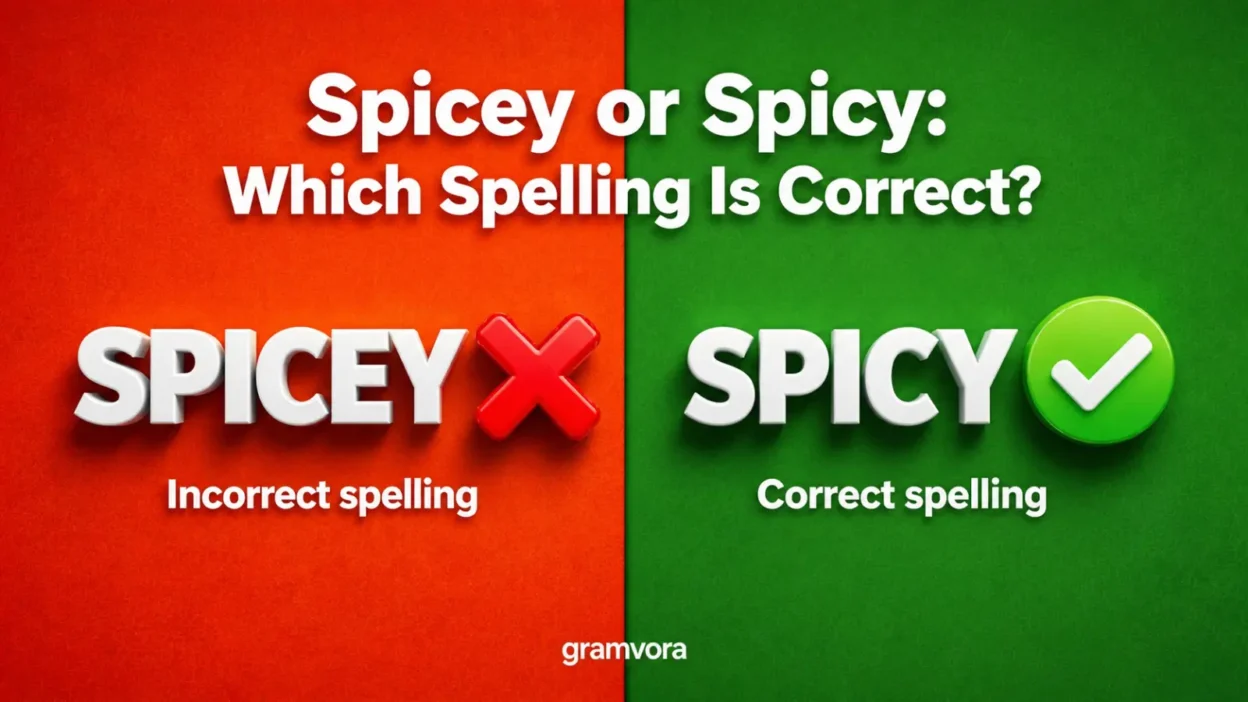
Use spicy when you mean food with a strong, hot, peppery, or seasoned flavor. You can also use it in informal writing for something lively, bold, or slightly shocking.
Spicey may appear sometimes, but it is not the normal spelling in modern US English. For school, work, recipes, menus, product labels, and everyday writing, choose spicy.
Quick Answer
Spicy is the standard spelling.
Spicey is best treated as a nonstandard spelling, typo, or rare variant. Some dictionaries record it, but that does not make it the best choice for normal writing.
Write:
Correct: The salsa is too spicy for me.
Avoid: The salsa is too spicey for me.
There is no useful meaning difference between the two spellings. The issue is spelling, not grammar or word choice.
Why People Confuse Them
The confusion comes from the base word spice.
Many people see spice and think the adjective should keep the e: spice + y = spicey. That looks logical, but English often drops a silent final e before adding a suffix that starts with a vowel-like sound or letter pattern.
That is why spice becomes spicy, not spicey.
The same pattern appears in words like:
• ice → icy
• juice → juicy
• shine → shiny
So the spelling may feel odd at first, but spicy is the form readers expect.
Key Differences At A Glance
| Context | Best Choice | Why |
|---|---|---|
| US English | spicy | Standard modern spelling |
| UK English | spicy | Also the normal spelling |
| Recipes and food writing | spicy | Clear, expected, and professional |
| School or business writing | spicy | Safest formal choice |
| Brand names or creative names | spicey, only if official | Keep the spelling if it is part of a name |
| Search typos or casual notes | spicey may appear | Usually a misspelling or rare variant |
Are They the Same Word?
Yes. Spicey and spicy point to the same word idea: something related to spice, strong flavor, heat, or lively effect.
The difference is not meaning. It is spelling status.
Spicy is the form to use in standard US English. Spicey is a variant you may see in dictionaries, older-looking text, casual writing, or names, but it is not the spelling most readers expect.
Compact comparison:
• Spicy: standard, modern, widely accepted
• Spicey: rare, nonstandard in most current writing, often read as a typo
• Meaning: the same basic adjective idea
• Pronunciation: usually the same: “SPY-see”
US vs UK Preference
There is no strong US-vs-UK split here.
American English uses spicy. British English also uses spicy. This is different from pairs like color/colour, where regional spelling matters.
For spicey or spicy, the best answer for US readers is simple: use spicy. It will look correct to American readers and to most English readers outside the US.
Do not choose spicey to sound British. That would create a spelling problem, not a regional style choice.
Which Spelling Should You Use?
Use spicy almost every time.
Choose spicy for:
• spicy chicken wings
• spicy ramen
• spicy salsa
• a spicy joke
• spicy details
• a spicy debate
Use spicey only when it is part of an exact title, username, brand name, restaurant name, product name, or quoted text.
Example:
The food truck’s official name is “Spicey Street Tacos.”
In that sentence, the unusual spelling is part of the name. You should not “fix” it unless you are editing your own text and the name is not official.
When One Spelling Looks Wrong
Spicey looks wrong to many readers because they are used to seeing spicy in recipes, restaurant menus, grocery labels, and news writing.
It may also look like someone added y to spice without applying the spelling change.
That does not mean every appearance of spicey is impossible. A dictionary may list it as a variant, and a business may use it as a stylized name. Still, in ordinary sentences, spicey can distract the reader.
Better:
This chili is smoky, spicy, and filling.
Not:
This chili is smoky, spicey, and filling.
Common Mistakes (and Quick Fixes)
Mistake 1: Keeping the final e
Wrong: I ordered the spicey noodles.
Right: I ordered the spicy noodles.
Mistake 2: Treating spicey as a British spelling
Wrong: The UK spelling is spicey.
Right: The standard spelling is spicy in both US and UK English.
Mistake 3: Using both spellings in one article
Wrong: spicy sauce, spicey wings, spicy soup
Right: spicy sauce, spicy wings, spicy soup
Mistake 4: Changing an official name
Wrong: Correcting “Spicey’s BBQ” to “Spicy’s BBQ” when that is the business’s real name.
Right: Keep official names as written.
Everyday Examples
Here are natural US-English examples with the correct spelling:
• This salsa is spicy, but it still has great flavor.
• I like spicy food, but jalapeños are my limit.
• The restaurant added a spicy chicken sandwich to the lunch menu.
• She made a spicy tomato sauce for the pasta.
• The wings were crispy, sweet, and spicy.
• His comment made the meeting a little spicy.
• The group chat got spicy after the game.
• Add less chili powder if you do not want the soup too spicy.
In formal writing, keep the figurative use light. Spicy works well for food. It can also work for lively or shocking topics, but it may sound casual.
Dictionary-Style Word Details
Verb
• Spicey: Not commonly used as a verb in standard US English.
• Spicy: Not commonly used as a verb in standard US English.
The verb is spice, as in “spice the soup.” The adjective is spicy, as in “spicy soup.”
Noun
• Spicey: Not commonly used as a noun in standard US English, unless it appears as a name.
• Spicy: Not commonly used as a noun in standard US English.
The noun is spice. The adjective is spicy.
Use:
Noun: Add more spice.
Adjective: Make it spicy.
Synonyms
For spicy, the closest plain alternatives depend on the meaning.
For food:
• hot
• peppery
• zesty
• pungent
• seasoned
• flavorful
For a lively or bold situation:
• lively
• sharp
• bold
• provocative
Clear opposites for food can include:
• mild
• bland
• plain
These alternatives apply to the shared meaning behind spicey and spicy. They do not create a difference between the spellings.
Example Sentences
• Spicey: The word may appear as a variant or in a name, but it is not the best spelling for normal sentences. Example: The logo says “Spicey Bites,” so we kept the name as written.
• Spicy: The standard spelling in ordinary use. Example: The spicy tacos came with lime, onions, and cilantro.
More examples:
• The curry was spicy enough to make everyone reach for water.
• I ordered the spicy version, but my brother chose mild.
• The story had a few spicy details, so it spread fast.
Word History
The spelling issue comes from adding -y to spice. In the standard adjective form, the final e is dropped, giving spicy.
Some dictionaries still record spicey as a variant or point it back to spicy. That supports treating the two as spelling forms of the same word, but modern standard writing strongly favors spicy.
No special US-vs-UK history is needed to explain this pair. The practical rule is enough: use spicy.
Phrases Containing
• Spicey: Rare in standard phrases. It may appear in names or stylized titles.
• Spicy: Common in everyday phrases.
Common phrases with spicy include:
• spicy food
• spicy sauce
• spicy chicken
• spicy ramen
• spicy salsa
• spicy take
• spicy details
• spicy debate
FAQs
1. Is it spelled spicy or spicey?
The correct spelling is spicy. The word spicey is a common misspelling and is not accepted as standard English.
2. What does spicy mean?
Spicy means having the strong flavor or heat of spices, especially foods that create a burning or intense taste. It can also describe something exciting, bold, or controversial.
3. Why do people spell spicy as spicey?
People often write spicey because they add “e” before the “y” based on patterns from words like “nice” or “price.” However, spicy follows the correct spelling rule for this adjective.
4. Is spicy only used for food?
No. While spicy commonly describes food, it can also describe conversations, stories, movies, opinions, or situations that are exciting, dramatic, or slightly controversial.
5. Is “spicey” ever correct in English?
No. In modern standard English, spicey is considered incorrect. Use spicy in writing, professional communication, and everyday English.
6. What is the difference between spice and spicy?
Spice is a noun that refers to a seasoning, such as pepper or cinnamon. Spicy is an adjective that describes something containing or tasting like spices.
7. What is the plural form of spicy?
Spicy does not have a plural form because it is an adjective. However, you can say spicy foods, spicy dishes, or spicy flavors.
Conclusion
Use spicy, not spicey, in standard US English.
The two spellings refer to the same word idea, but spicy is the clear modern choice. Spicey may appear as a rare variant, typo, or official name, but it will often look wrong in regular writing.