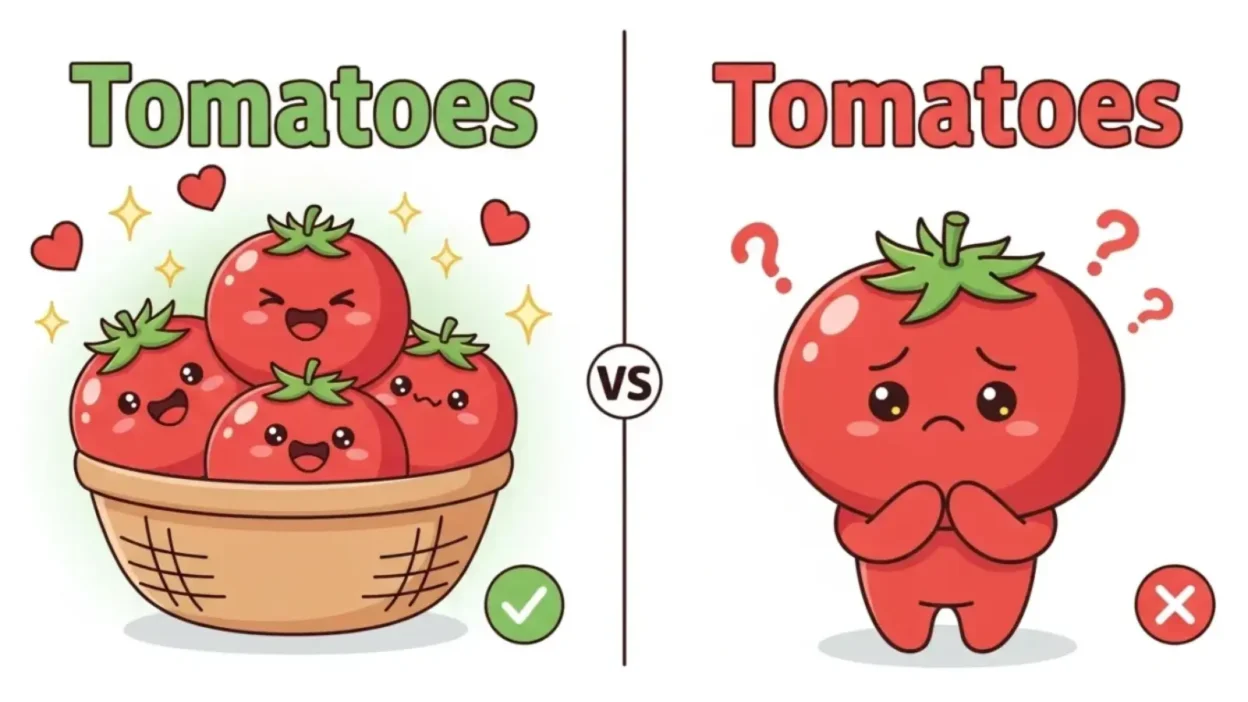
If you are wondering whether the correct spelling is tomatoes or tomatos, the answer is simple: tomatoes is correct.
Tomatoes is the standard plural form of tomato in US English. Tomatos is a common spelling mistake and should not be used in standard writing.
For example:
- Correct: We need three tomatoes for the salsa.
- Incorrect: We need three tomatos for the salsa.
The difference is not about meaning or pronunciation. It is simply a matter of spelling. When you are referring to more than one tomato, write tomatoes.
Quick Answer
Use tomatoes.
The singular form is tomato, and the plural form is tomatoes:
one tomato → two tomatoes
The spelling tomatos is incorrect in standard English.
A useful way to remember the spelling is to pair it with potatoes:
potato → potatoes
tomato → tomatoes
Both words use -es to form their standard plurals.
Why Is “Tomatoes” Correct?
English has several different ways of forming plurals, and words ending in -o can be especially confusing.
Some words ending in o take only -s:
- photo → photos
- radio → radios
- video → videos
- piano → pianos
Other words take -es:
- potato → potatoes
- tomato → tomatoes
- hero → heroes
- echo → echoes
Because tomato ends in o, it is easy to assume that adding s gives the plural:
tomato + s = tomatos
But that is not the standard spelling. The accepted plural is:
tomato + es = tomatoes
There is no single rule that perfectly predicts the plural of every English word ending in o, so some forms simply need to be learned individually.
For tomato, remember tomatoes.
Tomatoes vs. Tomatos: At a Glance
| Word | Correct? | Use | Example |
|---|---|---|---|
| tomato | Yes | One tomato | I sliced one tomato. |
| tomatoes | Yes | More than one tomato | I bought five tomatoes. |
| tomatos | No | Common misspelling | Use tomatoes instead. |
| tomato’s | Sometimes | Possessive singular | The tomato’s skin was soft. |
| tomatoes’ | Sometimes | Possessive plural | The tomatoes’ skins were removed. |
This distinction is important because an apostrophe does not normally make a noun plural.
What Does “Tomatoes” Mean?
Tomatoes is simply the plural of tomato. It means two or more tomatoes.
For example:
- The garden is full of ripe tomatoes.
- I bought four tomatoes from the grocery store.
- Add the chopped tomatoes to the pan.
- These tomatoes are ready to harvest.
- We used fresh tomatoes to make the sauce.
The word can refer to many varieties, including cherry tomatoes, Roma tomatoes, grape tomatoes, heirloom tomatoes, and green tomatoes.
Regardless of the variety, the standard plural spelling is tomatoes.
Is “Tomatos” Ever Correct?
In standard modern US English, tomatos is not considered a correct plural spelling of tomato.
You might see it in:
- text messages
- social media posts
- handwritten notes
- online comments
- grocery lists
- user-generated content
- rushed writing
However, seeing the spelling does not make it an accepted variant. In most cases, tomatos is simply a spelling error.
If you are writing something that needs to look polished and professional, replace tomatos with tomatoes.
Why Do People Write “Tomatos”?
The most common reason is simple: people add s to the singular word without thinking about the special plural spelling.
The process seems logical:
tomato + s = tomatos
This works for some words ending in o, such as photo → photos, so the mistake is understandable.
However, tomato belongs to the group that traditionally takes -es:
tomato → tomatoes
Another reason is pronunciation. In normal speech, the difference between the imagined forms may not be obvious. A person can say the word correctly while still spelling it incorrectly.
That is why this mistake is more noticeable in writing than in conversation.
Tomato vs. Tomatoes
Understanding the singular and plural forms makes the spelling easier.
Tomato
Use tomato when you mean one:
I bought one tomato.
The tomato is ripe.
She planted a tomato in the garden.
Tomatoes
Use tomatoes when you mean two or more:
I bought three tomatoes.
The tomatoes are ripe.
She planted several tomatoes in the garden.
A quick rule is:
One = tomato
More than one = tomatoes
What About “Tomato’s”?
A common mistake is using an apostrophe to form the plural:
Incorrect: I bought three tomato’s.
Correct: I bought three tomatoes.
The apostrophe in tomato’s has a different purpose. It usually indicates possession.
For example:
The tomato’s skin was damaged.
Here, tomato’s means the skin belongs to or is associated with one tomato.
When you simply mean more than one tomato, use tomatoes with no apostrophe.
What About “Tomatoes’”?
The form tomatoes’ can also be correct when you are showing possession for multiple tomatoes.
For example:
The tomatoes’ bright colors made the salad look attractive.
Here, the word refers to something associated with several tomatoes.
Compare:
- tomato = one
- tomatoes = more than one
- tomato’s = belonging to one tomato
- tomatoes’ = belonging to multiple tomatoes
This is why apostrophes should not be added simply because a noun is plural.
Common Mistakes
1. Writing “Tomatos”
Incorrect: We bought six tomatos.
Correct: We bought six tomatoes.
The plural requires -es.
2. Writing “Tomato’s” for the Plural
Incorrect: The recipe needs two tomato’s.
Correct: The recipe needs two tomatoes.
An apostrophe is unnecessary when forming an ordinary plural.
3. Forgetting the Plural Ending
Incorrect: These tomato are fresh.
Correct: These tomatoes are fresh.
Because these refers to more than one item, the noun should be plural.
4. Assuming Every Word Ending in “O” Uses “-S”
Not every English word ending in o forms its plural in the same way.
For example:
- tomato → tomatoes
- potato → potatoes
- photo → photos
- piano → pianos
This is why it is better to remember common plural forms rather than rely on one universal rule.
Everyday Examples With “Tomatoes”
Here are some natural examples showing how tomatoes is used in everyday American English:
- I added diced tomatoes to the taco filling.
- The grocery store has fresh tomatoes on sale.
- My dad grows tomatoes in the backyard.
- Can you buy two tomatoes for the salad?
- The soup contains roasted tomatoes and garlic.
- We used canned tomatoes to make the sauce.
- The children picked ripe tomatoes from the garden.
- Slice the tomatoes before serving the sandwiches.
- These tomatoes are perfect for a fresh salad.
- The recipe calls for three large tomatoes.
- We planted several tomatoes in containers.
- The farmer sells organic tomatoes at the market.
Common Phrases With “Tomatoes”
You will frequently see tomatoes in phrases such as:
- fresh tomatoes
- ripe tomatoes
- cherry tomatoes
- grape tomatoes
- Roma tomatoes
- green tomatoes
- canned tomatoes
- diced tomatoes
- crushed tomatoes
- roasted tomatoes
- sun-dried tomatoes
- heirloom tomatoes
- fried green tomatoes
For example:
The recipe calls for fresh tomatoes and basil.
I bought a can of crushed tomatoes for the pasta sauce.
The garden produced dozens of cherry tomatoes this summer.
Tomatoes in Recipes and Food Writing
The correct spelling is especially important in recipes because tomatoes is such a common ingredient.
You might see instructions like:
Chop two tomatoes and set them aside.
Add the diced tomatoes to the skillet.
Simmer the sauce until the tomatoes become soft.
Top the salad with fresh tomatoes and basil.
Writing tomatos in a recipe would not change what the reader understands, but it would still be considered a spelling error.
For published recipes, food blogs, restaurant menus, and cooking websites, tomatoes is the appropriate choice.
Tomatoes in Formal and Professional Writing
Although a spelling mistake like tomatos may seem minor, errors in common words can make writing look less polished.
Using tomatoes is important in:
- school assignments
- professional emails
- business documents
- restaurant menus
- product descriptions
- food labels
- websites
- blog posts
- advertisements
- gardening articles
- cookbooks
A reader may overlook a typo in an informal message, but published and professional writing benefits from consistent standard spelling.
A Simple Memory Trick
The easiest way to remember tomatoes is to connect it with potatoes.
Think:
potato → potatoes
tomato → tomatoes
Both words follow the same spelling pattern.
Another useful sentence is:
I bought tomatoes and potatoes.
If you can remember those two words together, you are less likely to write tomatos by mistake.
You can also break the spelling into two parts:
tomato + es = tomatoes
The plural ending is -es, not just -s.
Tomatoes: Noun and Plural Form
Tomatoes is a plural noun.
Singular noun
tomato
Example:
The tomato is ready to eat.
Plural noun
tomatoes
Example:
The tomatoes are ready to eat.
The verb in a sentence may also change depending on whether you are using the singular or plural form.
Compare:
The tomato is ripe.
with:
The tomatoes are ripe.
This is a normal example of subject-verb agreement in English.
Word History
The word tomato entered English through Spanish tomate, which is ultimately connected to Nahuatl, a language historically spoken in central Mexico.
Over time, English adopted the modern spelling tomato, and its standard plural became tomatoes.
The form tomatos does not represent a separate modern English word with a different meaning. It is best treated as a misspelling created by adding -s directly to tomato.
For everyday writing, the important point is straightforward:
tomato → tomatoes
Tomatoes vs. Tomatos: Which One Should You Use?
Use tomatoes whenever you are talking about more than one tomato.
Correct
The salad has cucumbers, onions, and tomatoes.
Roma tomatoes are excellent for making sauce.
She picked five ripe tomatoes from the garden.
We need two tomatoes for the sandwiches.
Fresh tomatoes are available at the market.
Incorrect
The salad has cucumbers, onions, and tomatos.
Roma tomatos are excellent for making sauce.
She picked five ripe tomatos from the garden.
We need two tomatos for the sandwiches.
Fresh tomatos are available at the market.
In every example, replace tomatos with tomatoes.
FAQs
Is “tomatos” a correct spelling?
No. Tomatos is a common misspelling. The standard plural spelling is tomatoes.
Is “tomatoes” singular or plural?
Tomatoes is plural. The singular form is tomato.
What is the plural of tomato?
The standard plural is tomatoes.
Why does tomato become tomatoes?
The word tomato traditionally forms its plural with -es, giving tomatoes.
Is “tomato’s” the plural of tomato?
No. Tomato’s is generally a possessive form referring to one tomato. The ordinary plural is tomatoes.
Is “tomatoes” correct in American English?
Yes. Tomatoes is the standard plural spelling in US English.
Is “tomatos” accepted in dictionaries?
It should not be used as the standard plural spelling. If you mean multiple tomatoes, use tomatoes.
How can I remember the spelling?
Remember the pair potato → potatoes and tomato → tomatoes.
Do tomatoes and tomatos have different meanings?
No. Tomatoes is the correct plural. Tomatos is simply a spelling mistake.
What is the easiest way to remember it?
Think:
One tomato. Two tomatoes.
The plural adds -es.
Conclusion
The correct spelling is tomatoes.
Use tomato when you mean one and tomatoes when you mean more than one:
one tomato → two tomatoes → many tomatoes
Avoid tomatos because it is a common misspelling, not a standard alternative.
If you are writing a recipe, school assignment, business email, website, menu, article, or any other polished content, always choose tomatoes.
Quick memory tip:
potato → potatoes
tomato → tomatoes
So, when in doubt, remember: one tomato, many tomatoes.