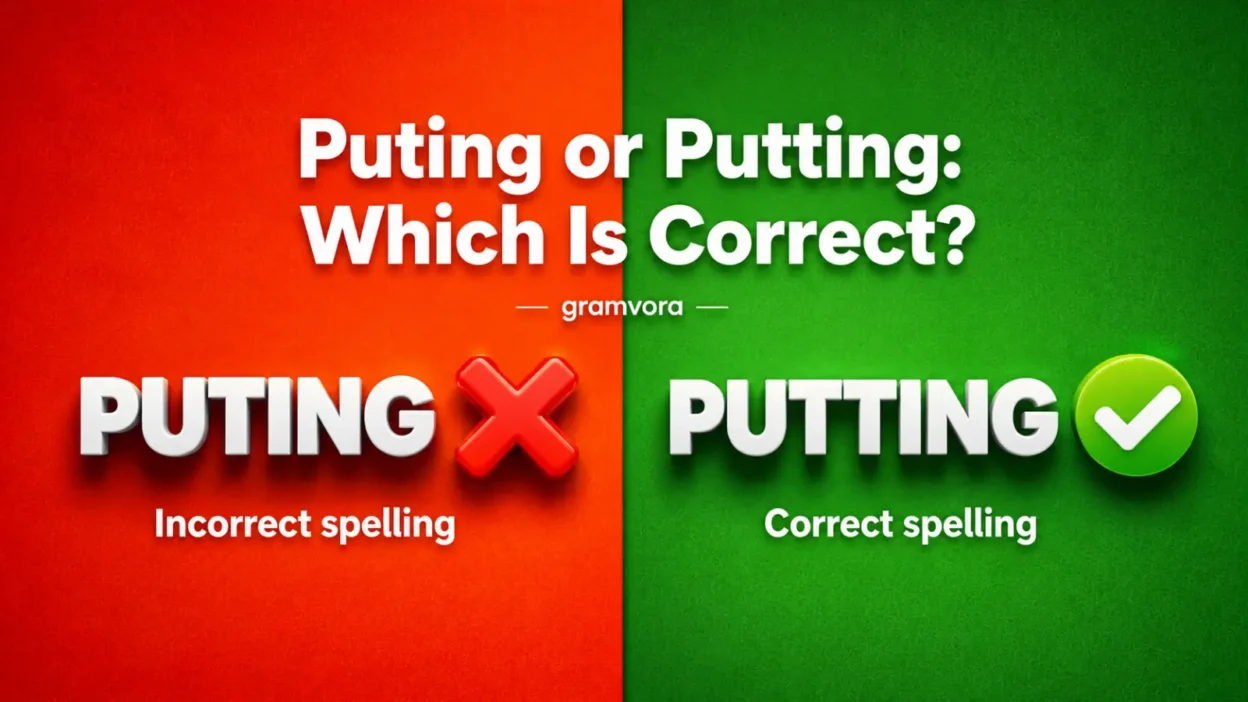
Putting is the correct spelling in standard American English. Puting is a misspelling and is not considered a standard English word.
Use putting when you need the -ing form of “put,” as in “I’m putting my phone away.” The same spelling is also used for the golf term putting, as in “She practiced her putting before the tournament.”
If you are unsure which form to use, the answer is simple: choose putting.
Quick Answer
The correct spelling is putting.
Putting can mean placing, moving, setting, or bringing something into a particular position or situation. It can also refer to the golf action or skill of hitting a ball with a putter.
Puting is not the standard spelling in American English. It is usually a typing or spelling error.
Correct:
I’m putting the groceries in the car.
Incorrect:
I’m puting the groceries in the car.
Correct:
She spent an hour practicing her putting.
Incorrect:
She spent an hour practicing her puting.
Why Is “Putting” Spelled With Two Ts?
The confusion usually comes from the spelling of the base verb put.
When -ing is added to many verbs, the spelling changes in different ways. In the case of put, the final consonant is doubled:
put + ing → putting
The result is putting, not puting.
This is why the second t should not be left out.
Compare:
- put → putting
- cut → cutting
- shut → shutting
Although English spelling rules have exceptions and patterns vary between verbs, the practical rule here is easy: putting always has two t’s.
Putting vs. Puting at a Glance
| Context | Correct Choice | Why |
|---|---|---|
| “I’m ___ the box on the shelf.” | putting | Correct -ing form of put |
| “She is ___ effort into the project.” | putting | Standard spelling |
| “He practiced his ___ before the match.” | putting | Correct golf term |
| “I’m ___ the file here.” | putting | Correct verb form |
| Formal writing | putting | Standard English spelling |
| Casual texting | putting | Still the correct spelling |
| puting | ❌ | Misspelling |
What Does “Putting” Mean?
Putting has several common uses depending on the sentence.
1. Putting as the -ing form of “put”
The most common use is as the present participle or gerund of put.
It can describe placing something somewhere, moving something into a position, adding something, or causing something to be in a particular situation.
Examples:
- I’m putting the dishes away.
- She is putting her books in her backpack.
- We’re putting more money toward the project.
- He keeps putting off the meeting.
- Thanks for putting that into simple English.
- They are putting a new sign outside the store.
2. Putting in golf
In golf, putting refers to the action or skill of hitting the ball with a putter, usually on or around the green.
Examples:
- His putting improved after several lessons.
- She spent twenty minutes practicing her putting.
- Good putting can make a big difference in a round.
- He is working on his putting before the tournament.
In this context, putting comes from the golf verb putt.
Is “Puting” Ever Correct?
In standard American English, puting is not the correct spelling of the word you normally mean.
If you are talking about:
- placing something,
- moving something into position,
- adding effort or resources,
- using phrases such as “putting off” or “putting together,” or
- the golf action of putting,
the correct spelling is putting.
The word puting may appear online because of typing mistakes, spelling errors, or user-generated content, but that does not make it a standard spelling.
The only reason you might intentionally write puting is when you are discussing the misspelling itself.
For example:
“Puting” is a common misspelling of “putting.”
Putting vs. Putt
Another common source of confusion is the difference between put, putt, and putting.
Put
Put is the general verb.
I will put the keys on the table.
Putting
Putting is the -ing form of put.
I am putting the keys on the table.
Putt
Putt is a golf verb.
She will putt the ball toward the hole.
Putting
Putting is also the -ing form of putt.
She is putting from six feet away.
So, although put and putt are different words, both can produce the spelling putting when used in the -ing form.
Pronunciation Difference
The spelling can look similar, but the pronunciation depends on which base word is being used.
When putting comes from put, it is pronounced roughly like:
PUT-ing
The vowel sound is the same one heard in put.
When putting comes from the golf verb putt, it is pronounced roughly like:
PUTT-ing
The vowel sound is the same one heard in putt.
The spelling is still putting in both cases.
Why People Write “Puting”
The mistake is understandable because put is such a short word.
Someone may naturally think:
put + ing = puting
But standard spelling requires the extra t:
put + ing = putting
Because puting looks like it follows a simple add-ing pattern, it can be especially tempting when typing quickly.
Autocorrect, texting, and fast online writing can also contribute to the mistake.
Still, the standard form remains putting.
Tone, Context, and Formality
There is no difference in meaning or tone between putting and puting because puting is not a standard alternative spelling.
Putting is appropriate in every normal context, including:
- school assignments
- professional emails
- business reports
- websites
- academic writing
- text messages
- social media
- everyday conversation
Puting, on the other hand, generally looks like a spelling mistake.
It does not make your writing more casual or informal. Even in a text message, putting is the standard choice.
Common Mistakes and Quick Fixes
Mistake 1: Dropping the second “t”
❌ I’m puting my shoes by the door.
✅ I’m putting my shoes by the door.
Mistake 2: Assuming “puting” is a simpler spelling
❌ We are puting together a plan.
✅ We are putting together a plan.
The shorter spelling is not the standard spelling.
Mistake 3: Using “puting” in golf
❌ His puting has improved.
✅ His putting has improved.
Golf uses putting with two t’s.
Mistake 4: Confusing “putt” with “put”
❌ She will putting the ball.
✅ She will putt the ball.
But:
✅ She is putting the ball.
The correct form depends on the grammar of the sentence.
Everyday Examples With “Putting”
Here are some natural examples of putting in American English:
- I’m putting my laptop in my bag.
- She’s putting the baby down for a nap.
- They’re putting a new sign outside the store.
- We’re putting more money toward rent.
- He keeps putting off his appointment.
- Thanks for putting that into plain English.
- The coach is putting the new player in the game.
- She practiced putting before tee time.
- I’m putting this reminder on my calendar.
- We’re putting the final touches on the presentation.
“Putting” in Common Phrases
Putting appears in many everyday English expressions.
Some common examples include:
- putting away — placing something where it belongs
- putting off — delaying something
- putting on — placing clothing or another item on something
- putting together — assembling or organizing something
- putting up with — tolerating something
- putting into words — expressing an idea verbally or in writing
- putting pressure on — creating pressure for someone
- putting effort into — devoting effort to something
- putting money toward — allocating money to something
- putting green — an area used for practicing golf putting
None of these phrases uses the spelling puting.
Dictionary-Style Word Details
Putting
Part of speech: Verb form and noun
Putting is the present participle and gerund of put.
Examples:
I am putting the dishes away.
Putting your phone on silent can help you concentrate.
It can also be associated with the golf verb putt.
Example:
He is putting from several feet away.
As a noun, putting can refer to the act, skill, or practice of putting in golf.
Example:
Her putting was excellent today.
Puting
Part of speech: Not a standard English word in this context
Puting is generally a misspelling of putting.
It should not be used as the standard spelling for either the -ing form of put or the golf term putting.
Synonyms for “Putting”
The best synonym depends on what putting means in the sentence.
When “putting” means placing:
- placing
- setting
- positioning
- laying
- moving
Example:
She is putting the book on the desk.
Possible alternative:
She is placing the book on the desk.
When “putting” means adding effort:
- applying
- devoting
- investing
- contributing
Example:
He is putting a lot of effort into the project.
Possible alternative:
He is devoting a lot of effort to the project.
When “putting” refers to golf:
Depending on the sentence, alternatives may include:
- making a putt
- taking a putt
- practicing short strokes
- working on short-game technique
There is no single synonym that works in every context.
Opposites of “Putting”
The opposite of putting depends on its meaning.
When it means placing something somewhere, possible opposites include:
- removing
- taking away
- taking out
For example:
She is putting the books on the shelf.
Possible opposite:
She is taking the books off the shelf.
Because putting has many meanings, there is no single opposite that works in every sentence.
Word History and Spelling
For this spelling comparison, the most important point is straightforward:
put → putting
The standard form includes two t’s.
In golf, putting is related to the separate verb putt:
putt → putting
Although the historical development of these words is more complicated, you do not need to know their full etymology to spell the word correctly.
The practical rule is simple:
When you mean the -ing form, write “putting,” never “puting.”
Frequently Asked Questions
Is “putting” or “puting” correct?
Putting is correct. Puting is a misspelling in standard American English.
Why does “putting” have two t’s?
The standard spelling of the -ing form of put is putting. The final t is doubled.
Is “puting” a real word?
It may appear as a spelling error or typo, but it is not the standard spelling of the word intended in this comparison.
Is “putting” used in golf?
Yes. Putting is the standard golf term for the action or skill of hitting the ball with a putter.
Is “putting” a verb or a noun?
It can be both, depending on the sentence. It is the -ing form of put and can also function as a gerund. In golf, putting can also be a noun referring to the skill or practice of putting.
Is “puting” acceptable in texting?
It may be understood, but it is still a misspelling. Putting is correct even in casual texting.
What is the difference between “putting” and “putt”?
Putting is the -ing form of put or putt, depending on context. Putt is the base golf verb.
For example:
I am putting the groceries away.
I will putt the ball toward the hole.
What is the correct spelling of “putting together”?
The correct phrase is putting together.
❌ We are puting together a presentation.
✅ We are putting together a presentation.
Conclusion
The correct spelling is putting, not puting.
Use putting whenever you need the -ing form of put, such as in “I’m putting the book on the table.” Use putting for the golf term as well, as in “She practiced her putting.”
Puting is simply a misspelling and should be corrected in both formal and casual writing.