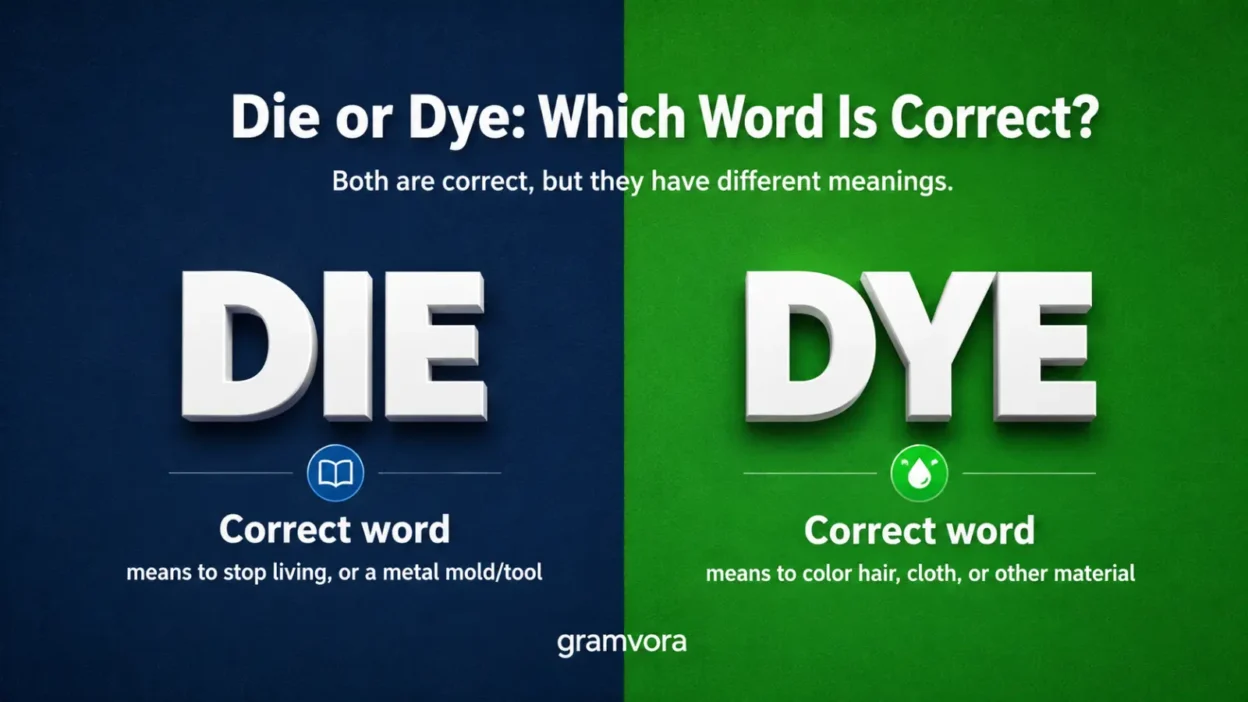
Die or dye depends on what you mean. Use die when something stops living, stops working, fades away, or when you mean one cube used in a game. Use dye when you mean to color something or the coloring substance itself.
These words sound the same in American English, but they do not mean the same thing. That is why one letter can completely change your sentence.
Quick Answer
Die usually means to stop living or come to an end.
Example: The flowers will die without water.
Dye means to add color, or it names the substance used to add color.
Example: She wants to dye her hair dark brown.
So the fastest rule is this: die is about death, endings, failure, dice, or shaping devices. Dye is about color.
Why People Confuse Them
People confuse die and dye because they are pronounced the same. Both sound like “dye,” rhyming with “eye.”
That means you cannot hear the spelling difference in conversation. You have to use the sentence meaning. If the sentence is about hair color, fabric, food coloring, or stain, choose dye. If the sentence is about life ending, a phone battery stopping, a sound fading, or one cube in a board game, choose die.
Key Differences At A Glance
| Context | Best Choice | Why |
|---|---|---|
| A person, animal, or plant stops living | die | It refers to death or loss of life. |
| A machine, phone, or battery stops working | die | It can mean to stop functioning. |
| A sound, feeling, or habit fades away | die | It can mean to fade, weaken, or end. |
| Hair, fabric, eggs, or clothing gets color | dye | It means to color something. |
| A coloring substance | dye | It names the material used for coloring. |
| One cube used in a board game | die | It is the singular form of dice. |
| A metal shaping device | die | It names a device used to shape or stamp material. |
Meaning and Usage Difference
Die is most often a verb. It can mean that a living thing stops living. It can also mean that something stops working, fades away, or comes to an end.
You might say, “My phone is about to die,” or “The noise died down after midnight.” In both cases, nothing is being colored.
Dye can be a verb or a noun. As a verb, it means to color something with a substance. As a noun, it means the coloring substance.
You might say, “I dyed my shirt black,” or “The red dye stained the sink.” In both cases, the word is about color.
Tone, Context, and Formality
Die can sound serious when it refers to death. It can also sound casual in phrases like “I’m dying to see that movie,” where it means “I really want to.” That casual use is common, but it is not literal.
Dye is neutral and practical. It appears in everyday contexts like hair dye, fabric dye, food dye, and tie-dye shirts. It does not carry the serious tone that die can have.
Neither word is more formal by itself. The right choice depends on meaning, not formality.
Which One Should You Use?
Use this compact guide:
- Use die for death, ending, fading, stopping, one game cube, or a shaping device.
- Use dye for coloring hair, fabric, clothes, eggs, food, or any material.
- Use died as the past tense of die.
- Use dyed as the past tense of dye.
- Use dying for death or ending.
- Use dyeing for coloring.
The sentence meaning should choose the spelling for you.
When One Choice Sounds Wrong
“I want to die my hair” sounds wrong because it suggests death, not color. The correct sentence is “I want to dye my hair.”
“My laptop dye after two hours” also sounds wrong. A laptop does not take color in that sentence. The correct sentence is “My laptop dies after two hours.”
“Roll the dye” is wrong for a board game. The correct sentence is “Roll the die” when you mean one cube.
Common Mistakes (and Quick Fixes)
A common mistake is writing died when you mean dyed.
Wrong: She died her jeans black.
Correct: She dyed her jeans black.
Another mistake is writing dyeing when you mean dying.
Wrong: The plant is dyeing.
Correct: The plant is dying.
Writers also mix up die and dice. Use die for one cube and dice for two or more.
Correct: I rolled one die.
Correct: I rolled two dice.
Everyday Examples
The cactus will die if you water it too much.
My phone might die before I get home.
The cheering finally died down after the game.
She used blue dye on the cotton shirt.
We dyed eggs before brunch.
The red dye left a stain on the counter.
Roll one die and move that many spaces.
The factory ordered a custom die for the metal parts.
Dictionary-Style Word Details
Verb
die: Commonly used as a verb. It means to stop living, stop working, fade away, or come to an end. Example: “The battery will die soon.”
dye: Commonly used as a verb. It means to color something with dye. Example: “They dye the fabric before cutting it.”
Noun
die: Used as a noun for one cube used in games. It can also mean a device used to shape, cut, or stamp material.
dye: Used as a noun for a coloring substance. Example: “The dye turned the water green.”
Synonyms
die: Closest plain alternatives include “pass away,” “expire,” “perish,” “stop,” “fade,” and “end.” For the opposite meaning, “live” or “survive” may fit when the topic is life.
dye: Closest plain alternatives include “color,” “tint,” “stain,” and “colorant.” There is no single exact opposite in every use. In color-removal contexts, “bleach” may work.
Example Sentences
die: “Many houseplants die from too much water.” “The engine died at the stoplight.” “Each player rolls one die.”
dye: “She used semi-permanent dye on her hair.” “We dyed the curtains navy.” “Food dye can change the color of frosting.”
Word History
die: The death-related verb and the noun meanings have different paths in English. The spelling die now covers the verb meaning and the noun meanings for games and shaping devices.
dye: The color word developed separately from die. Modern spelling helps readers keep coloring meanings separate from death, ending, dice, and shaping meanings.
Phrases Containing
die: Common phrases include “die down,” “die out,” “never say die,” “the die is cast,” and “die of embarrassment.”
dye: Common phrases include “hair dye,” “fabric dye,” “food dye,” “tie-dye,” and “dyed-in-the-wool.”
Conclusion
Use die when the meaning involves death, stopping, fading, one game cube, or a shaping device. Use dye when the meaning involves adding color or the substance used to add color.
The words sound the same, so context does the work. If your sentence is about color, choose dye. If it is about life ending, something stopping, dice, or a shaping device, choose die.