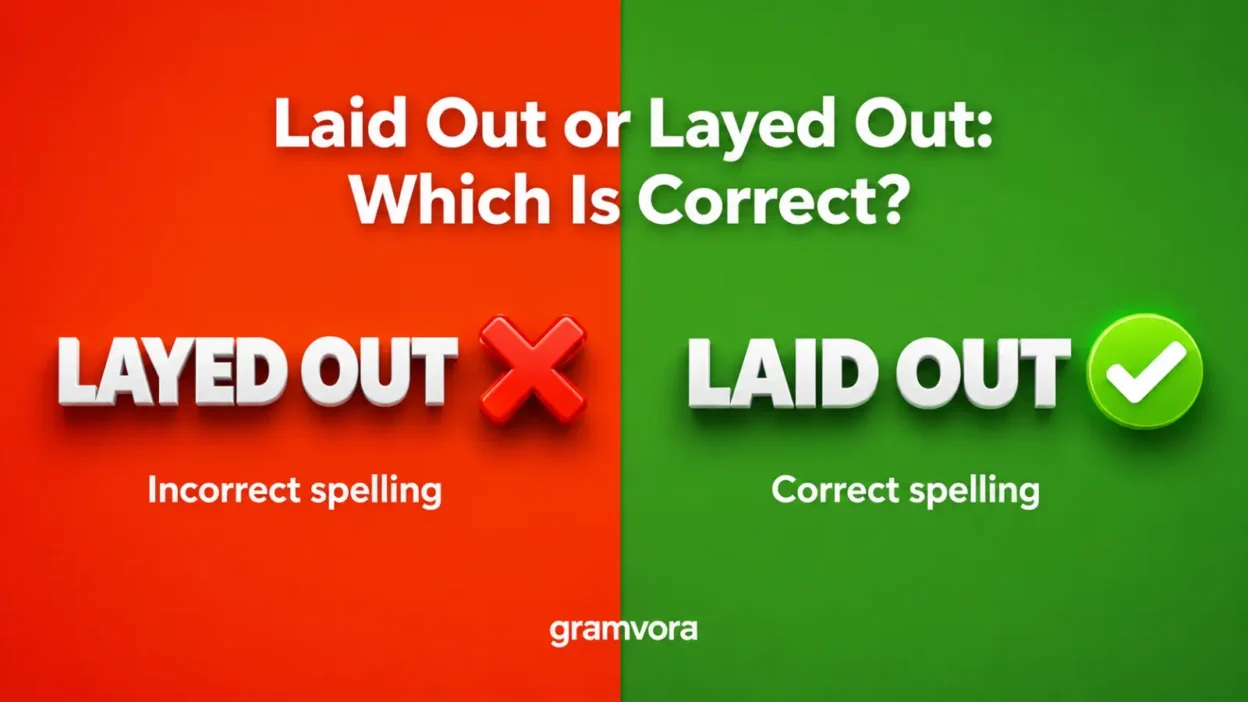
If you are choosing between laid out or layed out, use laid out.
That is the standard form in US English. Layed out is not the accepted spelling for this phrase. It usually appears when someone adds -ed to lay, as if lay were a regular verb. But lay is irregular, so its past tense and past participle are laid.
This choice matters in everyday writing. You may need it in an email, a school paper, a design note, a business plan, or a simple text. The correct phrase is the same in all of those settings:
The manager laid out the new schedule.
Not: The manager layed out the new schedule.
The difference is not a deep meaning contrast. It is a standard form versus a nonstandard mistake. Still, the phrase laid out has several useful meanings, so it helps to see how it works in real sentences.
Quick Answer
Laid out is correct. Layed out is not standard English.
Use laid out when you mean that someone arranged something, planned something, explained something, spent money, or was stretched out or knocked down.
Correct: She laid out the folders before the meeting.
Correct: He laid out the plan in simple steps.
Incorrect: She layed out the folders before the meeting.
Incorrect: He layed out the plan in simple steps.
The reason is simple: laid is the past tense and past participle of lay. Since lay out is built from lay, the past form is laid out.
Why People Confuse Them
People write layed out because it looks regular. Many English verbs form the past tense by adding -ed:
walk → walked
look → looked
paint → painted
So it can feel natural to write:
lay → layed
But that pattern does not work here. The verb lay changes to laid, not layed.
Another reason for the confusion is sound. Laid and layed would be said the same way: like “layd.” So your ear may not help you catch the mistake. You need to remember the spelling pattern instead.
There is also a common mix-up between lay and lie, but you do not need a full grammar lesson to fix this phrase. For this exact comparison, the safe answer is clear: write laid out.
Key Differences At A Glance
| Context | Best Choice | Why |
|---|---|---|
| Arranging items | laid out | It is the correct past form of “lay out.” |
| Explaining a plan | laid out | It means presented or explained clearly. |
| Describing a design | laid out | It can mean planned or arranged. |
| Casual writing | laid out | The correct form does not change in casual use. |
| Formal writing | laid out | “Layed out” looks like an error. |
| Any standard US sentence | laid out | “Layed out” is not the accepted form. |
Compact comparison:
- laid out: correct, standard, useful in many contexts.
- layed out: nonstandard, usually a misspelling.
- laid out can describe arranging, explaining, planning, spending, or being stretched out.
- layed out should be replaced with laid out in polished writing.
Meaning and Usage Difference
The main difference is that laid out is the correct phrase and layed out is not.
Laid out comes from the phrasal verb lay out. In the past tense, it becomes laid out. It can have several meanings, and the sentence usually makes the meaning clear.
First, laid out can mean arranged on a surface:
She laid out the photos on the kitchen table.
Here, the photos were placed where people could see them.
Second, laid out can mean explained clearly:
The attorney laid out the options for the family.
Here, nobody is placing physical items on a table. The phrase means the attorney presented the choices in an organized way.
Third, laid out can mean planned or designed:
The team laid out the new office space.
Here, the phrase means they decided where things should go.
Fourth, in casual speech, laid out can mean stretched out, exhausted, or knocked down:
After the long shift, he was laid out on the couch.
That use is more casual and depends on context.
Layed out does not carry a separate standard meaning. It is best understood as an incorrect spelling of laid out.
Tone, Context, and Formality
Laid out works in both formal and informal writing.
You can use it in a business email:
The proposal laid out three ways to cut costs.
You can use it in school writing:
The article laid out the causes of the problem.
You can use it in everyday speech:
I laid out my clothes for tomorrow.
The tone depends on the sentence, not on the phrase itself. In a work report, laid out can sound clear and professional. In a text to a friend, it can sound natural and relaxed.
Layed out has a different effect. It can make the sentence look careless because readers may see it as a spelling or grammar mistake. Even if the meaning is easy to guess, the form can distract from the message.
Pronunciation does not help much here because the two forms sound alike. The useful difference is in spelling and standard usage.
Which One Should You Use?
Use laid out every time you need the past tense or past participle of lay out.
Use it after a subject:
Maya laid out the welcome packets.
Use it after was, were, is, been, or had when the sentence needs a past participle:
The rules were laid out clearly.
The budget had been laid out before the call.
Use it when you are describing a physical arrangement:
He laid out the cards in three rows.
Use it when you are describing an explanation:
The teacher laid out the steps before the quiz.
Use it when you are describing a plan:
The city laid out a safer traffic pattern.
Do not use layed out in standard writing. If you typed it, change it to laid out.
When One Choice Sounds Wrong
Layed out may not sound wrong when spoken because it sounds like laid out. The problem shows up in writing.
This sentence sounds fine if read aloud, but it is wrong on the page:
The designer layed out the brochure.
The correct version is:
The designer laid out the brochure.
The mistake becomes more noticeable in formal settings. In a resume, report, college essay, client email, or public post, layed out can hurt the sentence because the reader may focus on the error instead of the idea.
Laid out can sound wrong only when the sentence needs a different tense. For example:
Incorrect: I laid out the supplies every morning.
This can be correct if you mean it happened in the past. But if you mean it happens as a habit now, write:
I lay out the supplies every morning.
So the choice is not between laid out and layed out there. It is between present tense and past tense.
Common Mistakes (and Quick Fixes)
Mistake 1: Adding -ed to lay
Incorrect: She layed out the guest list.
Correct: She laid out the guest list.
Quick fix: Remember lay → laid, not lay → layed.
Mistake 2: Using layed out after helping verbs
Incorrect: The plan was layed out last week.
Correct: The plan was laid out last week.
Quick fix: After was, were, has been, or had been, use laid out.
Mistake 3: Thinking casual writing changes the rule
Incorrect: I just layed out my outfit.
Correct: I just laid out my outfit.
Quick fix: Casual tone does not make layed out standard.
Mistake 4: Using laid out when you need present tense
Incorrect: I laid out the agenda every Monday.
Correct: I lay out the agenda every Monday.
Quick fix: Use lay out for a regular present habit and laid out for the past.
Mistake 5: Treating layed out as a style choice
Incorrect: Either spelling is fine.
Correct: Laid out is the standard form.
Quick fix: Do not present layed out as a normal variant.
Everyday Examples
Here are natural US-English examples with laid out.
The nurse laid out the forms for each patient.
Our coach laid out the plan before practice.
I laid out my clothes so I would not rush in the morning.
The report laid out the risks in plain language.
The contractor laid out the tile pattern before starting.
She laid out the snacks for the birthday party.
The professor laid out the grading policy on the first day.
The app screen was laid out in a simple way.
He laid out the facts and let the group decide.
After moving boxes all day, I was laid out on the sofa.
Now compare those with the incorrect form:
Incorrect: The nurse layed out the forms.
Correct: The nurse laid out the forms.
Incorrect: The report layed out the risks.
Correct: The report laid out the risks.
Incorrect: I layed out my clothes.
Correct: I laid out my clothes.
In each case, the meaning is clear, but the spelling must be fixed.
Dictionary-Style Word Details
Verb
laid out: A standard past-tense and past-participle verb phrase from lay out. It can mean arranged, explained, planned, spent, or stretched out, depending on context.
Example: The planner laid out the seating chart.
layed out: Not standard as the past tense or past participle of lay out. In standard US English, replace it with laid out.
Example correction: “She layed out the map” should be “She laid out the map.”
Noun
laid out: Not commonly used as a noun by itself in standard US English. It is mainly a verb phrase or part of a passive verb structure.
Example: The pages were laid out neatly.
layed out: Not used as a standard noun. It is best treated as an incorrect spelling when the intended phrase is laid out.
A related noun is layout, written as one word, but that is a different form. Keep laid out as two words when you need the past verb phrase.
Synonyms
laid out: Closest plain alternatives depend on meaning.
The team arranged the items neatly.
After that, they placed them on the table.
Later, they prepared the display for everyone.
Finally, they explained the process clearly.
Clear opposites also depend on meaning. For arrangement, possible opposites include scattered or disordered. For explanation, possible opposites include hid or withheld.
layed out: No true synonyms are needed because it is not the standard form. If you see layed out, the best replacement is laid out.
Example Sentences
laid out:
The menu was laid out in a way that made ordering easy.
She laid out the receipts before filing her taxes.
The director laid out the goals for the next quarter.
The garden beds were laid out along the fence.
He was laid out after the double shift.
layed out:
Incorrect: The menu was layed out clearly.
Correct: The menu was laid out clearly.
Incorrect: She layed out the receipts.
Correct: She laid out the receipts.
Incorrect: The director layed out the goals.
Correct: The director laid out the goals.
Word History
laid out: The phrase comes from lay out, and laid is the established past tense and past participle of lay in modern standard English. No special modern spelling change is needed.
layed out: This form appears because writers apply the regular -ed pattern to an irregular verb. That explains the mistake, but it does not make the form standard.
No exact origin date is needed to use the phrase correctly. For current US writing, the practical rule is enough: lay out becomes laid out in the past.
Phrases Containing
Laid out:
Laid out on the table
Before the meeting began, the assistant laid out the papers on the table.
clearly laid out
The instructions were clearly laid out.
laid out flat
The blanket was laid out flat on the grass.
layed out:
No standard phrase should contain layed out in careful US English. If a phrase contains layed out, correct it to laid out.
layed out the plan → laid out the plan
layed out the rules → laid out the rules
clearly layed out → clearly laid out
FAQs
Is it laid out or layed out?
Laid out is correct. Layed out is not standard English.
Use laid out when you mean something was arranged, planned, explained, or spread out.
Example:
She laid out the documents on the table.
Why is laid out correct?
Laid is the past tense of lay. Since lay out uses the verb lay, its past form is laid out, not layed out.
Example:
The manager laid out the new schedule.
Is layed out ever correct?
No, layed out is not correct in standard US English. It usually happens because people treat lay like a regular verb and add -ed, but lay is irregular.
Incorrect: He layed out the plan.
Correct: He laid out the plan.
What does laid out mean?
Laid out can mean arranged, spread out, planned, or explained clearly.
Examples:
The designer laid out the page.
She laid out her argument step by step.
They laid out blankets for the picnic.
Can laid out mean someone was unconscious?
Yes. In informal use, laid out can mean someone was knocked down, exhausted, or lying flat.
Example:
After the long hike, he was laid out on the couch.
Is laid out formal or informal?
Laid out works in both casual and professional writing. It sounds natural in emails, reports, instructions, and everyday speech.
Example:
The proposal laid out the costs clearly.
Should I use laid out in business writing?
Yes. Laid out is correct and professional when you mean explained, organized, or presented.
Example:
The report laid out three options for reducing expenses.
Is layout the same as laid out?
No. Layout is usually a noun that means the design or arrangement of something. Laid out is a verb phrase.
Example:
The layout looks clean.
She laid out the design yesterday.
What is the easiest way to remember the difference?
Remember this simple rule: lay becomes laid in the past.
So the correct phrase is always:
lay out → laid out
Which sentence is correct: “I laid out my clothes” or “I layed out my clothes”?
The correct sentence is:
Conclusion
The correct choice is laid out, not layed out.
Use laid out when something was arranged, explained, planned, displayed, spent, or stretched out. It is the standard past form of lay out, and it works in casual, school, and professional writing.