
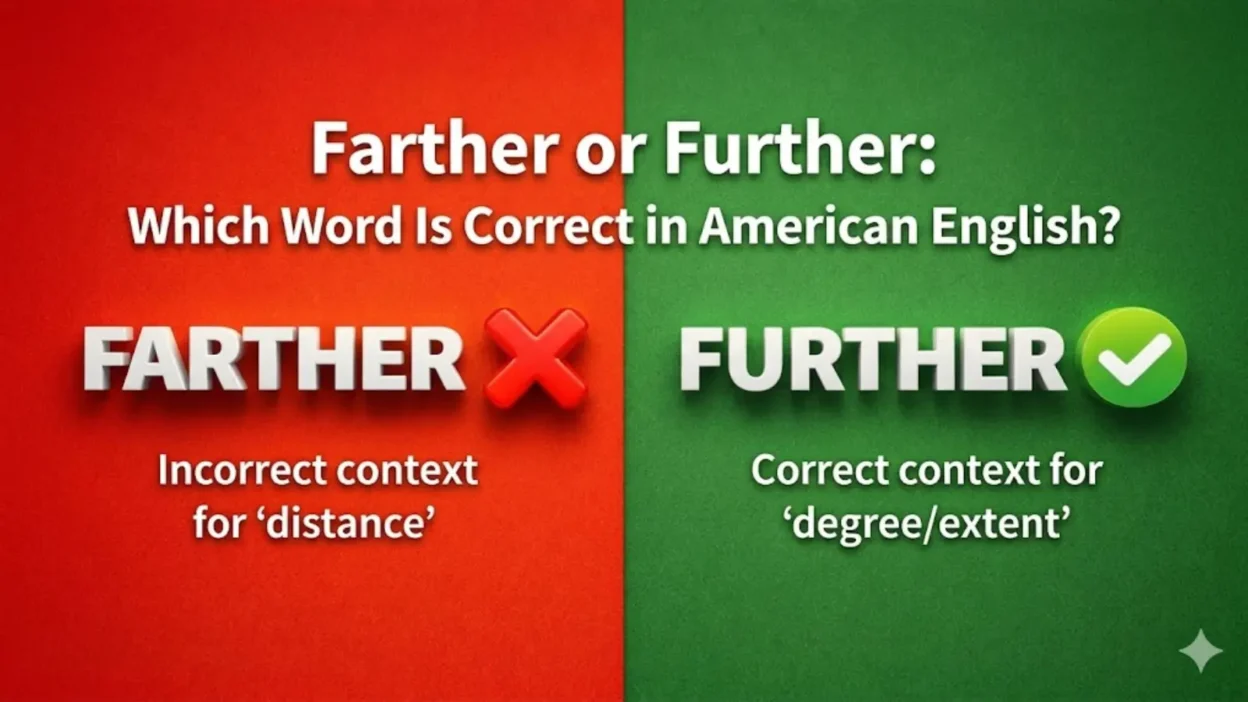
Americans often pause when deciding between farther and further in their writing or speech. These two words feel closely related, and in everyday situations the lines between them can blur. Yet understanding their specific roles leads to clearer, more confident communication. This guide breaks down the practical differences that matter to US speakers and writers today, using real-life contexts from roads, workplaces, schools, and daily decisions. By the end, you will know exactly when each word fits best without second-guessing yourself.
Quick Answer
Farther is the better choice for literal, measurable physical distance. Further works for abstract ideas, additional information, degree of progress, or as a verb meaning to advance something. In many physical distance situations, further is also acceptable, but farther sounds more precise when talking about actual miles, feet, or steps. The distinction helps your writing feel polished, especially in professional or academic settings common across the United States.
Why People Confuse Them
The confusion starts because both words share similar spellings and pronunciations. They both trace back to the concept of “far,” which makes them feel interchangeable at first. In fast-paced American conversations, people swap them constantly without losing meaning. Social media posts, text messages, and casual talks rarely demand perfect separation. However, school teachers, editors, and style guides often highlight differences, creating uncertainty. Many grown adults who speak English fluently still wonder which version to pick when writing an email, report, or school paper. The overlap in real usage makes the choice feel trickier than it needs to be.
Key Differences At A Glance
| Context | Best Choice | Why |
|---|---|---|
| Measurable physical distance | Farther | Refers to actual space that can be calculated or seen on a map |
| Abstract ideas, time, or degree | Further | Deals with non-physical extension or progress |
| Adding more information | Further | Functions like “additionally” or “moreover” |
| Advancing a process or goal | Further | Acts as a verb; farther cannot |
| Sports or travel descriptions | Farther | Emphasizes literal movement or location |
Feature | Farther | Further Core focus | Physical, measurable | Figurative, additional, or advancement Flexibility | More limited to distance | Broader applications including verb use Common in | Travel stories, directions | Business, education, discussions
Meaning and Usage Difference
Farther specifically points to greater physical distance. You use it when discussing something you could measure with a ruler, odometer, or GPS. Imagine driving across Texas or running laps on a high school track — farther fits naturally here because the distance is concrete.
Further, on the other hand, extends into non-physical territory. It describes greater degree, additional effort, deeper thought, or extra steps in a process. It also serves as a verb, which gives it more versatility in American English.
In practice, the boundary is not always rigid. Many respected dictionaries note that further frequently appears in physical contexts too, especially in casual or spoken American English. However, choosing farther for clear distance situations adds precision that educated readers appreciate. For example, a real estate agent might say a property is farther from downtown to emphasize the actual commute time, while a teacher might ask students to explore an idea further during class discussion.
The key lies in whether the “distance” can be quantified in real-world terms. If you can ask “how many miles?” or “how many steps?” then farther strengthens the sentence. When the extension involves ideas, emotions, time, or processes that cannot be measured on a physical scale, further becomes the stronger option.
This flexibility reflects how American English evolves. In 2026, with so much written communication happening quickly online, writers often default to further for simplicity. Yet professional fields like journalism, law, science reporting, and education still value the traditional distinction for accuracy.
Tone, Context, and Formality
In relaxed everyday American speech — chatting with friends at a barbecue, texting family, or posting on social platforms — the difference rarely matters. People understand your meaning either way. The words carry a similar neutral tone that feels natural across the country.
In more formal contexts, the choice becomes noticeable. Business emails, academic papers, news articles, legal documents, and official reports benefit from careful selection. Using farther for physical descriptions feels concrete and factual. Further in abstract contexts sounds thoughtful and expansive.
Neither word feels overly casual or extremely formal on its own. They both fit comfortably in standard American English. Pronunciation stays straightforward too. Farther sounds like “FAR-ther” and further like “FUR-ther.” Most speakers pronounce them clearly without confusion in normal conversation.
Context also influences preference. Travel blogs and road trip stories lean toward farther. Policy discussions, research summaries, and planning meetings favor further. Understanding these patterns helps you match your language to your audience, whether writing for colleagues in Chicago, students in California, or readers across the South.
Which One Should You Use?
Choose farther when the sentence involves literal movement through space that could be measured. Choose further for everything else — additional points, deeper exploration, advancement of goals, or non-physical extent.
If you feel unsure in a particular sentence, further serves as the safer default in most American writing because it covers more situations without sounding wrong. However, deliberately using farther in clear physical cases demonstrates attention to detail and strengthens your overall command of the language.
Consider your audience and purpose. For creative writing or storytelling, either might work depending on rhythm. For technical or professional communication common in US workplaces, the distinction adds credibility. Practice by reading your sentence aloud. Does it feel precise? That instinct often guides you correctly.
When One Choice Sounds Wrong
Certain combinations immediately stand out as off to experienced listeners. Saying “I plan to farther my career” sounds incorrect because farther does not function as a verb in standard American English. The right choice is “further my career.”
Another example: “We need farther discussion on this topic” feels awkward. Further sounds much more natural when talking about additional conversation.
“The investigation went farther than expected” might work in some distance-related crime scene contexts, but “further than expected” fits better when describing depth of inquiry.
“Go no farther” works well in literal warnings about physical boundaries, like trail signs in national parks. “Go no further” carries a stronger figurative tone, such as stopping an argument or process.
These subtle mismatches happen most often in writing. Native speakers might not correct you in conversation, but in published work or important emails, they can make the text feel less polished.
Common Mistakes (and Quick Fixes)
One frequent error involves using farther for abstract concepts. Fix: Replace with further when no physical measurement applies. Example mistake: “We discussed the issue farther.” Correct: “We discussed the issue further.”
Another common slip is avoiding farther entirely. Some writers stick only with further. Fix: Introduce farther in clear distance descriptions for variety and precision.
People also create nonexistent forms like “fartherest” or “furtherest.” Fix: Use farthest for physical superlatives and furthest for figurative ones.
Mixing them in the same sentence without clear reason can confuse readers. Fix: Keep the logic consistent within each paragraph.
Finally, overthinking casual situations wastes energy. Fix: Save mental effort for important documents where precision matters most.
Everyday Examples
Consider these realistic situations many Americans face in 2026:
During a family road trip through the Midwest, a parent might say, “The next rest stop is farther than I thought.” This emphasizes actual driving distance shown on the GPS.
In a virtual work meeting common across tech companies, a manager states, “We need to explore this proposal further before making a decision.” Here, further signals additional analysis rather than miles.
A high school coach in Texas tells athletes, “You ran farther in today’s practice than last week.” The measurable laps on the track make farther appropriate.
A college student writing a paper notes, “Further research revealed new data on climate patterns.” The extension involves deeper study, not physical space.
At a neighborhood planning meeting in a growing suburb, someone says, “The new park should be placed farther from the main road for safety.” Distance is literal.
In personal development, a friend advises, “You should further your skills by taking that coding course.” The verb form of further fits perfectly.
More daily examples include:
- “My new apartment is farther from the subway station, but it has better views.”
- “Let’s not take the disagreement any further.”
- “The hiking trail goes farther into the mountains than most people realize.”
- “Further updates will be posted on the community website.”
- “She drove farther south to escape the winter weather.”
- “The committee wants to further discussions on affordable housing.”
- “Which store is farther away — the one on Main Street or the mall?”
- “Further consideration is needed before approving the budget.”
These examples show how both words appear naturally throughout American life — from commuting in big cities to conversations in small towns.
Dictionary-Style Word Details
Verb
- Farther: Not commonly used as a verb in standard US English. Attempts to use it this way usually sound incorrect to native speakers.
- Further: Commonly used as a verb meaning to help advance, promote, or develop something. Example: “The scholarship helped further her medical training.”
Noun
- Farther: No standard noun usage exists in modern American English.
- Further: Occasionally appears in rare or formal constructions referring to additional extent, but it is uncommon as a true noun. Most often replaced by “furtherance” when a noun form is truly needed.
Synonyms
- Farther: Closest plain alternatives include more distant, beyond, and farther away (when emphasizing physical space).
- Further: More, additional, to a greater degree, moreover, in addition. Antonyms are context-dependent. For distance senses, nearer or closer work well. For advancement senses, direct opposites are less common but could include hinder or impede.
Example Sentences
- Farther: “The finish line is farther than it looks from here.”
- Farther: “They traveled farther west than their original plan.”
- Further: “We will discuss the matter further tomorrow.”
- Further: “The company aims to further its commitment to sustainability.”
- Mixed: “The mountain peak is farther away, so we need further preparation before climbing.”
Word History Both words developed from older English terms connected to the word “far.” They have existed alongside each other for a long time with overlapping uses. Modern American English shows a tendency toward separating their roles more clearly in formal writing, though spoken language remains flexible. Exact historical details vary across sources, but the shared roots explain much of the ongoing confusion.
Phrases Containing
- Farther: “Nothing could be farther from the truth” (often figurative despite the word), “farther along,” “go farther,” “push farther.”
- Further: “Further education,” “until further notice,” “furthermore,” “further along,” “further details,” “further reading,” “without further ado.”
Conclusion
Mastering farther and further comes down to matching the word to the type of distance or extension you want to describe. Farther serves best for physical, measurable situations that Americans encounter in travel, sports, and daily movement. Further handles the broader range of abstract ideas, additional information, and advancement that fill conversations, work, and education across the country.
With the examples and guidelines in this guide, you can make these choices confidently in 2026. Practice by reviewing your own writing or listening carefully during conversations. Over time, the distinction becomes second nature. Clear word choice strengthens every message you share, whether in professional documents, school assignments, or casual talks with friends and family. Keep practicing, and your American English will continue to improve naturally.
[…] of speech, proper noun conventions, everyday objects, and even regional preferences within English. American English has developed clear preferences that set it apart from British usage in some cases. Understanding […]