Many English speakers pause when writing ensure and insure. The two words look alike, sound alike, and even share some historical connections. Because of that similarity, people often wonder whether they can be used interchangeably.
In most modern American English writing, the answer is no.
Although both words involve ideas of protection and certainty, they are usually used in different situations. One word focuses on making something happen or guaranteeing a result. The other focuses on financial protection through insurance.
Understanding this distinction can improve clarity, reduce mistakes, and make your writing look more professional.
Whether you’re writing an email, preparing a business report, completing legal paperwork, or simply trying to choose the correct word in everyday communication, knowing when to use ensure and when to use insure is an important skill.
This guide explains the difference clearly, provides practical examples, highlights common mistakes, and shows you exactly which word fits each situation.
Quick Answer
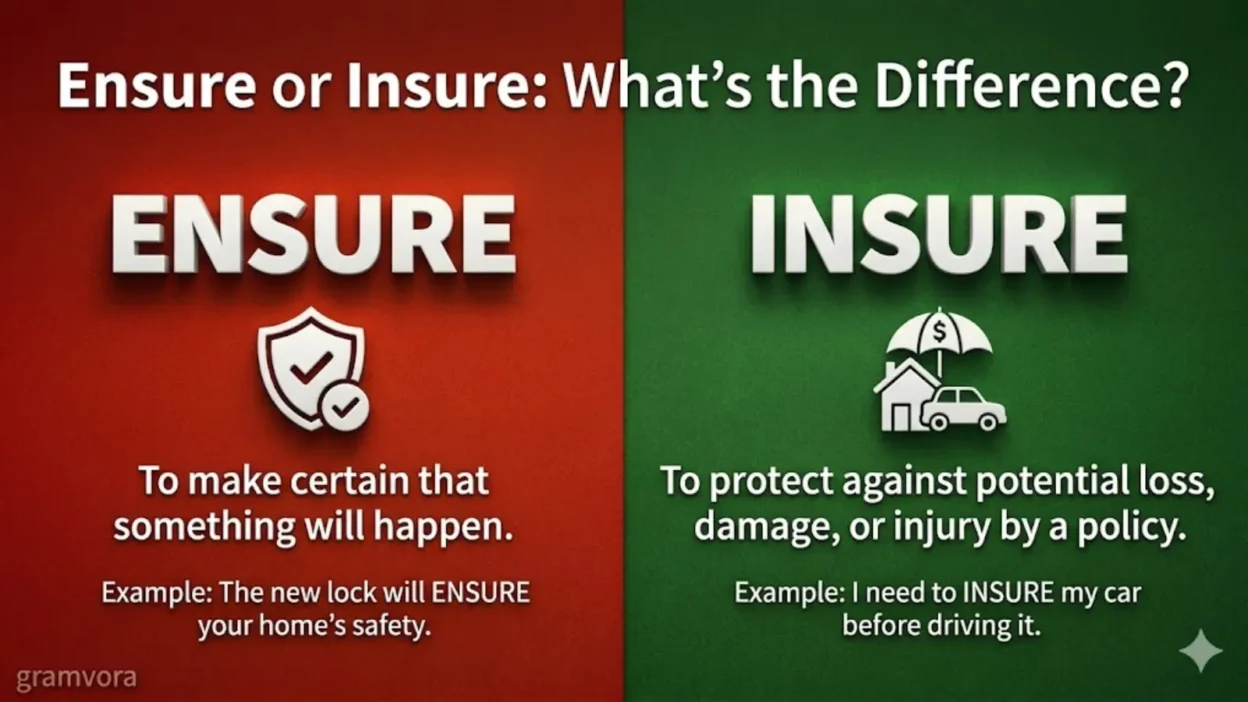
Use ensure when you mean to make certain that something happens.
Use insure when you mean to provide insurance coverage or financial protection.
Examples
- We implemented new procedures to ensure accuracy.
- You should insure your vehicle before driving it.
A simple rule that works most of the time:
If insurance is involved, use “insure.” If not, use “ensure.”
Why People Confuse Them
There are several reasons why these words cause confusion.
They Look Similar
The spellings differ by only one letter. Many readers quickly skim over words and may not notice the difference.
They Sound Similar
In everyday speech, many Americans pronounce the words very similarly. As a result, people often rely on context rather than pronunciation to distinguish them.
Their Meanings Overlap Slightly
Both words involve some form of protection or certainty.
When you ensure something, you make sure it happens.
When you insure something, you protect it against financial loss.
Because both ideas involve reducing risk, confusion naturally occurs.
Historical Usage Was Less Strict
In older English, the distinction between these words was not always as clear as it is today. Modern style guides and dictionaries generally encourage a more specific separation between the two terms.
Today, most editors, teachers, and professional writers prefer using ensure for certainty and insure for insurance matters.
Key Differences At A Glance
| Context | Best Choice | Why |
|---|---|---|
| Make certain something happens | Ensure | Means guarantee or make sure |
| Confirm a process works correctly | Ensure | Focuses on certainty |
| Purchase insurance coverage | Insure | Refers to insurance protection |
| Protect property financially | Insure | Related to insurance policies |
| Improve safety procedures | Ensure | Creates a desired outcome |
| Cover a building against damage | Insure | Financial protection against loss |
Meaning and Usage Difference
The most important distinction involves meaning.
What Does Ensure Mean?
Ensure is a verb that means:
- To make certain
- To guarantee
- To make sure
- To cause a desired result
The focus is on achieving a particular outcome.
Examples:
- Please ensure all forms are completed.
- The manager worked hard to ensure customer satisfaction.
- Strong passwords help ensure online security.
- Careful planning can ensure success.
In every example, the idea is making something certain.
What Does Insure Mean?
Insure is also a verb.
However, its primary meaning involves insurance coverage.
It means:
- To protect through insurance
- To provide financial coverage
- To compensate for potential losses through an insurance policy
Examples:
- We decided to insure our home.
- The company insures commercial vehicles.
- You should insure expensive equipment.
- They insured the building against fire damage.
In each example, insurance protection is involved.
The Most Practical Difference
Think of it this way:
Ensure = make sure
Insure = provide insurance
This simple distinction solves the majority of usage questions.
Tone, Context, and Formality
Both words are considered standard and appropriate in formal writing.
Neither is informal, slang, or conversational-only language.
However, they appear in different contexts.
Ensure in Professional Writing
You will often see ensure in:
- Business reports
- Academic writing
- Government documents
- Workplace communications
- Instruction manuals
- Policies and procedures
Examples:
- Ensure compliance with company regulations.
- Ensure all participants receive training.
- Ensure proper documentation is maintained.
Insure in Professional Writing
You will commonly see insure in:
- Insurance contracts
- Legal documents
- Real estate paperwork
- Financial agreements
- Business risk-management materials
Examples:
- The company insures all corporate vehicles.
- Owners should insure valuable property.
- The policy insures the building against flood damage.
Formality Comparison
| Feature | Ensure | Insure |
| Formal writing | Common | Common |
| Business writing | Very common | Common in insurance contexts |
| Financial usage | Rare | Primary usage |
| Legal documents | Common | Common |
| Everyday communication | Frequent | Less frequent |
Which One Should You Use?
When deciding between the two words, ask yourself one question:
Is insurance involved?
If the Answer Is No
Use ensure.
Examples:
- Ensure that everyone receives the memo.
- Ensure all doors are locked.
- Ensure the software is updated.
If the Answer Is Yes
Use insure.
Examples:
- Insure the car before driving it.
- Insure the property against damage.
- Insure valuable artwork.
This rule works in most situations and aligns with modern American usage.
When One Choice Sounds Wrong
Sometimes the wrong word creates an obvious problem.
Example 1
Incorrect:
- Please insure everyone understands the instructions.
Correct:
- Please ensure everyone understands the instructions.
No insurance coverage exists in this situation.
Example 2
Incorrect:
- We need to ensure the warehouse.
Correct:
- We need to insure the warehouse.
The sentence discusses insurance protection.
Example 3
Incorrect:
- The company insured customer satisfaction.
Correct:
- The company ensured customer satisfaction.
Satisfaction cannot literally be insured in the usual sense.
Example 4
Incorrect:
- Ensure your vehicle before driving.
Correct:
- Insure your vehicle before driving.
Insurance coverage is clearly involved.
Common Mistakes (and Quick Fixes)
Mistake #1: Using Insure for General Certainty
Incorrect:
- Please insure that the report is accurate.
Correct:
- Please ensure that the report is accurate.
Quick Fix:
If you can replace the word with make sure, choose ensure.
Mistake #2: Using Ensure for Insurance Coverage
Incorrect:
- We ensured our new home.
Correct:
- We insured our new home.
Quick Fix:
If an insurance company could be involved, choose insure.
Mistake #3: Assuming They Are Always Interchangeable
Many writers believe the words mean exactly the same thing.
Modern American usage generally treats them differently.
For the clearest writing, maintain the distinction.
Mistake #4: Following Sound Instead of Meaning
Because the words sound similar, writers sometimes choose based on pronunciation rather than context.
Always focus on the meaning of the sentence.
Mistake #5: Overthinking the Decision
Most situations become simple when you remember:
- Make sure = ensure
- Insurance = insure
Everyday Examples
Workplace Examples
- Managers ensure projects stay on schedule.
- Companies insure office buildings.
- Supervisors ensure safety procedures are followed.
- Businesses insure expensive equipment.
Education Examples
- Teachers ensure students understand instructions.
- Schools ensure testing standards are met.
- Universities ensure academic integrity.
Insurance rarely appears in these examples, so ensure is usually correct.
Homeownership Examples
- Homeowners insure their property.
- Families insure vehicles.
- Landlords insure rental units.
Insurance protection makes insure the correct choice.
Technology Examples
- Developers ensure software reliability.
- Engineers ensure systems function properly.
- IT teams ensure network security.
Again, the focus is certainty rather than insurance.
Travel Examples
- Travelers ensure they have proper documentation.
- Tour operators insure company vehicles.
- Airlines ensure passenger safety procedures are followed.
Dictionary-Style Word Details
Verb
Ensure:
A verb meaning to make certain, guarantee, secure, or cause something to happen.
Examples:
- Ensure compliance.
- Ensure accuracy.
- Ensure success.
Insure:
A verb meaning to provide insurance coverage or financial protection.
Examples:
- Insure a vehicle.
- Insure a home.
- Insure valuable property.
Noun
Ensure:
Not commonly used as a noun in standard American English.
Insure:
Not commonly used as a noun in standard American English.
Synonyms
Ensure
Closest plain alternatives:
- guarantee
- secure
- confirm
- establish
- make certain
Possible antonyms:
- jeopardize
- threaten
- endanger
- undermine
Insure
Closest plain alternatives:
- cover
- underwrite
- protect financially
- provide insurance for
Possible antonyms:
- leave uninsured
- expose to financial loss
Example Sentences
Ensure
- Regular inspections help ensure quality.
- Strong communication helps ensure success.
- The new policy will ensure consistency.
Insure
- We insured the property against storm damage.
- Businesses often insure company vehicles.
- She decided to insure her jewelry collection.
Word History
Ensure
The word developed from earlier forms associated with certainty, safety, and security. Over time, its meaning centered on making something certain or guaranteed.
Insure
The word shares historical roots with ensure but became increasingly associated with insurance and financial protection. Modern American usage typically reserves it for insurance-related contexts.
Phrases Containing
Ensure
- ensure compliance
- ensure safety
- ensure quality
- ensure accuracy
- ensure success
- ensure consistency
- ensure fairness
Insure
- insure a home
- insure a vehicle
- insure property
- insure against loss
- fully insured
- properly insured
- insured driver
Real-World Business Examples
Business writing frequently uses both words.
Using Ensure Correctly
- We implemented new procedures to ensure quality control.
- Managers must ensure deadlines are met.
- The company aims to ensure customer satisfaction.
Using Insure Correctly
- The business insures all delivery vehicles.
- The company insures its warehouse against theft.
- We insured our equipment before shipping it overseas.
Notice how the distinction remains clear even in professional settings.
Legal and Contract Contexts
Legal documents often require precise wording.
Ensure in Contracts
- The supplier shall ensure compliance with safety regulations.
- The contractor shall ensure timely completion of work.
Insure in Contracts
- The contractor shall insure all equipment.
- The tenant must insure personal property.
Choosing the wrong word in a legal document may create confusion, which is why lawyers and editors generally maintain the distinction.
Memory Tricks That Actually Work
Trick #1: Insurance Starts With “Ins”
The word insure begins with letters that remind many people of insurance.
If insurance is involved, choose insure.
Trick #2: Ensure Means Make Sure
The meaning of ensure closely matches the phrase make sure.
If “make sure” fits naturally, use ensure.
Example:
- Please make sure everyone signs in.
- Please ensure everyone signs in.
Both express the same idea.
Trick #3: Financial Protection vs Certainty
Ask:
- Am I talking about certainty?
- Or am I talking about financial protection?
Certainty = ensure
Financial protection = insure
FAQs
Is ensure or insure more common?
Ensure is generally encountered more often in everyday writing because people frequently discuss making sure something happens. Insure tends to appear primarily in insurance-related contexts.
Can ensure and insure ever mean the same thing?
Historically, there has been some overlap. However, modern American writing usually separates the meanings for clarity.
Is insure incorrect outside insurance?
Many editors prefer reserving insure for insurance matters. Using ensure for general certainty is usually the clearest choice.
Do professional writers distinguish between them?
Yes. Most professional writers, editors, businesses, and style guides maintain the distinction.
Which word should students use?
Students should typically use ensure when they mean make certain and insure when discussing insurance coverage.
Can a company insure customer satisfaction?
Not literally in the standard insurance sense. Companies can ensure customer satisfaction through policies and service improvements.
What is the easiest rule to remember?
If insurance is involved, use insure. Otherwise, use ensure.
Conclusion
The difference between ensure and insure becomes simple once you focus on the context.
Use ensure when you mean to make certain, guarantee, or make sure something happens.
Use insure when you mean to provide insurance coverage or protect against financial loss through an insurance policy.
Although the words share similarities in spelling and pronunciation, modern American English generally keeps their meanings separate. Following that distinction makes your writing clearer, more precise, and easier for readers to understand.