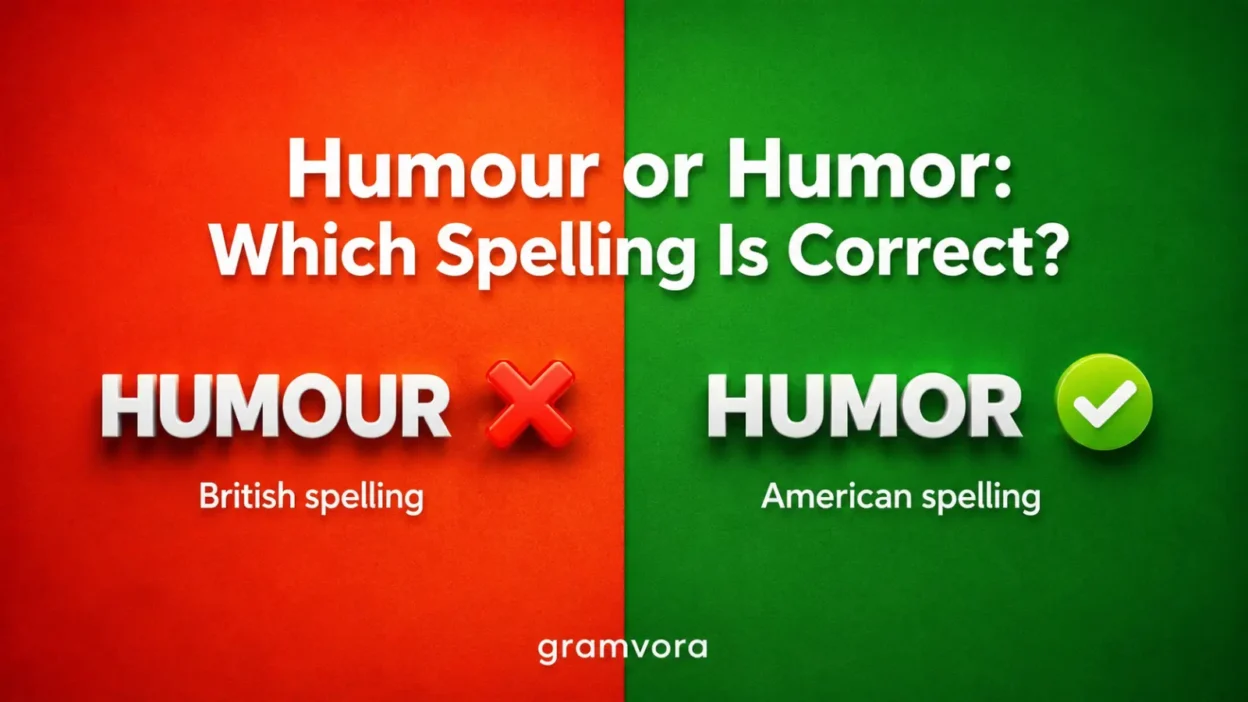
If you are writing for a US audience, humor is the spelling you usually want. Humour is also a real word, but it is the British and Commonwealth spelling.
That means the choice is not about meaning. It is about the type of English you are using. A student in the United States should write sense of humor, while a writer using British English would write sense of humour. Both forms refer to the same idea: the quality of being funny, the ability to enjoy funny things, or, as a verb, to indulge someone.
Quick Answer
For American English, use humor. For British English and many Commonwealth varieties, use humour. The two spellings have the same meaning and can work as both a noun and a verb. The safest rule is simple: choose the spelling that matches your audience and keep it consistent.
Why People Confuse Them
People confuse humour and humor because both spellings look correct in different places. You may see humor in US books, websites, school assignments, and workplace writing. Then you may see humour in British, Canadian, Australian, or Indian English.
The extra u is the main visual difference. Because both spellings appear in edited English, neither one looks completely wrong to many readers. The confusion gets stronger online, where American and British writing appear side by side.
Another reason is that the pronunciation is basically the same in everyday speech. You cannot hear the spelling difference when someone says the word. The choice only matters when you write it.
Key Differences At A Glance
| Context | Best Choice | Why |
|---|---|---|
| US school writing | humor | Standard American spelling |
| US business writing | humor | Expected in American professional style |
| US blog or website | humor | Best fit for American readers |
| British English | humour | Standard British spelling |
| Canadian, Australian, or Indian English | humour | Often follows British spelling patterns |
| Quoting a source title | Keep original spelling | Do not change titles or direct wording |
| Writing “humor me” in the US | humor me | Standard US verb spelling |
| Writing “sense of humour” for a UK audience | sense of humour | Fits British spelling |
Meaning and Usage Difference
There is no meaning difference between humour and humor. They are regional spelling variants of the same word.
As a noun, the word can mean the quality that makes something funny.
Example:
The movie’s humor worked because the characters felt real.
It can also mean a person’s ability to enjoy or understand funny things.
Example:
She has a dry sense of humor.
As a verb, humor means to go along with someone’s request or idea, often to keep them happy.
Example:
Just humor me and read the first page.
For British-style writing, the same examples would use humour.
Compact comparison:
- Humour: same meaning, British/Commonwealth spelling.
- Humor: same meaning, American spelling.
- Main difference: spelling and audience, not definition.
- Pronunciation: usually the same in practical use.
Tone, Context, and Formality
Neither spelling is more formal, smarter, or more correct by itself. The right choice depends on the writing context.
In American writing, humour can look foreign, old-fashioned, or inconsistent unless the topic is British English, a title, a quotation, or a brand name. In British writing, humor can look noticeably American.
For a US audience, humor feels natural in almost every context: essays, emails, captions, articles, scripts, and workplace messages. It also fits medical and technical phrases in American English, such as vitreous humor.
Use humour when your whole document follows British or Commonwealth English. The important point is consistency. Do not write humor in one paragraph and humour in the next unless you are comparing the spellings.
Which One Should You Use?
Use humor if your readers are mainly in the United States. This is the best choice for US schools, US companies, American websites, and general American writing.
Use humour if your readers expect British or Commonwealth English. This may include writing for the UK, Australia, New Zealand, India, or many Canadian contexts.
Keep the original spelling in titles, names, direct quotes, and quoted phrases. For example, if a British book title contains humour, do not change it to humor. If an American article title contains humor, do not add a u.
A simple rule works well: match your audience, then stay consistent.
When One Choice Sounds Wrong
Humour sounds wrong in standard US writing when nothing else in the document uses British spelling.
Awkward for US writing:
The comedian’s humour made the audience laugh.
Better for US writing:
The comedian’s humor made the audience laugh.
Humor can look wrong in British-style writing because it breaks the expected spelling pattern.
Awkward for British-style writing:
The programme had a sharp sense of humor.
Better for British-style writing:
The programme had a sharp sense of humour.
One spelling may also look wrong if it appears next to other regional spellings from the opposite system. Mixing them makes the writing feel unedited.
Common Mistakes (and Quick Fixes)
A common mistake is saying humour is incorrect. It is not incorrect. It is just not the usual American spelling.
Another mistake is saying humor and humour are different kinds of comedy. They are not. “British humour” may describe a cultural style of comedy, but the spelling humour itself does not create a new meaning.
Writers also mix forms in one piece. That is usually a consistency problem.
Incorrect mix:
His humor was subtle, but her humour was louder.
Better US version:
His humor was subtle, but her humor was louder.
Also, do not write humourous as the adjective. The standard adjective is humorous, even in English varieties that use humour as the noun.
Everyday Examples
Here are natural examples for American English:
I like his sense of humor.
The show uses dark humor, but it still has a warm heart.
Please humor me for a minute while I explain.
Her speech had just enough humor to keep people engaged.
The teacher used humor to make the lesson easier to remember.
Here are the same ideas in British-style spelling:
I like his sense of humour.
The show uses dark humour, but it still has a warm heart.
Please humour me for a minute while I explain.
Her speech had just enough humour to keep people engaged.
The teacher used humour to make the lesson easier to remember.
Dictionary-Style Word Details
Verb
Humour: Used as a verb in British-style English. It means to go along with someone, indulge them, or accept their request for the moment.
Example:
She decided to humour him and listen to the idea.
Humor: Used as a verb in American English with the same meaning.
Example:
She decided to humor him and listen to the idea.
Noun
Humour: A noun in British-style English. It can mean funniness, the ability to enjoy funny things, a mood, or, in some medical or historical contexts, a bodily fluid.
Example:
The story was full of gentle humour.
Humor: A noun in American English with the same meanings.
Example:
The story was full of gentle humor.
Synonyms
Humour: Closest plain alternatives include comedy, wit, amusement, funniness, mood, and temperament. These do not all fit every sentence.
Humor: Closest plain alternatives include comedy, wit, amusement, funniness, mood, and temperament. These match the same meanings as humour.
Clear antonyms depend on the sentence. For the “funny quality” meaning, possible opposites include seriousness or solemnity. For the “good mood” meaning, a rough opposite may be irritation or bad mood.
Example Sentences
Humour:
His dry humour made the interview more relaxed.
I tried to humour her because she was nervous.
The article uses humour without becoming silly.
Humor:
His dry humor made the interview more relaxed.
I tried to humor her because she was nervous.
The article uses humor without becoming silly.
Word History
Humour: The older spelling is connected with earlier English use and the old idea of bodily fluids affecting mood. Over time, the word also came to refer to mood, temperament, and the quality of being funny.
Humor: The American spelling developed as part of the broader American preference for shorter -or endings in words where British-style English often keeps -our. The meaning stayed the same.
Phrases Containing
Humour:
sense of humour
dry humour
good humour
out of humour
humour me
vitreous humour
Humor:
sense of humor
dry humor
good humor
out of humor
humor me
vitreous humor
FAQs
Is it humor or humour?
Both spellings are correct, but they belong to different English styles. Humor is the standard spelling in American English. Humour is the standard spelling in British English and many Commonwealth varieties.
Which spelling should I use in the United States?
Use humor in the United States. It is the normal spelling for American schools, websites, business writing, essays, emails, and everyday communication.
Is humour wrong in American English?
Humour is not wrong as a word, but it can look unusual in American writing. If your audience is mainly in the United States, humor is the better choice.
Is humor wrong in British English?
Humor is understood in British English, but it looks American. If you are writing for a British, Australian, or many Commonwealth audiences, humour is usually the expected spelling.
Do humor and humour mean the same thing?
Yes. Humor and humour have the same meaning. Both can refer to funniness, a sense of comedy, a person’s mood, or the act of indulging someone.
Is it sense of humor or sense of humour?
For American English, write sense of humor. For British-style English, write sense of humour. The phrase means the ability to understand, enjoy, or express funny ideas.
Is “humor me” or “humour me” correct?
Both are correct depending on the audience. In American English, write humor me. In British-style English, write humour me. The phrase means “go along with me for a moment.”
Should I use humor or humour in a blog post?
Use humor if your blog targets a US audience. Use humour if your blog targets a British or Commonwealth audience. The most important rule is to keep the spelling consistent.
What is the adjective form: humorous or humourous?
The correct adjective is humorous. Do not write humourous. Even when the noun is spelled humour, the adjective is still normally spelled humorous.
What is the main difference between humour and humor?
The main difference is regional spelling. Humor is American English, while humour is British/Commonwealth English. The meaning does not change.
Conclusion
The choice between humour and humor is simple once you know your audience. Use humor for American English and humour for British or many Commonwealth contexts.
Both spellings are real, standard, and meaningful. They can work as a noun or a verb, and they usually sound the same when spoken. The key is not to mix them randomly. Pick the spelling your readers expect, then use it consistently throughout your writing.