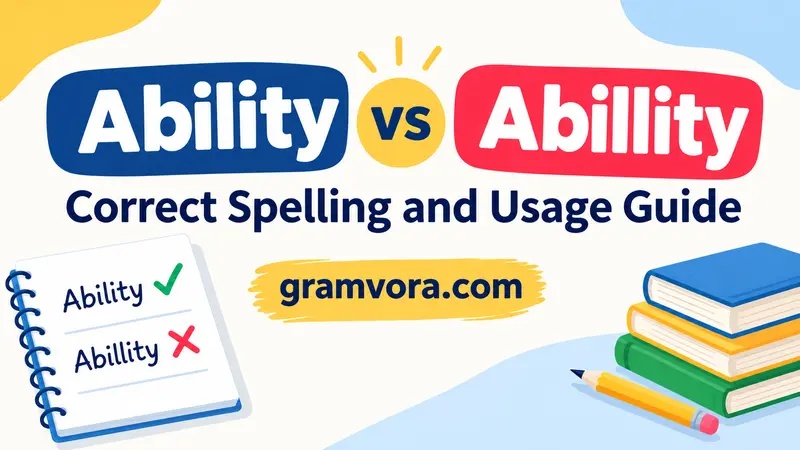
Choosing the correct spelling is an important part of clear writing. Even a small spelling mistake can make a sentence look unprofessional or confuse a reader. One example is the difference between ability and abillity.
These two forms look almost identical. However, only one is the standard English spelling. The correct word is ability, which refers to the power, skill, or capacity to do something. The form abillity contains an extra letter l and is a misspelling.
People may write the incorrect form because they remember the word’s sound but are unsure how many letters to use. Others may accidentally type an extra letter while writing quickly on a computer or phone. These errors are common reasons to double-check spelling before submitting an assignment, sending a professional email, or publishing an article.
The good news is that the correct form is easy to learn. Once you understand how ability is spelled and how it relates to the word able, you can recognize and avoid this mistake.
This guide explains the difference between ability and abillity, shows how to use the correct form in everyday American English, and provides practical examples to help you remember it.
Quick Answer
Ability is the correct spelling in standard American English. Abillity is incorrect because it contains an extra l.
The word ability is a noun that describes someone’s skill, talent, competence, or capacity to perform an action.
Examples:
- She has the ability to explain difficult ideas clearly.
- His ability to solve problems impressed the manager.
- Reading regularly can improve your ability to understand new words.
Incorrect example:
- She has the abillity to explain difficult ideas clearly.
Corrected version:
- She has the ability to explain difficult ideas clearly.
Remember this simple rule: Write ability with one l after the letter i and one l before the ending ity. More simply, the correct spelling is a-b-i-l-i-t-y.
Why People Confuse Them
The confusion between ability and abillity usually comes from the way people remember and type the word. Since the two forms differ by only one letter, it is easy to overlook the mistake.
1. The Extra Letter
The most obvious difference is the additional l in abillity. The correct spelling contains only one l.
Correct: ability
Incorrect: abillity
When someone types quickly, the fingers may repeat a letter by accident. This can happen even when the writer knows the word well.
2. Confusion With Related Words
English has several words that share a similar ending or spelling pattern. For example, skill, will, and full contain double letters. A writer may mistakenly carry that pattern into ability.
However, spelling patterns do not always work the same way across related words. The fact that skill has two letters l does not mean ability should have two consecutive l’s.
The correct spelling must be learned as its own word.
3. Learning English as a Second Language
Students learning English may find spelling difficult because written forms do not always follow a simple pattern. Some words contain repeated letters, while others do not.
A learner might hear ability, remember the general sound, and add an extra letter when writing it. Regular reading and practice can help build a stronger visual memory of the correct form.
4. Typing Without Proofreading
Fast typing can lead to duplicated letters, omitted letters, and other small errors. A person might write abillity without noticing the extra letter.
Reading a sentence again before sharing it is a simple way to catch this problem. Spell-checking can also help, but it should not replace careful proofreading.
Key Differences At A Glance
Ability and abillity do not represent two different meanings. They are not two accepted spelling variants. Instead, one is correct and the other is a spelling error.
| Feature | Ability | Abillity |
|---|---|---|
| Spelling status | Correct | Incorrect |
| Standard US English | Accepted | Not standard |
| Part of speech | Noun | Misspelling of a noun |
| Meaning | Skill, capacity, or competence | No separate standard meaning |
| Letter pattern | One l | Extra l |
| Use in formal writing | Appropriate | Should be corrected |
The key point is that the difference is purely a spelling error. Writers should not use abillity to express a different level of skill or a different kind of capacity.
Are They the Same Word?
The intended word is the same, but the written forms are not equally correct.
Ability is a standard English noun. It describes what a person or thing can do, whether that capacity comes from natural talent, learned skills, practice, or suitable conditions.
For example:
- The student has the ability to learn new languages.
- The software has the ability to process large files.
- Her musical ability developed through years of practice.
In each sentence, ability refers to a capacity or skill.
By contrast, abillity is not a separate standard English word with its own meaning. When a writer uses it, readers will generally understand that the writer intended to write ability.
This distinction matters in schoolwork, business communication, resumes, reports, and published content. An incorrect spelling may not prevent a reader from understanding the sentence, but it can distract from the message and reduce the appearance of care.
There is no meaningful difference in pronunciation intended by these two spellings. The extra letter in abillity does not create a separate standard pronunciation or meaning. The correct response is to fix the spelling rather than assign a special definition to the incorrect form.
US vs UK Preference
The correct spelling is ability in both American and British English.
There is no standard US-versus-UK spelling difference between ability and abillity. American and British writers use ability for the same general meaning.
For example, an American student might write:
- I want to improve my ability to write clearly.
A British student can write the same sentence with the same spelling.
The incorrect form abillity does not become acceptable simply because a writer is using British English, informal English, or a particular regional style.
This is different from genuine regional spelling differences, where two forms may both be accepted in their respective varieties of English. Here, there is no comparable regional choice to make.
For American readers, use ability in school assignments, job applications, business emails, website articles, and other formal or informal writing.
Which Spelling Should You Use?
Choose ability every time you intend to use the standard English noun meaning skill, capacity, or competence.
The correct form works in a wide range of situations.
In Schoolwork
Students can use ability when writing about learning, academic performance, or personal strengths.
Example: “The experiment tested the students’ ability to follow instructions.”
In the Workplace
The word is useful when describing professional skills and responsibilities.
Example: “The candidate demonstrated an ability to manage several projects at once.”
In Resumes and Applications
Job seekers often use ability to describe what they can do.
Example: “I have the ability to communicate effectively with customers.”
For a stronger resume, writers should support broad claims with specific skills or achievements when possible.
In Everyday Conversation
The word also fits ordinary discussions about talent, confidence, and performance.
Example: “I admire your ability to stay calm under pressure.”
In Educational and Informational Articles
Writers can use ability when discussing reading skills, problem-solving, communication, memory, or other capacities.
Example: “Daily practice can strengthen a learner’s ability to recognize spelling patterns.”
In all these situations, abillity should be corrected to ability.
When One Spelling Looks Wrong
The form abillity may look familiar because it is close to the correct spelling. Nevertheless, it is wrong in standard English writing.
A useful way to check it is to compare the letters:
- A-b-i-l-i-t-y: Correct.
- A-b-i-l-l-i-t-y: Incorrect.
Notice that the correct spelling does not place two consecutive l’s in the middle of the word.
The incorrect form can appear in a draft, a social media post, a typed message, or a school assignment. Its appearance in published text does not make it an accepted spelling.
If you see abillity in a sentence, check whether the writer intended ability. In most ordinary contexts, that will be the intended word.
For example:
Incorrect: “The new employee showed great abillity in customer service.”
Correct: “The new employee showed great ability in customer service.”
Incorrect: “Practice can improve your abillity to speak clearly.”
Correct: “Practice can improve your ability to speak clearly.”
The meaning remains the same after correction. Only the spelling changes.
Common Mistakes (and Quick Fixes)
Learning to recognize common errors can make proofreading easier. Here are practical ways to avoid writing abillity.
Mistake 1: Adding an Extra L
Incorrect: “He has the abillity to lead a team.”
Correct: “He has the ability to lead a team.”
Quick fix: Remember that ability contains one l in its standard spelling, not two consecutive l’s.
Mistake 2: Repeating the Wrong Form
A writer may use abillity several times in a long article. If the error is copied and pasted, it may appear throughout the document.
Quick fix: Search your draft for “abillity” before publishing. Replace each unintended occurrence with “ability.”
Mistake 3: Trusting Appearance Instead of Checking
The incorrect form can look plausible because it differs by just one letter.
Quick fix: Compare the word with a reliable dictionary or a trusted spelling reference when uncertain.
Mistake 4: Assuming Both Forms Are Acceptable
Some English words have more than one accepted spelling. However, that does not mean every small spelling variation is valid.
Quick fix: Do not treat ability and abillity as regional alternatives. Use ability in both American and British English.
Mistake 5: Overlooking the Error in a Resume
A spelling mistake in a resume or cover letter can distract a hiring manager from the applicant’s qualifications.
Quick fix: Proofread important documents slowly, especially the sections describing your skills and abilities.
Mistake 6: Relying Only on Automatic Corrections
A spell-checking program may identify many errors, but settings and dictionaries vary. A missed error is still possible.
Quick fix: Combine spelling checks with a final human review. Read the entire sentence, not just the individual word.
Everyday Examples
The following examples demonstrate how to use ability naturally in American English.
Correct Sentences
- Her ability to solve complex problems made her a valuable team member.
- Reading every day can improve a child’s ability to understand written instructions.
- The coach praised the player’s ability to work with teammates.
- My ability to concentrate improves when I study in a quiet room.
- The manager appreciated his ability to explain the plan clearly.
- Practice helped Maya develop the ability to play the piano confidently.
- The position requires the ability to communicate with customers.
- Good planning can improve your ability to manage your time.
- The teacher noticed the student’s ability to recognize patterns.
- His ability to remain patient helped resolve the disagreement.
- The application measures a person’s ability to complete certain tasks.
- She wants to improve her ability to write professional emails.
Incorrect Sentences and Corrections
Incorrect: “She has an excellent abillity to organize events.”
Correct: “She has an excellent ability to organize events.”
Incorrect: “The course improved my abillity to communicate.”
Correct: “The course improved my ability to communicate.”
Incorrect: “We were impressed by his abillity to solve the problem.”
Correct: “We were impressed by his ability to solve the problem.”
Incorrect: “This job requires the abillity to work independently.”
Correct: “This job requires the ability to work independently.”
Incorrect: “The student showed a strong abillity to learn.”
Correct: “The student showed a strong ability to learn.”
These examples all follow the same rule: use ability when referring to a skill, capacity, or competence.
Dictionary-Style Word Details
Verb
Ability: This word is a noun, not a verb. It names a capacity or skill rather than an action. The related verb enable means to make something possible, but it is a different word.
Abillity: This is a misspelling of the noun ability. It is not a standard verb.
Noun
Ability: A noun referring to the power, skill, or capacity to do something.
Examples:
- She has the ability to learn quickly.
- His ability improved with practice.
Abillity: Not a standard noun spelling. Correct it to ability when that is the intended word.
Synonyms
Ability: Depending on the sentence, suitable synonyms include skill, capacity, competence, and aptitude. These words have related meanings but are not interchangeable in every context.
For example, skill often emphasizes something learned or practiced, while capacity can emphasize the potential to do something.
Abillity: It has no separate set of synonyms because it is a misspelling. Use the synonyms of ability only when they fit the intended meaning.
There is no single antonym that fits every use of ability. Depending on context, inability may express the opposite, while lack of skill may be more natural in a particular sentence.
Example Sentences
Ability:
- The student has the ability to explain the answer.
- Her writing ability improved during the semester.
- The job requires the ability to work under pressure.
Abillity:
- “His abillity is impressive” should be corrected to “His ability is impressive.”
- “The course develops abillity” should be corrected to “The course develops ability.”
The incorrect form should not be used as an alternative spelling.
Word History
Ability: The word entered English through French and ultimately comes from Latin roots associated with being able or fit to do something. Its present-day use refers to a person’s or thing’s capacity or skill.
Abillity: There is no separate established word history to explain for this misspelling. It is best understood as an incorrect written form of ability, not as an independent word with a different origin.
Phrases Containing
Ability: Common expressions include:
- ability to learn
- ability to communicate
- ability to solve problems
- ability to work independently
- ability to make decisions
- natural ability
- physical ability
- writing ability
- learning ability
- problem-solving ability
Abillity: These phrases should use ability, not abillity. For example, write “ability to learn” and “problem-solving ability.”
FAQs
Is it ability or abillity?
Ability is the correct spelling. Abillity is incorrect because it contains an extra letter “l.” Use ability in standard American and British English.
What does ability mean?
Ability means the skill, power, or capacity to do something. For example, “She has the ability to solve difficult problems.”
Why do people misspell ability as abillity?
People may add an extra “l” because they type quickly, confuse spelling patterns, or remember the word incorrectly. Proofreading helps prevent this mistake.
Is abillity a real English word?
No. Abillity is not a standard English spelling. It is generally considered a misspelling of ability and should be corrected in formal and informal writing.
Is ability correct in American English?
Yes. Ability is the standard spelling in American English. Use it in school assignments, business emails, resumes, and website articles.
Is ability also correct in British English?
Yes. British English also uses ability. Abillity is not an accepted British spelling variant.
What is the plural form of ability?
The plural form is abilities. For example, “The program helps students develop their abilities.”
What are some synonyms for ability?
Depending on the context, synonyms include skill, capacity, competence, and aptitude. These words have related meanings, but they are not always interchangeable.
How can I remember the correct spelling of ability?
Remember the letter sequence a-b-i-l-i-t-y. The correct spelling has one “l,” not two consecutive “l” letters. Reviewing the word while reading and writing can also help.
What is the difference between ability and inability?
Ability means having the skill or capacity to do something. Inability means lacking the skill or capacity to do it. For example, “Her ability to communicate is strong” contrasts with “His inability to communicate clearly caused confusion.”
Conclusion
The choice between ability and abillity is straightforward: ability is correct, and abillity is a misspelling.
The correct word is a noun that describes a skill, capacity, or competence. It is used in American and British English and works in school assignments, workplace communication, resumes, and everyday writing.
The incorrect form contains an extra l and has no separate standard meaning. It should not be treated as an accepted regional spelling or a different word.
To avoid this mistake, remember the correct letter sequence: a-b-i-l-i-t-y. Proofread your writing carefully, check repeated words in longer documents, and use a reliable dictionary whenever you are uncertain.
With this simple correction in mind, you can write more clearly and confidently whenever you need to describe someone’s ability to do something.