English spelling can be confusing when a word contains repeated letters. Embarrass is a good example because it has two consecutive r’s and two consecutive s’s. Writers sometimes remember one doubled letter but forget the other, producing the incorrect spelling embarass.
The difference may look small, but it matters in school assignments, emails, workplace documents, social media posts, and published articles. A misspelled word can distract readers or make otherwise clear writing look less polished.
The good news is that the correct form is easy to learn once you remember its letter pattern. The word is spelled e-m-b-a-r-r-a-s-s. It contains two r’s in the middle and two s’s at the end.
This guide compares embarrass and embarass directly. It explains which spelling to use, why the mistake happens, how to remember the correct form, and how to write related words such as embarrassed, embarrassing, and embarrassment.
Quick Answer
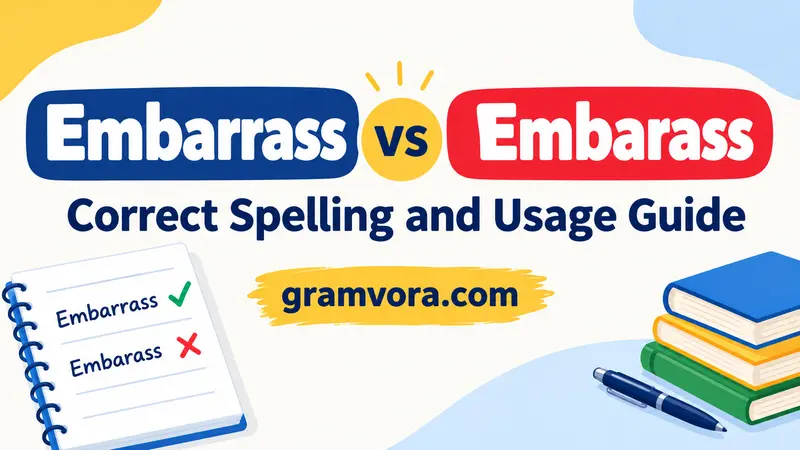
Embarrass is the correct spelling in standard American English. Embarass is a misspelling and should not be used in formal or edited writing.
The correct spelling contains both a double r and a double s:
- Correct: embarrass
- Incorrect: embarass
The word is a verb meaning to make someone feel awkward, self-conscious, ashamed, or uncomfortable. For example: “I did not want to embarrass my friend by mentioning the mistake in front of everyone.”
The same spelling pattern appears in its common forms:
- Embarrassed
- Embarrassing
- Embarrasses
- Embarrassment
Remembering both pairs of repeated letters is the simplest way to avoid this error.
Why People Confuse Them
People often misspell embarrass because the repeated letters are easy to overlook. The word contains several letters in a compact sequence, and writers may remember its general appearance without recalling every letter.
The first common mistake is using only one r. That produces embarass, which looks plausible at a glance but is not the standard spelling.
The second mistake is forgetting the double s at the end. Some writers spell the word with two r’s but finish it with a single s. That version is also incorrect.
Pronunciation can contribute to uncertainty. In ordinary speech, the repeated letters are not pronounced as separate, extended sounds. As a result, hearing the word does not necessarily tell a learner how many r’s or s’s to write.
Another reason is familiarity with related words. Writers may know embarrassed or embarrassing but still hesitate when spelling the base verb. Learning the complete family together can make the pattern easier to remember.
The most reliable approach is to treat the spelling as a fixed sequence rather than trying to spell the word by sound alone. Check for both pairs: rr in the middle and ss at the end.
Key Differences At A Glance
The two forms are not accepted alternatives with different regional preferences. One is standard; the other is a misspelling.
| Context | Best Choice | Why |
|---|---|---|
| American English writing | embarrass | Standard spelling |
| British English writing | embarrass | The same spelling is used |
| School assignments | embarrass | The misspelled form may be marked incorrect |
| Professional emails | embarrass | Correct spelling supports clear, polished writing |
| Website articles | embarrass | Use the standard form in titles and body text |
| Past-tense sentence | embarrassed | The base word keeps both r’s and adds -ed |
| Present participle | embarrassing | The base word keeps both r’s and adds -ing |
| Noun form | embarrassment | The noun also contains double r and double s |
The key difference is spelling accuracy, not meaning. Embarass is not a separate standard word with its own definition.
Are They the Same Word?
The forms look similar, but they do not have equal status in standard English. Embarrass is the recognized word. Embarass is an incorrect spelling of that word.
When you use embarrass, you describe an action that causes someone to feel awkward, uncomfortable, or self-conscious. A person might embarrass a coworker by revealing private information during a meeting, or a student might feel embarrassed after giving the wrong answer in class.
For example:
- “Please do not embarrass him during the presentation.”
- “She worried that her question might embarrass her colleague.”
- “The unexpected announcement could embarrass the entire team.”
In each sentence, the standard spelling is embarrass.
By contrast, embarass should not be treated as an alternative spelling. It does not become correct because a reader understands what the writer means. In informal messages, readers may recognize the intended word, but that does not make the spelling standard.
The pronunciation is similar enough that speaking the word aloud may not reveal the spelling error. For American English learners, a practical pronunciation guide is “im-BAIR-uhs.” The main learning point, however, is visual: remember the double r and double s.
US vs UK Preference
There is no standard American-versus-British spelling split between these two forms. Both American and British English use embarrass.
Regional spelling differences do exist in English. For example, some words have different accepted forms in the United States and the United Kingdom. However, embarrass does not follow that pattern. Writers should not use embarass on the assumption that it is a British spelling.
The same advice applies to international websites, school materials, business communications, and general publishing. Unless a fictional name or deliberately stylized brand requires a nonstandard form, use embarrass.
Consistency is useful, but consistency does not mean preserving an error. If a draft uses embarass several times, correct each occurrence to embarrass. Apply the same check to headings, captions, image text, page titles, and descriptions.
Which Spelling Should You Use?
Choose embarrass whenever you mean to cause someone to feel awkward, ashamed, or uncomfortable.
Use it in formal writing, casual messages, academic work, professional correspondence, and online articles. The correct spelling remains the same across these contexts.
Consider these examples:
- Correct: “I did not mean to embarrass you.”
- Incorrect: “I did not mean to embarass you.”
- Correct: “The teacher did not want to embarrass the student.”
- Incorrect: “The teacher did not want to embarass the student.”
The meaning is usually clear in the incorrect examples, but the spelling still needs correction.
When editing a document, do not check only the first occurrence. Search for embarass and review every result. Also check related forms, because a writer who misses the double r in the base word may repeat the same error in other forms.
A helpful editing habit is to pause briefly at words with repeated consonants. Ask whether the word needs one letter or two, then compare the result with a trusted dictionary if you remain uncertain.
When One Spelling Looks Wrong
At first glance, embarass may look reasonable because it contains the same letters as embarrass, apart from one missing r. However, familiar-looking letter sequences are not always correct.
The best way to judge the spelling is to check whether it is the standard written form, rather than whether it looks or sounds plausible. In this case, dictionaries recognize embarrass, and the spelling with one r is not an accepted standard variant.
The mistake can be especially easy to miss in a long paragraph. Readers tend to focus on meaning, so a familiar word with one missing letter may escape notice during a quick review.
For that reason, pay particular attention when the word appears in prominent places, such as a page heading, article title, presentation slide, or public announcement. These are the places where spelling errors can be most noticeable.
Do not assume that a spelling is acceptable simply because a spell-checking program or another writer has used it. Check the actual word. If you find embarass, replace it with embarrass.
Common Mistakes (and Quick Fixes)
Several mistakes occur when writers spell embarrass and its related forms. The following corrections cover the most common patterns.
1. Writing one r instead of two
Incorrect: “I did not want to embarass my teammate.”
Correct: “I did not want to embarrass my teammate.”
Quick fix: Look for rr in the middle of the word.
2. Using one s at the end
Incorrect: “That comment could embarras her.”
Correct: “That comment could embarrass her.”
Quick fix: The base verb ends with ss, not a single s.
3. Misspelling the past-tense form
Incorrect: “He was embarassed by the mistake.”
Correct: “He was embarrassed by the mistake.”
Quick fix: Start with embarrass, remove the final s, and add -ed. The resulting spelling is embarrassed.
4. Misspelling the -ing form
Incorrect: “I am embarassing my friend.”
Correct: “I am embarrassing my friend.”
Quick fix: Keep both r’s and both s’s in embarrass, remove the final s, and add -ing.
5. Misspelling the noun
Incorrect: “She felt embarassment after the announcement.”
Correct: “She felt embarrassment after the announcement.”
Quick fix: Learn embarrassment as part of the same word family. It contains double r and double s.
6. Assuming the shorter form is a regional spelling
Incorrect assumption: “Embarass must be acceptable in British English.”
Correction: Embarrass is the standard spelling in both American and British English.
Quick fix: Do not change this word based on regional spelling preferences.
7. Correcting only one occurrence
A writer may fix the spelling in the main paragraph but leave the error in a subheading, caption, or image description.
Quick fix: Search the entire document for embarass and inspect every result before publishing.
Everyday Examples
These examples show how to use the correct spelling in natural American English.
At school
- “I did not want to embarrass my classmate by correcting him in front of everyone.”
- “The student felt embarrassed after forgetting the answer.”
- “Making a small mistake during a presentation is not something to be embarrassed about.”
At work
- “Please raise your concerns privately so you do not embarrass your coworker.”
- “The manager apologized for the embarrassing mix-up.”
- “The team worked together to fix the issue without embarrassing anyone.”
With friends and family
- “My brother likes to embarrass me by sharing old photos.”
- “She was embarrassed when she realized she had sent the message to the wrong group.”
- “I did not mean to cause you embarrassment.”
In online communication
- “Think carefully before posting a photo that could embarrass someone.”
- “The typo was embarrassing, but it was easy to correct.”
- “I would rather admit my mistake than embarrass someone else.”
Notice how the spelling changes with the grammatical form. The base verb is embarrass, the past-tense form is embarrassed, the ongoing-action form is embarrassing, and the noun is embarrassment. Each standard form preserves the double r and double s.
Dictionary-Style Word Details
Verb
- Embarrass: A standard transitive verb meaning to make someone feel awkward, uncomfortable, ashamed, or self-conscious. Example: “I did not want to embarrass my guest.”
- Embarass: Not a standard spelling of the verb. Replace it with embarrass in edited writing.
The verb can appear in different tenses. Use embarrass for the base form, embarrasses for the third-person singular present, embarrassed for the past tense, and embarrassing for the present participle.
Noun
- Embarrass: This is a verb, not the usual noun form.
- Embarass: This is not a standard noun spelling either.
The related noun is embarrassment. It refers to the feeling of being embarrassed or to a person, event, or situation that causes that feeling.
Example: “Forgetting his speech caused him considerable embarrassment.”
Remember that embarrassment also contains two r’s and two s’s. Learning the verb and noun together helps prevent spelling errors.
Synonyms
- Embarrass: Depending on the sentence, useful alternatives include humiliate, mortify, fluster, and make uncomfortable. These words have slightly different shades of meaning, so they are not interchangeable in every situation.
- Embarass: It has no separate standard meaning or independent set of synonyms because it is a misspelling of embarrass.
For example, fluster often suggests making someone confused or nervous, while humiliate usually suggests a stronger loss of dignity. Choose the alternative that best matches the situation.
There is no single antonym that fits every use of embarrass. Depending on the context, phrases such as put at ease or make someone comfortable may express the opposite effect.
Example Sentences
- Embarrass: “I would never embarrass my friend on purpose.”
- Embarass: Incorrect spelling; write “I would never embarrass my friend on purpose.”
- Embarrassed: “She felt embarrassed when she called the wrong person.”
- Embarrassing: “It was an embarrassing moment, but everyone moved on.”
- Embarrassment: “He laughed at his own embarrassment and continued speaking.”
These examples show why it is useful to recognize the whole word family. Although the endings change, the standard spellings preserve the double r and double s.
Word History
The word embarrass entered English through French embarrasser. Its earlier meanings included perplexing, hindering, or making something difficult. Its familiar modern sense of causing someone to feel awkward or self-conscious developed over time.
This background helps explain the established spelling, but it does not make embarass an alternative form. There is no standard American or British spelling rule that removes one r from the word.
For everyday writing, the most important point is simple: learn the current standard spelling rather than trying to reconstruct it from its history.
Phrases Containing
- Embarrass someone: “Do not embarrass your coworker in front of the team.”
- Embarrass yourself: “Check the details so you do not embarrass yourself during the meeting.”
- Feel embarrassed: “I felt embarrassed after arriving late.”
- An embarrassing mistake: “The wrong name on the invitation was an embarrassing mistake.”
- A source of embarrassment: “The misunderstanding became a source of embarrassment.”
- Public embarrassment: “She wanted to resolve the problem without causing public embarrassment.”
In each phrase, use the standard spelling of the word that applies. Avoid embarass and check related forms carefully.
FAQs
Is it embarrass or embarass?
Embarrass is the correct spelling. Embarass is a misspelling. The correct word contains two r’s in the middle and two s’s at the end.
Why is embarrass spelled with two r’s?
The standard spelling of embarrass includes two consecutive r’s. Remembering the double r, along with the double s, helps prevent common spelling mistakes.
Is embarass ever correct?
No. Embarass is not an accepted standard spelling in American or British English. Use embarrass in formal writing, schoolwork, emails, and published content.
Is embarrass the correct spelling in American English?
Yes. Embarrass is the standard spelling in American English. The spelling does not change to embarass in the United States.
Do British English speakers spell it embarrass or embarass?
British English also uses embarrass. The form embarass is a misspelling, not a British spelling variation.
What does embarrass mean?
Embarrass is a verb meaning to make someone feel awkward, uncomfortable, ashamed, or self-conscious. For example: “I did not want to embarrass my friend in front of the class.”
How do you spell embarrassed?
The correct spelling is embarrassed. It contains two r’s and two s’s, followed by -ed. Example: “He felt embarrassed after forgetting his lines.”
How do you spell embarrassing?
The correct spelling is embarrassing. It retains the double r and double s before adding -ing. Example: “It was an embarrassing mistake.”
What is the noun form of embarrass?
The noun form is embarrassment. It describes the feeling or situation associated with being embarrassed. Example: “She laughed to hide her embarrassment.”
What is an easy way to remember embarrass?
Remember double R, double S. The word is spelled E-M-B-A-R-R-A-S-S. Checking both pairs of letters can help you avoid writing embarass.
Conclusion
When choosing between embarrass and embarass, use embarrass. It is the standard spelling in American English and British English, while embarass is a misspelling rather than an accepted regional alternative.
The easiest way to remember the correct form is to focus on its two pairs of repeated letters: RR in the middle and SS at the end. The complete spelling is E-M-B-A-R-R-A-S-S.
Keep the same pattern in mind when writing embarrassed, embarrassing, and embarrassment. If you are editing an article, email, school assignment, or website page, search for the incorrect form and correct every occurrence.
A small spelling check can make your writing clearer and more professional. Whenever you are unsure, remember: double R, double S — embarrass.