English spelling can be confusing, especially when a word sounds familiar but its written form is easy to misremember. Fascinating is one such word. People sometimes write it as facinating, leaving out an important letter.
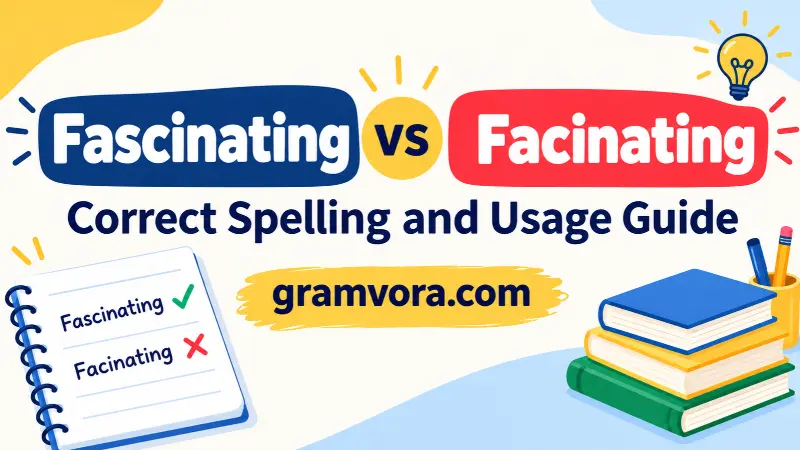
If you have wondered which spelling belongs in an essay, email, school assignment, or online article, the answer is straightforward: fascinating is correct, while facinating is a misspelling.
The correct word describes something that attracts attention, creates interest, or makes someone want to learn more. You might use it when talking about a documentary, a historical event, a scientific discovery, or an interesting conversation.
The spelling does not change between American and British English. Both varieties use fascinating. Learning how it connects to the base word fascinate makes the correct form easier to remember.
Quick Answer
Fascinating is the correct spelling in standard American English and British English.
Facinating is an incorrect spelling and should not be used in formal or edited writing.
For example:
- Correct: The documentary about space was fascinating.
- Incorrect: The documentary about space was facinating.
The important detail is the letter s after “fa.” Remember the base word fascinate, and you have a reliable clue for spelling fascinating correctly.
Why People Confuse Them
The confusion often happens because people rely on the sound of a word rather than its full spelling. When someone says fascinating in a conversation, the individual sounds can run together. A listener may remember the general sound but overlook the letter sequence.
Another reason is that English does not always allow writers to predict spelling from pronunciation alone. Familiar words can contain letter combinations that are easy to miss when writing quickly.
The connection between fascinate and fascinating also helps explain the correct form. The second word is formed from the first by adding the ending -ing. The spelling of the base word remains visible.
Compare these forms:
- Fascinate
- Fascinates
- Fascinated
- Fascinating
Each form keeps the same essential spelling pattern. Writing facinating breaks that connection by removing the s.
The mistake is understandable, but it is still a spelling error. Once you recognize the relationship between the words, you can correct it quickly.
Key Differences At A Glance
The two forms may look similar, but only one is accepted as the standard spelling.
| Context | Best Choice | Why |
|---|---|---|
| American English | Fascinating | Standard spelling |
| British English | Fascinating | Same spelling convention |
| School assignments | Fascinating | Appropriate for edited writing |
| Professional emails | Fascinating | Correct and widely understood |
| Informal messages | Fascinating | The misspelling remains incorrect |
| Proofreading | Replace facinating | The letter s is missing |
Here is a compact comparison of their main features:
| Feature | Fascinating | Facinating |
|---|---|---|
| Standard spelling | Yes | No |
| Meaning | Extremely interesting | No separate standard meaning |
| Suitable for formal writing | Yes | No |
| Regional spelling variant | No special regional restriction | No |
The difference is not a matter of personal preference. Use fascinating whenever you intend to write the standard English word.
Are They the Same Word?
The two forms are intended to represent the same word, but they do not have equal spelling status.
Fascinating is a standard English adjective. It describes something that holds attention or creates a strong sense of interest. It can also function as the present participle of the verb fascinate.
For example:
- The lecture was fascinating.
- I find marine biology fascinating.
- The subject is fascinating to students.
In each sentence, the word communicates strong interest or attention.
By contrast, facinating is not a recognized alternative spelling with a separate definition. If a reader encounters it, the likely intended word is fascinating.
There is no special difference in meaning, grammar, or tone between the two forms because only one is the standard spelling. Writers should not use them interchangeably.
US vs UK Preference
American and British English both use fascinating. Unlike certain words that have established regional spelling variants, this word does not have a standard American form and a different standard British form.
For example, a writer in New York would write, “The museum has a fascinating collection.” A writer in London would use the same spelling in the same sentence.
The form facinating does not become acceptable simply because someone uses British English, Australian English, or another variety of English.
This makes the choice easy for international readers. Whether you are writing a classroom assignment, a business email, a website article, or a personal message, keep the s in fascinating.
If a publisher or school provides a style guide, follow its general spelling and editing instructions. However, there is no ordinary regional preference that requires changing fascinating to facinating.
Which Spelling Should You Use?
Choose fascinating every time you mean something extremely interesting or attention-grabbing.
Use it when describing:
- A book that keeps you interested.
- A person with an unusual life story.
- A scientific discovery that makes you curious.
- A conversation that introduces new ideas.
- A place with an interesting history.
- A class topic that encourages further learning.
For example, write, “Her presentation about ocean life was fascinating.” The sentence is clear, natural, and correctly spelled.
If you are unsure while writing, return to the base word fascinate. The ending -ing attaches to that word to create fascinating. You do not remove the s.
A quick proofreading habit can help, too. Search your draft for facinating. If you find it, replace it with fascinating wherever the intended word has that meaning.
Do not preserve the incorrect form simply because it appears in an older draft, an informal post, or a message written by someone else. Correct spelling improves clarity and helps your writing look polished.
When One Spelling Looks Wrong
Facinating may look plausible because it resembles the correct word. However, resemblance alone does not make a spelling acceptable.
The missing s is the key problem. The standard spelling contains the letter sequence f-a-s-c-i-n-a-t-i-n-g.
A useful way to check it is to break the word into manageable parts:
Fascinate + ing = fascinating
The word fascinate already contains the letter sequence that writers sometimes forget. Keeping the base word in mind prevents the common error.
Consider these corrections:
- Incorrect: We watched a facinating documentary.
- Correct: We watched a fascinating documentary.
- Incorrect: The professor shared a facinating theory.
- Correct: The professor shared a fascinating theory.
- Incorrect: It was a facinating experience.
- Correct: It was a fascinating experience.
In all three cases, the intended meaning stays the same after correction. The improvement is in spelling, not in the sentence’s meaning.
Common Mistakes (and Quick Fixes)
Writers can avoid this error by watching for a few recurring problems.
1. Leaving out the s
Incorrect: The book was facinating.
Correct: The book was fascinating.
Quick fix: Check that the spelling begins fascin- rather than facin-.
2. Forgetting the base word
Incorrect: She finds astronomy facinating.
Correct: She finds astronomy fascinating.
Quick fix: Write fascinate first, then add -ing.
3. Assuming the misspelling is regional
Incorrect assumption: Facinating is the British spelling.
Correct understanding: Both American and British English use fascinating.
Quick fix: Do not treat a missing letter as a regional spelling difference.
4. Repeating the error in longer documents
A spelling mistake can appear several times in an article or assignment if the writer does not check the whole document.
Quick fix: Search for the exact string facinating before submitting or publishing your work.
5. Correcting only the first occurrence
If a document contains the misspelling more than once, changing a single instance may leave other errors behind.
Quick fix: Review every occurrence and confirm that the intended word is fascinating.
These small habits are useful for students, professionals, and anyone who wants to communicate clearly.
Everyday Examples
The following examples show how fascinating works naturally in American English.
School and learning
- The teacher gave us a fascinating explanation of the solar system.
- I found the chapter about ancient civilizations fascinating.
- It was fascinating to see how the experiment worked.
Work and communication
- Your presentation included some fascinating details about the project.
- She shared a fascinating idea during the team meeting.
- The report offers a fascinating look at customer behavior.
Entertainment and travel
- We watched a fascinating documentary about wildlife.
- The guide told us a fascinating story about the old building.
- Their trip across Alaska sounded fascinating.
Everyday conversations
- That is a fascinating question.
- I had a fascinating conversation with my neighbor.
- Your grandmother’s story about moving to the United States was fascinating.
Before-and-after corrections
- Incorrect: The podcast was facinating.
- Correct: The podcast was fascinating.
- Incorrect: He has a facinating collection of old records.
- Correct: He has a fascinating collection of old records.
- Incorrect: It was facinating to learn about the ocean.
- Correct: It was fascinating to learn about the ocean.
Notice that the correct spelling works before nouns, after linking verbs, and in expressions such as “It was fascinating to learn.” The spelling stays the same in each context.
Dictionary-Style Word Details
Verb
Fascinating: The -ing form of the verb fascinate. It can appear in progressive verb constructions, as in “The subject is fascinating the audience,” although that phrasing is less common than using it as an adjective.
Facinating: Not a standard verb form. When the intended word comes from fascinate, use fascinating.
The base verb fascinate means to interest someone greatly or hold someone’s attention.
Noun
Fascinating: Not ordinarily a noun by itself in standard contemporary English. It is primarily an adjective and a present participle. The related noun fascination describes a strong interest or attraction.
Facinating: Not a standard noun.
For example, “Her fascination with astronomy began in childhood” uses the related noun correctly. The spelling facinating does not serve as a noun substitute.
Synonyms
Fascinating: Depending on the sentence, suitable synonyms include captivating, absorbing, engrossing, intriguing, and enthralling. These words overlap in meaning but are not interchangeable in every context.
Facinating: No separate standard set of synonyms applies because it is a misspelling.
For example, “The story was captivating” is a reasonable alternative to “The story was fascinating.” The best choice depends on the level of interest or attraction you want to express.
There is no single antonym that fits every use. Words such as boring or uninteresting can express the opposite idea in suitable contexts.
Example Sentences
Fascinating:
- The scientist explained a fascinating discovery.
- We learned fascinating facts about the human brain.
- Her photographs offer a fascinating view of rural life.
- It was fascinating to watch the artist at work.
Facinating:
- Incorrect: The scientist explained a facinating discovery.
- Correct: The scientist explained a fascinating discovery.
The correction is the same whether the word describes a person, place, event, story, or idea.
Word History
Fascinating: This word developed from the verb fascinate, which entered English through French from Latin. Historical references connect its earlier sense with enchanting or bewitching. Its familiar modern sense of attracting and holding attention developed over time.
Facinating: There is no established separate word history for this misspelling. It is best understood as an error in writing fascinating, not as an independent English word with its own origin.
The historical connection to fascinate reinforces the practical spelling lesson: preserve the base word when adding -ing.
Phrases Containing
Fascinating: Common expressions include:
- A fascinating story
- A fascinating subject
- A fascinating discovery
- A fascinating conversation
- A fascinating insight
- A fascinating experience
- A fascinating look at history
Facinating: These expressions are not standard when written with the missing s. Write “a fascinating story,” not “a facinating story.”
The word fits naturally in both everyday conversation and formal writing. Its spelling remains unchanged across these expressions.
FAQs
Is it fascinating or facinating?
Fascinating is the correct spelling. Facinating is a misspelling because it leaves out the letter s. Use fascinating in essays, emails, articles, and everyday writing.
Is facinating a real word?
No. Facinating is not a standard English word. It is a common spelling error for fascinating, which describes something extremely interesting or engaging.
What does fascinating mean?
Fascinating means extremely interesting or capable of holding someone’s attention. For example, “The documentary about wildlife was fascinating.”
Why is fascinating spelled with an s?
The word comes from the verb fascinate. When you add the ending -ing, the result is fascinating. Keeping the original spelling of fascinate helps you avoid leaving out the s.
Is fascinating correct in American English?
Yes. Fascinating is the standard spelling in American English. It is appropriate for school assignments, professional documents, online articles, and casual messages.
Is fascinating also correct in British English?
Yes. British English uses fascinating as well. There is no standard American-versus-British spelling difference between fascinating and facinating.
How do you use fascinating in a sentence?
Here are three examples:
- The professor shared a fascinating story about ancient history.
- I found the science exhibit fascinating.
- Her book offers a fascinating look at life in Alaska.
What are some synonyms for fascinating?
Depending on the context, synonyms include captivating, intriguing, absorbing, engrossing, and enthralling. Each word has a slightly different shade of meaning, so choose the one that best fits your sentence.
How can I remember the correct spelling of fascinating?
Remember the base word fascinate. Add -ing to form fascinating. Keeping the s in the original word will help you avoid the misspelling facinating.
What is the difference between fascinating and facinating?
The difference is spelling accuracy. Fascinating is the correct standard spelling, while facinating is incorrect. The misspelled form has no separate standard meaning, and both American and British English use fascinating.
Conclusion
When comparing fascinating and facinating, there is one clear answer: fascinating is correct. The other form is a misspelling, not an accepted regional variant.
Remember the base word fascinate. Adding -ing gives you fascinating, with the original letters preserved.
Use the correct spelling in essays, emails, reports, website articles, and everyday messages. A quick review for the missing s can prevent this common error and keep your writing clear and professional.