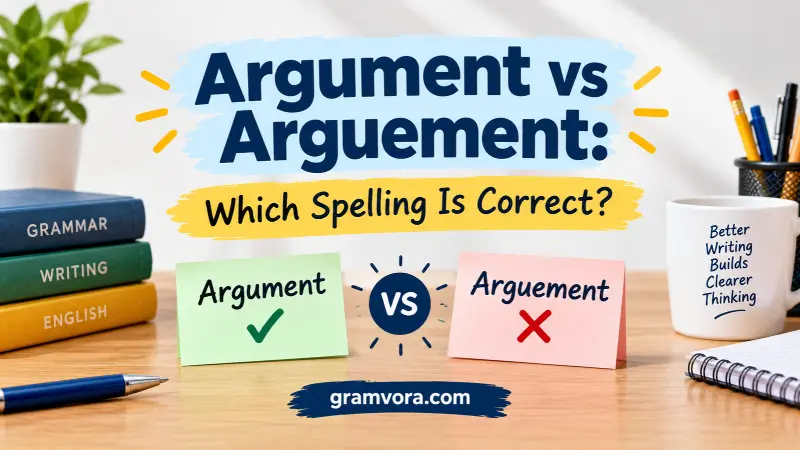
Choosing the correct spelling of a word can make a noticeable difference in essays, emails, reports, and everyday writing. One common spelling mistake involves argument and arguement. These two forms look almost identical, so it is easy to understand why students and English learners sometimes confuse them. However, only one is accepted as the standard spelling in modern English.
The correct spelling is argument. It is a noun that can describe a disagreement, a reason supporting an opinion, or a set of ideas presented to prove a point. You may use it when discussing a debate with a friend, explaining an opinion in an essay, or describing the reasons behind a decision.
By contrast, arguement is a misspelling. It adds an unnecessary letter e between the letters u and m. Although the mistake may seem minor, it can make schoolwork, professional documents, and published content look less polished.
The confusion often begins with the verb argue, which ends in the letter e. Writers may assume that the letter should remain when they form the noun. Nevertheless, the standard spelling is argument, not arguement.
This guide explains the difference, the meaning of argument, the reason for the spelling mistake, and how to use the word correctly. It also provides examples, grammar notes, and practical tips to help you remember the right form.
Quick Answer
Argument is the correct spelling in American English and British English. Arguement is a misspelling and should not be used in standard writing.
- Correct: We had an argument about the best way to solve the problem.
- Incorrect: We had an arguement about the best way to solve the problem.
The word argument has several meanings. It can describe a disagreement between people or a reason used to support a claim. In academic writing, it often refers to the main point a writer develops and supports with evidence.
Easy rule: Write argue as the verb and argument as the noun. Remember that the noun does not contain an extra e.
Why People Confuse Them
The main reason people confuse argument and arguement is the spelling of the related verb argue. Because the verb ends in e, writers sometimes carry that letter into the noun by mistake.
For example, someone who knows the word argue might naturally write arguement. The incorrect form appears to follow a familiar pattern in English word formation. However, the established spelling of the noun is different.
Another reason is pronunciation. In ordinary conversation, people generally cannot see the letters that make up a word. When they hear argument, they may imagine that it includes the same final-letter pattern as argue. This can lead to spelling errors, particularly among students who are still building their English vocabulary.
Typing habits also contribute to the problem. Writers may enter arguement quickly without noticing the extra letter. If a document is not carefully proofread, the error can remain in an essay, website article, presentation, or email.
The mistake becomes easier to understand when you compare the two forms:
- Argue: The verb used when people disagree or present reasons.
- Argument: The noun describing a disagreement or a reasoned case.
- Arguement: An incorrect spelling of the noun.
Learning the correct form is more useful than relying on how the word looks at first glance. Once you remember that argument drops the extra e, you can recognize and correct the mistake more easily.
Key Differences At A Glance
The difference between argument and arguement is spelling accuracy, not meaning. The standard word is argument, while arguement is an error.
| Context | Best Choice | Why |
|---|---|---|
| American English | Argument | This is the standard spelling. |
| British English | Argument | British English uses the same spelling. |
| School essay | Argument | It is the accepted noun form. |
| Workplace email | Argument | It is appropriate for professional writing. |
| A disagreement | Argument | The word can describe a conflict or dispute. |
| Reasons supporting an opinion | Argument | It can describe a case built from reasons. |
| Arguement | Avoid | This form is misspelled. |
A few examples show how the correct spelling works in different situations:
- Personal disagreement: Their argument ended after they discussed the problem calmly.
- Academic writing: The student supported her argument with reliable evidence.
- Professional discussion: The manager presented a clear argument for changing the schedule.
- Legal setting: The attorney prepared an argument for the hearing.
In each example, argument is the correct form. Adding an e after u would make the spelling incorrect.
Are They the Same Word?
No. Although argument and arguement may look like two versions of the same word, only argument is the standard spelling. The second form is a common spelling error rather than a separate word with its own meaning.
The correct word can be used in several ways. In everyday conversation, it often refers to a disagreement between two or more people. For instance, two friends might have an argument about where to eat dinner.
In persuasive writing, the word has a different but related use. An argument is a claim supported by reasons, examples, or evidence. A student might write an argument in favor of school uniforms or explain why a community should improve its public transportation.
The word also appears in law, philosophy, mathematics, and computer programming. Its exact meaning depends on the subject, but the spelling remains the same.
Consider these examples:
- The argument between the neighbors lasted several minutes.
- Her argument against the proposal was based on cost.
- The lawyer presented a detailed argument in court.
- The function requires two arguments.
The final example uses arguments in a technical programming context. This illustrates that the word is not limited to personal disagreements.
Regardless of the context, write argument. Do not use arguement as an alternative.
US vs UK Preference
There is no standard American-versus-British spelling difference between these two forms. Both American English and British English use argument.
Some English words have recognized regional spelling variations. For example, American English commonly uses color, while British English commonly uses colour. Likewise, organize and organise are associated with different spelling conventions, although usage varies by style and region.
The word argument does not follow that pattern. British writers do not normally use arguement as an accepted alternative to the American spelling. The extra e is not a regional preference.
Here is a simple comparison:
| English Variety | Correct Spelling | Incorrect Spelling |
|---|---|---|
| American English | Argument | Arguement |
| British English | Argument | Arguement |
| Canadian English | Argument | Arguement |
| Australian English | Argument | Arguement |
If you are writing for a US audience, choose argument. The same advice applies when writing for British, Canadian, or Australian readers.
Regional spelling conventions can matter, but this is not a case where you need to choose between two accepted national forms.
Which Spelling Should You Use?
Use argument whenever you need the noun that refers to a disagreement, a reason, or a supported claim.
In school assignments, the correct spelling helps make your work clear and professional. In workplace communication, it prevents avoidable mistakes that may distract readers from your message. For website content, correct spelling also supports readability and editorial quality.
Use the word in sentences such as these:
- I understand your argument, but I have a different opinion.
- The teacher asked us to develop an argument about the topic.
- Their argument was based on incomplete information.
- She made a strong argument for protecting local parks.
- The team discussed each argument before making a decision.
- His main argument was that the policy would save money.
Avoid writing arguement in these situations. The extra letter does not change the intended meaning, but it does make the spelling incorrect.
When proofreading, pay particular attention to the word in headings and opening paragraphs. A spelling mistake in a title can be especially noticeable because readers often see the title before anything else.
If you are unsure, remember this simple comparison: argue is the verb, but argument is the noun.
When One Spelling Looks Wrong
The spelling arguement often looks plausible because it resembles the verb argue. However, its extra e makes it incorrect in standard modern English.
Compare the following sentences:
Incorrect: The student presented a convincing arguement.
Correct: The student presented a convincing argument.
Incorrect: We had an arguement about the final decision.
Correct: We had an argument about the final decision.
Incorrect: Her arguement needs more supporting evidence.
Correct: Her argument needs more supporting evidence.
In each pair, the correction involves removing the extra e. No other part of the sentence needs to change.
A word processor or spelling checker may identify arguement as an error, but writers should still learn the correct form rather than depend entirely on automatic corrections. A spelling checker might miss some errors when a misspelled word resembles another valid word or appears in an unusual context.
It is also helpful to distinguish a spelling mistake from a grammatical mistake. In the sentence “She made a strong argument,” the noun is spelled correctly and used naturally. In “She made a strong arguement,” the sentence structure is still understandable, but the noun contains a spelling error.
Correct spelling helps readers focus on your ideas instead of stopping to interpret an unnecessary mistake.
Common Mistakes (and Quick Fixes)
Several habits can make arguement more likely to appear in writing. Fortunately, each can be corrected with a simple strategy.
1. Keeping the final e from argue
Writers may assume that the e in argue must remain when adding -ment. Remember the established spelling instead:
- Correct: argue
- Correct: argument
- Incorrect: arguement
2. Relying only on pronunciation
The word’s sound does not clearly show whether an extra letter belongs in its spelling. Learn the written form as a complete word.
3. Typing too quickly
Fast typing can introduce extra letters. Review important words after finishing a paragraph, especially in formal documents.
4. Repeating a mistake from an old draft
If you have used arguement before, you may repeat it automatically. Search for the incorrect form when editing older articles or assignments.
5. Assuming it is a British spelling
Some words have different American and British spellings, but argument is standard in both varieties. Do not treat arguement as a regional alternative.
6. Confusing spelling with meaning
The spelling difference does not create two separate meanings. Use argument whether you mean a disagreement or a reasoned explanation.
A useful proofreading method is to search your document for the exact string arguement. Review every result and change it to argument unless you are intentionally quoting or discussing the misspelling itself.
Everyday Examples
Seeing the correct spelling in different situations makes it easier to remember. The examples below show how argument appears in ordinary conversation, education, professional communication, and formal discussion.
Everyday conversation
- My brother and I had an argument about the television.
- I do not want to start an argument over something small.
- Their argument ended when both people apologized.
- We had a friendly argument about which movie was better.
School and academic writing
- The essay presents an argument in favor of renewable energy.
- Every argument should include clear reasons.
- The teacher asked the class to evaluate the author’s argument.
- Her argument became stronger after she added evidence.
- Students must explain their argument in the final paragraph.
Workplace communication
- The manager made an argument for extending the deadline.
- We considered every argument before choosing a solution.
- His argument helped the team understand the financial risks.
- Please explain the main argument in your report.
Formal and legal settings
- The attorney prepared an argument for the court.
- The legal argument relied on the wording of the contract.
- Each side presented an argument before the judge made a decision.
Technical usage
- The function accepts one argument.
- The program checks whether the required arguments are present.
Notice that the word remains argument in every example. Its meaning changes according to the situation, but its spelling does not.
For additional practice, try writing three sentences of your own. Use argument once to describe a disagreement, once to explain an opinion, and once in a school or workplace context.
Dictionary-Style Word Details
Verb
Argue is the related verb. It means to give reasons for or against an idea, or to disagree with another person.
Examples:
- They argue about money from time to time.
- She argued that the plan would benefit everyone.
- We should discuss the issue instead of arguing.
Remember that argue and argument are related forms, but their spelling is not identical. The noun is written without the extra e found at the end of the verb.
Noun
Argument is a noun. It can refer to a disagreement, a reason supporting a position, or a connected set of ideas intended to establish a conclusion.
Examples:
- Their argument disturbed the other guests.
- The report contains a strong argument for reform.
- The main argument is easy to understand.
The noun can be countable or uncountable, depending on its meaning and use. For example, “We had an argument” refers to one disagreement, while “There is an argument for change” refers to a possible reason or case.
Synonyms
The best synonym depends on the intended meaning.
When argument means a disagreement, possible alternatives include:
- Disagreement
- Quarrel
- Dispute
- Debate
- Conflict
When it means a reasoned case, possible alternatives include:
- Case
- Reasoning
- Claim
- Rationale
- Justification
These words are not interchangeable in every sentence. A quarrel usually suggests a personal disagreement, while a rationale explains the reasons behind a decision. Choose the word that communicates your intended meaning most clearly.
Example Sentences
Here are additional examples of the correct spelling:
- Her argument convinced the committee to reconsider the proposal.
- The two friends resolved their argument peacefully.
- A strong argument should be supported by reliable evidence.
- The author develops an argument throughout the article.
- His argument was logical, but it needed more examples.
- The lawyer presented a detailed argument to the judge.
- We discussed both sides of the argument before voting.
- The teacher asked students to write a persuasive argument.
- Their argument began over a misunderstanding.
- Each argument should address the central question.
In every sentence, argument is spelled without an extra e.
Word History
The word argument has roots in Latin and entered English through French. Its history helps explain why its spelling does not simply preserve the final e from the modern English verb argue. The noun’s established form developed through its historical word family rather than through a spelling pattern that writers can apply mechanically to every word.
English spelling contains many words whose forms reflect historical development, borrowing, and convention. For that reason, spelling rules can be useful, but not every word follows the pattern that a learner might expect.
The important practical point is that argument is the established spelling. Writers do not need to reconstruct its history every time they use it; they simply need to recognize and remember the standard form.
Phrases Containing
The word argument appears in many common phrases, including:
- Have an argument: to experience a disagreement.
- Win an argument: to persuade others or be judged to have made the stronger case.
- Lose an argument: to fail to persuade someone or to be judged to have the weaker case.
- A strong argument: a convincing case supported by reasons or evidence.
- A convincing argument: a case that persuades people.
- The main argument: the central claim or point being made.
- An argument for: reasons supporting an idea or action.
- An argument against: reasons opposing an idea or action.
- A heated argument: an intense or angry disagreement.
- The course of an argument: the way a discussion or line of reasoning develops.
Examples:
- She made a strong argument for improving public transportation.
- They had a heated argument about the budget.
- The article’s main argument is that education should be accessible to everyone.
- He presented an argument against changing the rules.
The spelling stays the same in each phrase.
FAQs
Is it argument or arguement?
Argument is the correct spelling in standard English. Arguement is a misspelling and should be avoided in formal and everyday writing.
How do you spell argument correctly?
The correct spelling is A-R-G-U-M-E-N-T. There is no extra e between the u and the m.
Why do people spell argument as arguement?
People often make this mistake because the related verb argue ends in e. They may incorrectly carry that letter into the noun. However, the standard spelling is argument.
Is argument correct in American English?
Yes. Argument is the correct spelling in American English. Use it in school assignments, business emails, reports, and online articles.
Is arguement correct in British English?
No. Arguement is not a standard British spelling either. Both American and British English use argument.
What does argument mean?
An argument can mean a disagreement between people or a reasoned explanation that supports an opinion or claim.
Examples:
- They had an argument about the schedule.
- She presented a strong argument for the new policy.
Is argument a noun or a verb?
Argument is a noun, while argue is the related verb.
Examples:
- Noun: Their argument lasted several minutes.
- Verb: They argue about politics.
What is the plural of argument?
The plural form is arguments.
Example: The student presented three arguments in favor of the proposal.
How can I remember the spelling of argument?
Remember the word pair argue → argument. The noun does not retain the final e from the verb. Practicing the correct form can help you avoid adding an unnecessary letter.
Does argument always mean a fight?
No. An argument can mean an angry disagreement, but it can also describe reasons that support an idea.
Example: Her argument for better public transportation included several useful facts.
Can I use argument in academic writing?
Yes. Argument is commonly used in essays, research papers, and debates. It often refers to a central claim supported by reasons and evidence.
Conclusion
The difference between argument and arguement is simple: argument is the correct standard spelling, while arguement is a misspelling. Both American and British English use argument, so there is no regional spelling choice to make.
The word can describe a disagreement between people, a reason supporting an opinion, or a case developed through reasoning and evidence. Its meaning depends on the context, but its spelling remains consistent.
The most common mistake is carrying the final e from argue into the noun. To avoid that error, remember the established forms: argue and argument. When you proofread, look for the incorrect form and replace it with the correct spelling.
Whether you are writing a school essay, a professional email, a website article, or an everyday message, use argument. A small spelling check can help your writing look clearer, more accurate, and more professional.