Many English words are easy to recognize but surprisingly difficult to spell. One common example is difference vs diffrence. The two forms look similar, and the incorrect version may appear when someone types quickly or forgets a letter. However, only one is the standard spelling in American English.
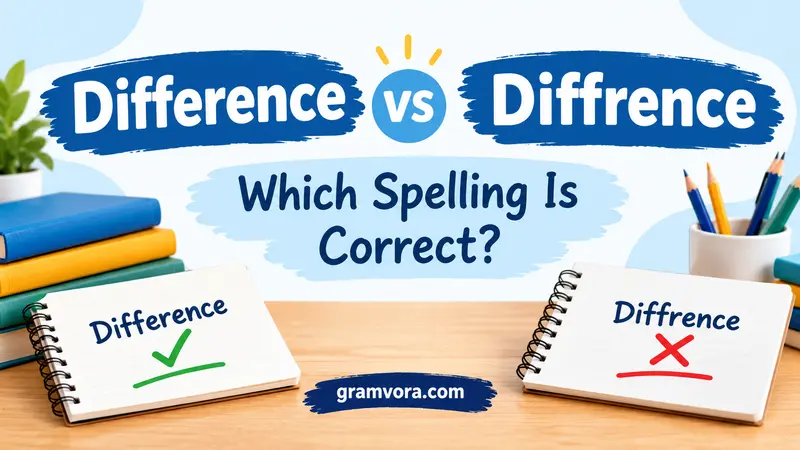
The correct spelling is difference. The spelling diffrence is incorrect because it leaves out the letter e after the first f. It is not a recognized alternative spelling in standard American English.
The word difference appears in everyday conversations, school assignments, workplace emails, mathematics, and many other situations. People use it to explain how two things are not the same, describe a disagreement, or identify the amount between two numbers.
For example, you might compare the prices of two products, explain the difference between two ideas, or discuss a difference of opinion with a friend. In each situation, the correct spelling is difference.
Learning the correct form helps you write clearly and avoid errors in important documents. It also makes it easier to recognize related words, such as different and differently.
This guide explains the correct spelling, meaning, pronunciation, grammar, common mistakes, and everyday examples. You will also learn a simple way to remember how to spell difference correctly.
Quick Answer
Difference is correct. Diffrence is a misspelling.
- Correct: There is a big difference between the two plans.
- Incorrect: There is a big diffrence between the two plans.
The word difference is a noun. It describes the way two or more things are not alike, a disagreement between people, or the amount by which quantities differ.
Easy spelling tip: Remember the letters in difference: d-i-f-f-e-r-e-n-c-e. After the double f, write an e before the r.
Why Do People Confuse Difference and Diffrence?
People often confuse these spellings because they remember the general sound of a word without remembering every letter. When someone writes quickly, a small letter can disappear from the middle of a word.
The word difference can be especially challenging because its pronunciation does not always make every written letter obvious. In everyday American speech, the middle sounds may blend together, making the word seem shorter than it looks.
Another reason is typing speed. Someone may begin writing difference, skip the first e after the double f, and produce diffrence without noticing the error.
Spelling habits can also contribute to the problem. If a writer repeatedly sees an incorrect form online, the mistake may begin to look familiar. Familiarity, however, does not make a spelling correct.
Students may face the same problem when taking notes or writing assignments under time pressure. Professionals can also make this mistake in emails, reports, and presentations.
The solution is to learn the letter pattern rather than rely only on pronunciation. Think of the word as diff + erence, and remember that the correct form includes an e between the double f and the r.
Key Differences at a Glance
| Feature | Difference | Diffrence |
|---|---|---|
| Spelling status | Correct | Incorrect |
| Standard American English | Accepted | Not accepted as a standard spelling |
| Part of speech | Noun | No standard grammatical use |
| Meaning | A distinction, disagreement, or amount that separates things | No established meaning as written |
| Formal writing | Appropriate | Should be corrected |
| Example | We noticed a difference in price. | We noticed a diffrence in price. |
The main issue is spelling. These forms do not represent two words with different meanings. Instead, diffrence is an incorrect version of difference.
Are They the Same Word?
No. In standard English, difference is the recognized word, while diffrence is a spelling error.
The correct word has several related meanings. First, it can describe how two things are unlike each other. For example, there may be a difference between two phones in price, size, or battery life.
Second, difference can refer to a disagreement. Two coworkers might have a difference of opinion about how to complete a project. In this case, the word describes a difference in their views rather than a physical distinction.
Third, the word can describe an amount between two values. If one shirt costs $20 and another costs $35, the price difference is $15.
Consider these examples:
- The difference between the two apartments is their location.
- My brother and I have different opinions, but we respect each other.
- The difference between 18 and 25 is 7.
- We settled our differences and continued working together.
Each sentence uses the same noun, but the context changes its meaning slightly.
By contrast, diffrence has no separate standard definition that would make it a valid alternative. If you encounter it in a sentence, the writer most likely intended to use difference.
US vs UK Preference
There is no meaningful American-versus-British spelling distinction between these two forms. Difference is the standard spelling in both American and British English.
Some English words have accepted regional spelling variations. For example, American and British writers may choose different spellings for certain words because of established regional conventions. That is not the situation here.
Neither American nor British English treats diffrence as a standard regional alternative to difference. Changing the spelling based on location will not make the incorrect form acceptable.
For American readers, use difference in school assignments, workplace documents, business communication, and published writing. The same advice applies when writing for a British audience.
Consistency is helpful, but the first priority is accuracy. Once you remember the correct spelling, you can use it confidently regardless of your audience.
Which Spelling Should You Use?
Choose difference whenever you want to describe a distinction, disagreement, or amount separating two things.
For example, use it when comparing products:
“The main difference between these laptops is their battery life.”
Use it when discussing opinions:
“We had a difference of opinion about the best way to organize the event.”
You can also use it in mathematics:
“The difference between 90 and 64 is 26.”
In each example, the word has a clear and standard meaning.
Avoid diffrence in essays, resumes, cover letters, schoolwork, reports, website articles, and professional messages. Although readers may understand what you intended, the missing letter is still a spelling error.
If you are proofreading your writing, look carefully at words with repeated consonants. A word can appear familiar at first glance while still containing a missing or misplaced letter.
When in doubt, check a reliable dictionary or a trusted spelling reference. Correct spelling is particularly important in documents that represent your education, work, or professional reputation.
When One Spelling Looks Wrong
The spelling diffrence may look plausible because it resembles the correct word. However, its appearance does not make it acceptable.
A useful way to identify the error is to examine the letters after the double f.
Correct: d-i-f-f-e-r-e-n-c-e
Incorrect: d-i-f-f-r-e-n-c-e
The incorrect form skips the e that belongs between the second f and the r.
This small omission can be difficult to notice when reading quickly. For that reason, proofreading should include a careful look at the middle of longer words, not just their first and last letters.
Here are some examples of how to correct the mistake:
- Incorrect: I can see a diffrence in the results.
- Correct: I can see a difference in the results.
- Incorrect: What is the diffrence between these prices?
- Correct: What is the difference between these prices?
- Incorrect: The diffrence was smaller than expected.
- Correct: The difference was smaller than expected.
The meaning remains the same after correction. The change simply restores the accepted spelling.
Common Mistakes (and Quick Fixes)
1. Leaving Out the First E
The most direct mistake is writing diffrence instead of difference.
Incorrect: There is a clear diffrence between the options.
Correct: There is a clear difference between the options.
Quick fix: Remember that the word contains an e immediately after the double f.
2. Adding Too Many Letters
Some writers may overcorrect the word by adding letters that do not belong. The safest approach is to memorize the complete spelling instead of trying to reconstruct it each time.
Correct spelling: difference
Write it slowly once or twice, then practice using it in a complete sentence.
3. Confusing Difference With Different
The words difference and different are related, but they serve different grammatical roles.
Use difference as a noun:
“There is a difference between the two designs.”
Use different as an adjective:
“The two designs are different.”
Incorrect spelling can make both words harder to recognize, so learn each form carefully.
4. Confusing Difference With Differently
Differently is an adverb. It describes how an action is performed.
For example:
“She approached the problem differently this time.”
By comparison, difference names the distinction itself.
Remembering the function of each word can help you choose the right form in a sentence.
5. Trusting Automatic Correction Without Reviewing
Spelling suggestions can help identify mistakes, but they should not replace careful reading. A correction may be missed, or the wrong word may remain in a sentence if the surrounding context is unusual.
Quick fix: Read your final text slowly, especially before submitting an assignment or publishing an article.
Everyday Examples
The following examples show how to use difference naturally in American English.
School and Education
- The teacher explained the difference between a fact and an opinion.
- I noticed a difference between my first draft and the final version.
- Understanding the difference helped me answer the question.
- There is a big difference between reading a topic and understanding it.
- The students discussed the differences between the two stories.
Work and Business
- The price difference made us choose the less expensive option.
- Good communication can make a difference in the workplace.
- We noticed a difference in customer feedback this month.
- The manager explained the difference between the two job roles.
- A small change in the schedule made a big difference.
Everyday Conversations
- What is the difference between these two jackets?
- I cannot tell the difference between the twins.
- We have a difference of opinion, but we can still be friends.
- The new recipe tastes different, but I like it.
- There is little difference between the two routes.
Mathematics and Measurements
- The difference between 45 and 30 is 15.
- Calculate the difference between the two measurements.
- The temperature difference was greater than expected.
- We compared the difference in distance between the routes.
- The teacher showed the class how to find the difference between two numbers.
These examples demonstrate that difference works in many settings. Its spelling stays the same regardless of the context.
Dictionary-Style Word Details
Verb
Difference: In ordinary modern American English, difference is primarily used as a noun. The related verb differ is more common when describing how things are unlike one another.
Example: “The two plans differ in cost.”
Diffrence: This is not a standard verb or accepted spelling. Use differ when you need the verb, and difference when you need the noun.
Noun
Difference: A noun referring to a distinction, disagreement, or amount separating two things.
Examples:
- There is a difference in quality.
- They resolved their differences.
- The difference between the totals is small.
Diffrence: This is a misspelling, not a separate standard noun.
Synonyms
Difference: Depending on the context, useful synonyms include distinction, contrast, disparity, and disagreement. For numerical comparisons, gap or amount separating two values may be suitable plain alternatives.
These words are not interchangeable in every sentence. For example, disagreement works when people hold opposing views, while distinction is often better for identifying how two things differ.
Diffrence: It has no separate standard meaning and therefore has no distinct set of synonyms.
Example Sentences
Difference:
- There is a noticeable difference between the two photographs.
- The difference in price is only five dollars.
- We discussed our differences and reached an agreement.
- A little preparation can make a big difference.
- Can you explain the difference between these options?
Diffrence: The spelling is incorrect in standard English. Write difference in each of the sentences above.
Word History
Difference: The word comes through French from Latin differentia, meaning a distinction or difference. Its modern English uses include distinctions between things, disagreements, and amounts separating values.
Diffrence: This is not an established alternative spelling with a separate history. It is best understood as a spelling mistake involving the standard word difference.
Phrases Containing
Difference: Common phrases include:
- Make a difference: Have an effect or bring about a change.
- The difference between: The distinction separating two things.
- A difference of opinion: A disagreement about a subject.
- Price difference: The amount by which prices vary.
- Tell the difference: Recognize how two things are unlike each other.
- Settle differences: Resolve disagreements.
Diffrence: This spelling should not be used in these phrases. Write make a difference, price difference, and the other expressions with the complete standard spelling.
FAQs
Is it difference or diffrence?
Difference is the correct spelling. Diffrence is incorrect because it leaves out the letter e after the double f.
What does difference mean?
Difference is a noun that describes how two or more things are not the same. It can also refer to a disagreement or the amount separating two numbers or quantities.
Why do people misspell difference as diffrence?
People may leave out the letter e when typing quickly or relying on memory. The middle letters can be easy to overlook, so learning the complete spelling helps prevent this mistake.
Is diffrence a real English word?
No. Diffrence is not a standard English spelling. The correct form is difference.
How do you spell difference correctly?
The correct spelling is D-I-F-F-E-R-E-N-C-E. Remember the double f followed by an e before the r.
Is difference the same in American and British English?
Yes. Difference is the standard spelling in both American and British English. Diffrence is not an accepted regional alternative.
What is the difference between difference and different?
Difference is a noun that identifies a distinction, while different is an adjective describing things that are not alike.
Examples:
- There is a difference between the two answers.
- The two answers are different.
What is the verb form of difference?
The related verb is differ. For example: “The two products differ in price.” Use difference as a noun and differ as a verb.
What are some synonyms for difference?
Depending on the context, synonyms include distinction, contrast, disparity, and disagreement. These words have slightly different uses, so choose the one that best fits your sentence.
How can I remember the spelling of difference?
Practice writing difference as D-I-F-F-E-R-E-N-C-E. Pay attention to the e after the double f. Reading and writing the word in complete sentences can also help you remember it.
Conclusion
The correct spelling is difference, not diffrence. The word is a noun used to describe a distinction, disagreement, or amount separating two things. It is standard in both American and British English.
The incorrect form diffrence leaves out an e after the double f. Although readers may understand the intended meaning, the spelling should be corrected in formal and informal writing.
To remember the correct form, practice writing d-i-f-f-e-r-e-n-c-e. Pay special attention to the middle letters, where the common error occurs.
Use difference in school assignments, emails, reports, comparisons, and everyday conversations. With a little practice, you can recognize the correct spelling and avoid this common mistake.