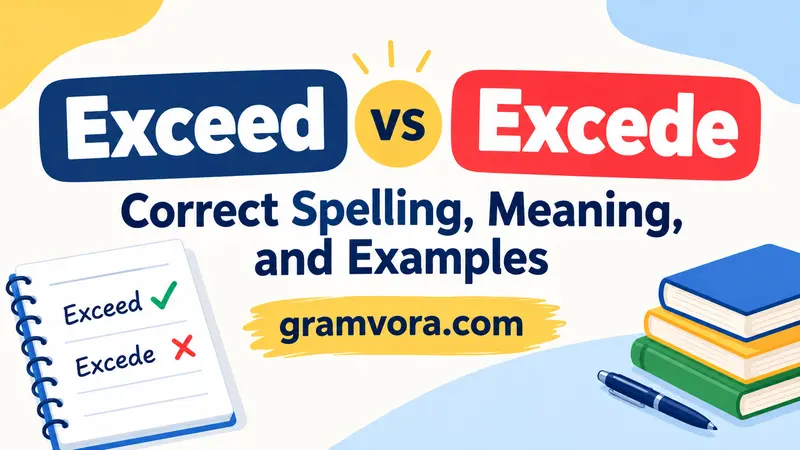
English spelling can be confusing, especially when two words look almost identical. A small change in the final letters can make the difference between a correct modern spelling and a form that readers should generally avoid in everyday writing. Exceed vs excede is one such comparison.
The correct spelling for modern standard American English is exceed. The spelling excede is obsolete in English. Although readers may encounter it in historical material or older word lists, it is not the spelling to use in current school assignments, emails, reports, business documents, or online articles.
The confusion is understandable because both forms look similar and are pronounced alike. Someone who has heard the word spoken may know what it means but remain unsure whether it ends in -ceed or -cede. Remembering the correct letter pattern helps prevent this error.
The word exceed is useful in many situations. You might exceed a spending limit, exceed a speed limit, exceed a sales target, or exceed someone’s expectations. It describes going beyond a particular amount, boundary, standard, or level.
This guide explains which spelling to choose, how to use the word correctly, why the alternative causes confusion, and how to remember the correct form.
Quick Answer
Exceed is the correct spelling in modern standard English. Excede is an obsolete spelling and should not be used in ordinary contemporary writing.
Use exceed when describing something that goes beyond a limit, amount, expectation, or standard.
Correct: The final cost should not exceed $500.
Incorrect in modern standard writing: The final cost should not excede $500.
The distinction is about spelling, not meaning. The obsolete form does not represent a separate modern English word with a different definition. For everyday American English, choose exceed consistently.
Why People Confuse Them
There are several reasons writers confuse exceed and excede. The first is their similar appearance. Both begin with the same five letters and differ only in the order of the final two letters. When someone types quickly, that difference can be easy to overlook.
Pronunciation also contributes to the confusion. In standard American English, exceed is pronounced approximately “ik-SEED,” with the main stress on the second syllable. The final sound does not clearly tell a listener whether to write -ceed or -cede. A person learning the word through conversation may therefore need to memorize its spelling.
Another reason is the broader pattern of English words ending in -cede and -ceed. English contains familiar words such as precede, succeed, and proceed. Their endings do not all follow one simple spelling pattern. As a result, writers may remember the sound of a word without remembering its exact letter sequence.
Typing errors can make the problem worse. A person may write excede in a first draft, overlook it during proofreading, and then repeat the same spelling in later documents. Spell-checking can help, but careful review remains important, especially when preparing material for publication.
Finally, the existence of an older spelling can create uncertainty. Historical forms may appear in older texts, dictionaries, or specialized word collections. Finding an old form does not automatically mean that it is an acceptable alternative today.
The simplest solution is to learn the current spelling as a complete word: exceed. Do not rely on pronunciation alone, and do not assume that similar-looking words must share the same ending.
Key Differences At A Glance
The main difference is the status of each spelling in contemporary English. One is standard and appropriate for current writing; the other is obsolete.
| Feature | Exceed | Excede |
|---|---|---|
| Modern standard spelling | Yes | No |
| Current American English use | Correct | Avoid |
| General meaning | Go beyond or surpass | Historical spelling of the same word |
| Pronunciation | “ik-SEED” | Historically associated with the same word |
| Suitable for everyday writing | Yes | No |
| Best choice for publication | Yes | No, unless discussing the historical form itself |
The comparison does not involve two modern words with different meanings. Instead, it concerns the accepted spelling of one word and an obsolete spelling recorded in historical usage.
For writers, students, editors, and website publishers, the practical choice is straightforward: use exceed whenever you mean to go beyond a limit or surpass a target.
Are They the Same Word?
Historically, excede is recorded as an obsolete spelling of exceed. That means the two forms are related to the same lexical item, but they do not have equal status in modern standard English.
Today, exceed is the established spelling. Dictionaries define it as a verb meaning to be greater than a particular amount, go beyond a limit, or surpass something in quality or performance.
For example:
- The number of applications may exceed the available places.
- Her results exceeded the teacher’s expectations.
- Drivers must not exceed the posted speed limit.
- Our expenses exceeded the original estimate.
In every sentence, the word describes going beyond a quantity, boundary, expectation, or standard.
By contrast, excede should not be substituted for exceed in these sentences. A reader may understand what the writer intended, but the spelling would look incorrect in ordinary modern prose.
It is also important not to create a false distinction between the forms. Excede does not mean going beyond a limit in a different way, nor does it have a separate modern grammatical function that makes it suitable in some situations.
The historical relationship explains why the alternative can be encountered in reference material. It does not make that form a recommended choice for contemporary writing.
US vs UK Preference
There is no meaningful American-versus-British spelling split for this comparison. Exceed is the standard spelling used in both American and British English.
American writers should use exceed in schoolwork, professional correspondence, news writing, instructions, financial reports, and general online content. British writers use the same spelling for the same meaning.
For example, an American company might write, “Expenses must not exceed the approved budget.” A British organization could use precisely the same sentence, although its surrounding vocabulary or formatting might follow a different house style.
The spelling does not change according to the writer’s location. There is no need to switch to excede when writing for a British audience, and an American publication should not treat it as a regional alternative.
This is an important distinction because many English words have recognized regional spelling differences. In this case, the usual regional explanation does not apply. The standard form remains exceed across the two major varieties.
If a publication follows a style guide, its writers should follow that guide’s general rules for spelling and editing. However, there is no ordinary US-versus-UK choice to make between these two forms.
Which Spelling Should You Use?
Choose exceed in virtually all contemporary writing. The correct spelling remains the same whether the word appears in a sentence about money, time, performance, safety, measurements, or expectations.
Use it in academic work:
“The student’s score did not exceed the maximum available points.”
Use it in business communication:
“Please confirm that the revised quote does not exceed the approved amount.”
Use it when discussing safety:
“The vehicle must not exceed the posted speed limit.”
Use it in everyday conversation written as a message:
“We expected 30 guests, but attendance exceeded 40.”
Use it in articles and educational content:
“The demand for tickets exceeded the number of available seats.”
In each case, exceed communicates that a quantity or level goes beyond a stated reference point.
When proofreading, pay special attention to the last four letters. The standard word ends in -ceed, not -cede. If you find excede in a current document and you intend the ordinary English verb, correct it to exceed.
Writers should also check related forms. The past tense is exceeded, and the present participle is exceeding. The third-person singular form is exceeds.
Examples include:
- The total exceeds our estimate.
- The total exceeded our estimate yesterday.
- The total is exceeding our estimate.
- The total has exceeded our estimate.
Learning these forms together makes it easier to recognize the spelling in different sentence structures.
When One Spelling Looks Wrong
The spelling excede looks wrong in modern standard writing because it is obsolete, not because the reader cannot understand it. Readers may recognize the intended word immediately, but recognition and correctness are not the same thing.
In a school assignment, a teacher would generally expect the spelling exceed.
A spelling error in a business report can make the document look less polished.
Repeated misspellings in an online article may also distract readers and weaken their confidence in the writing.
Consider these examples:
Incorrect: “The price will not excede $200.”
Correct: “The price will not exceed $200.”
Incorrect: “Our performance exceded the target.”
Correct: “Our performance exceeded the target.”
Incorrect: “The number of visitors may excede expectations.”
Correct: “The number of visitors may exceed expectations.”
The corrected versions use the standard spelling and the appropriate verb forms.
There is one exception worth understanding: when a writer is specifically discussing an obsolete spelling, the form excede may appear as the subject of the discussion. For instance, a historical spelling guide might explain that excede was once used as a form of exceed. In that context, the spelling is being mentioned rather than used as the ordinary modern verb.
This exception does not make it suitable for general writing. Unless you are discussing historical spelling itself, use exceed.
Common Mistakes (and Quick Fixes)
Several simple habits can help writers avoid this spelling error.
1. Replacing the final letters
Mistake: excede
Correction: exceed
The most important step is to remember the exact ending. The standard spelling finishes with -ceed.
2. Carrying the error into the past tense
Mistake: “The expenses exceded the budget.”
Correction: “The expenses exceeded the budget.”
Once you correct the base word, remember that the past tense is formed by adding -ed to exceed, producing exceeded.
3. Using the wrong form with a singular subject
Mistake: “The total exceed the limit.”
Correction: “The total exceeds the limit.”
This example is a verb-agreement issue rather than a spelling-choice issue, but it is a useful proofreading check. With a singular third-person subject in the simple present tense, use exceeds.
4. Confusing the base form and the past tense
Mistake: “Yesterday, the price exceed our budget.”
Correction: “Yesterday, the price exceeded our budget.”
Use exceed after a modal verb such as will, may, or can. Use exceeded for a completed past event.
5. Relying only on spell-checking
A spelling checker may catch many errors, but it should not replace careful reading. Check the sentence for both the correct word form and the intended meaning.
6. Assuming that similar sounds mean similar spellings
English spelling contains patterns, but not every word follows a pattern that can be predicted from sound alone. Memorizing exceed is more reliable than guessing its final letters.
A practical reminder is to associate exceed with the phrase “exceed the limit.” Repeating that familiar expression can help reinforce the correct spelling.
Everyday Examples
The following examples show how exceed works in common American English situations.
Money and budgets
- The repair bill should not exceed $300.
- Our monthly expenses exceeded the original budget.
- The company hopes its revenue will exceed last year’s total.
- Please make sure the purchase does not exceed the spending limit.
School and academic work
- Her test score exceeded the class average.
- Students should not exceed the word limit for the essay.
- The final project exceeded the teacher’s expectations.
- The number of applicants exceeded the number of available seats.
Work and business
- Sales exceeded the quarterly target.
- The revised estimate may exceed the approved budget.
- Our team exceeded its goal for customer satisfaction.
- The delivery time should not exceed five business days.
Safety and rules
- Drivers must not exceed the posted speed limit.
- The load must not exceed the vehicle’s weight capacity.
- Employees should not exceed their authorized spending limits.
- The temperature must not exceed the recommended range.
Daily life
- The line exceeded our expectations for how long it would be.
- The number of guests exceeded the available seating.
- The package weight must not exceed the shipping limit.
- Her kindness exceeded anything I had expected.
These examples demonstrate that the word can refer to a numerical amount, a formal limit, a level of performance, or a personal expectation. The meaning changes with context, but the spelling remains exceed.
Dictionary-Style Word Details
Verb
Exceed: This is the standard modern verb. It means to go beyond a limit, be greater than a particular amount, or surpass a person, result, or expectation.
Examples:
- The final price must not exceed $100.
- The new model exceeds the older one in battery life.
- Attendance exceeded our estimate.
- The team hopes to exceed its target.
The main forms are:
- Base form: exceed
- Third-person singular: exceeds
- Past tense: exceeded
- Past participle: exceeded
- Present participle: exceeding
Excede: This is an obsolete spelling of the same historical word. It is not the appropriate base form for contemporary standard American English. In ordinary writing, replace it with exceed and use the standard verb forms when needed.
Noun
Exceed: The word is primarily used as a verb in standard contemporary English. It does not ordinarily function as a noun in the intended sense. Related nouns such as excess or exceedance may fit particular contexts, but they are different words and should not be substituted automatically.
Excede: This obsolete spelling is not a standard modern noun. It should not be used as a noun in ordinary writing.
For example, write “the amount exceeded the limit,” not “the amount was an excede of the limit.” Depending on the intended meaning, a sentence using excess may be more natural.
Synonyms
Exceed: Useful synonyms depend on the sentence.
- Surpass: to be greater or better than something.
- Outperform: to achieve better results than someone or something.
- Go beyond: to pass a limit or move past an expected level.
- Outstrip: to surpass something, often in amount, speed, or progress.
- Overstep: to go beyond an acceptable boundary or limit.
These words are not interchangeable in every situation. For instance, overstep often suggests breaking a rule or crossing a boundary, while surpass frequently emphasizes greater achievement or quality.
Excede: Because this is an obsolete spelling of exceed, it has no separate set of modern synonyms. Choose a synonym based on the meaning of the standard word in your sentence.
There is no need to force an antonym into every sentence. Depending on context, words such as fall short of or remain below may express the opposite idea, but neither is a universal opposite of exceed.
Example Sentences
Exceed
- The final bill should not exceed the amount on the estimate.
- The number of applicants exceeded the available positions.
- Her performance exceeded the team’s expectations.
- The truck’s weight must not exceed the legal limit.
- The company’s revenue exceeds its expenses.
- The repair took longer than expected, and the cost exceeded our budget.
- Please keep your response within the word limit so it does not exceed the assignment’s requirements.
- The students exceeded their fundraising goal by Friday.
- The temperature should not exceed the manufacturer’s recommended range.
- Our results exceeded last year’s figures.
Excede
In contemporary writing, do not use excede as a replacement for exceed. The following sentences illustrate the correction:
- Incorrect: “The total may excede the limit.”
- Correct: “The total may exceed the limit.”
- Incorrect: “Our costs exceded the estimate.”
- Correct: “Our costs exceeded the estimate.”
- Incorrect: “Attendance is exceding expectations.”
- Correct: “Attendance is exceeding expectations.”
The examples show that correcting the base spelling also helps preserve the correct forms of the verb.
Word History
The word exceed comes through Middle English and Old French from Latin excedere, meaning to go out or beyond. Its parts are associated with the idea of moving beyond a boundary.
The historical record also includes excede as an obsolete English spelling. That background explains why the form can appear in historical references. However, it does not establish excede as a current regional spelling or an equally acceptable alternative.
Modern American and British English both use exceed. For contemporary writing, the practical lesson is simple: learn the established spelling rather than attempting to recreate an older form.
Phrases Containing
The following common phrases use the standard spelling exceed:
- Exceed the limit: go beyond an allowed boundary or amount.
- Exceed expectations: perform better than expected.
- Exceed the budget: spend more than the approved amount.
- Exceed the speed limit: travel faster than the permitted speed.
- Exceed a target: achieve a result greater than the stated goal.
- Exceed capacity: go beyond the amount a space, system, or object can hold.
- Exceed the maximum: go above the highest permitted value.
- Exceed the threshold: rise above a specified level.
- Exceed the requirements: go beyond what is required.
- Exceed the estimate: be greater than the amount originally predicted.
The spelling remains exceed in every phrase. The obsolete form excede should not be used in these expressions in ordinary modern English.
FAQs
Which spelling is correct: Exceed or Excede?
Exceed is the correct spelling in modern standard English. Excede is an obsolete spelling and should not be used in everyday American English.
What does exceed mean?
Exceed means to go beyond a limit, be greater than an amount, or surpass an expectation. For example, “The final cost should not exceed $500.”
Is excede a correct spelling in American English?
No. Excede is obsolete and is not accepted as a standard alternative in modern American English. Use exceed in school assignments, business documents, and articles.
Is exceed spelled the same way in British English?
Yes. Both American and British English use exceed. The spelling does not change based on the region.
How do you pronounce exceed?
Exceed is pronounced approximately “ik-SEED,” with the stress on the second syllable.
What is the past tense of exceed?
The past tense of exceed is exceeded. For example, “Our sales exceeded the monthly target.”
What is the difference between exceed and exceeded?
Exceed is the base form of the verb, while exceeded is its past tense and past participle. For example, “Costs may exceed the budget” and “Costs exceeded the budget.”
What are some synonyms for exceed?
Depending on the context, synonyms include surpass, outperform, outstrip, and go beyond. Each word has slightly different uses, so choose one that fits your sentence.
How can I remember the correct spelling of exceed?
Remember the phrase “exceed the limit.” The standard spelling ends in -ceed, not -cede.
Can I use excede in a published article?
Use excede only when discussing the obsolete spelling itself. When you mean to go beyond a limit or surpass an expectation, write exceed.
Conclusion
When comparing exceed vs excede, the correct choice for modern standard American English is clear: use exceed. It is the established spelling of the verb meaning to go beyond a limit, be greater than an amount, or surpass an expectation.
The spelling excede is obsolete. Although it may appear in historical references, it is not a recommended alternative for current schoolwork, professional writing, or online publishing. It also does not have a separate modern meaning that would justify choosing it in a particular sentence.
Remember the standard word forms: exceed, exceeds, exceeded, and exceeding. These forms cover the most common uses in everyday writing.
A simple proofreading habit can prevent the error: whenever you mean to describe going beyond a limit or surpassing a target, check that the word ends in -ceed. Choosing the correct spelling keeps your writing clear, accurate, and professional.
For GramVora readers, the takeaway is straightforward: Exceed is correct; excede is obsolete.