English spelling can be confusing, especially when a word contains several double letters. One common example is accommodate vs accomodate. These two forms look almost identical, so writers may wonder which one belongs in school assignments, business emails, articles, and everyday messages.
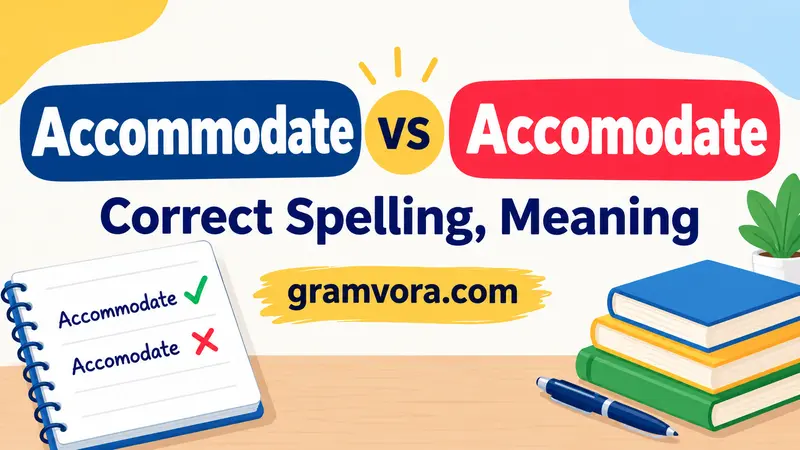
The correct spelling is accommodate. The word contains two c letters and two m letters. The spelling accomodate, with only one m, is a common misspelling. Standard American English uses accommodate in the same way as other major English varieties.
The confusion is understandable. When people pronounce a word, they do not always hear every letter that appears in its written form. In addition, double consonants can be difficult to remember, particularly when a word is long or unfamiliar. As a result, writers may remember the general sound of accommodate but leave out one of its letters.
This guide explains the correct spelling, the meaning of the word, its common uses, related word forms, and practical ways to remember it. It also provides example sentences and quick corrections to help students, professionals, and English learners use the word confidently.
Quick Answer
Accommodate is the correct spelling. Accomodate is a misspelling and should be corrected in standard writing.
| Spelling | Status | Example |
|---|---|---|
| Accommodate | Correct | The hotel can accommodate 100 guests. |
| Accomodate | Incorrect | The hotel can accomodate 100 guests. |
The easiest way to remember the correct form is to check its double letters. Accommodate has two c letters and two m letters.
Merriam-Webster specifically identifies accomodate as an incorrect spelling and explains that accommodate requires both pairs of double letters. Oxford also lists accommodate as a verb and provides examples of its standard use.
Why People Confuse Them
The main reason people confuse accommodate and accomodate is the unusual combination of repeated letters. Many English words contain a double consonant, but not every word follows an obvious pattern. Remembering two separate pairs in one word can therefore be challenging.
First, the word is relatively long. A writer may remember the beginning, middle, and ending without remembering the exact number of letters in each part. When typing quickly, it is easy to produce accomodate because the missing m does not usually change the way the writer intends to pronounce the word.
Second, pronunciation does not always provide a reliable spelling guide. In ordinary conversation, the two forms may sound indistinguishable because accomodate is generally intended as a misspelling of accommodate, not as a separate word with a different pronunciation.
Third, people often repeat the spelling they have seen before. If someone reads an incorrect form in a message, online post, or informal document, that version may become familiar. Familiarity, however, does not make a spelling standard.
Finally, the related noun can create additional confusion. The correct noun is accommodation, which also has double c and double m letters. Learning the noun and verb together can help reinforce the spelling of both.
The solution is simple: do not rely only on how the word sounds. Check the written form and remember that both pairs of consonants are necessary.
Key Differences At A Glance
Although the keyword compares two spellings, the forms do not have equal status in standard English. One is the accepted word, while the other is a misspelling.
| Feature | Accommodate | Accomodate |
|---|---|---|
| Standard spelling | Yes | No |
| Double c | Yes | Yes |
| Double m | Yes | No |
| Part of speech intended | Verb | Intended as the same verb |
| Suitable for formal writing | Yes | No |
| Recommended correction | Use as written | Change to accommodate |
The key difference is the missing m in accomodate. Adding the second m produces the correct spelling, accommodate.
The correct word has several related meanings. It can mean providing a place for someone, having enough room for people or things, adjusting to a situation, or taking someone’s needs into account. The intended meaning depends on the sentence.
For example, a hotel can accommodate guests, a meeting room can accommodate a large group, and a plan can accommodate a customer’s request. In every case, the spelling remains the same.
Are They the Same Word?
No. In standard English, accommodate is the recognized word, while accomodate is an incorrect spelling of that word. The incorrect form does not have a separate standard meaning.
When someone writes accomodate, readers will usually understand the intended word from the context. Nevertheless, the mistake can distract readers and reduce the professionalism of a document. It is especially important to correct it in academic papers, applications, reports, public articles, and workplace communication.
Consider these examples:
- Incorrect: We can accomodate your request.
- Correct: We can accommodate your request.
The meaning is clear in both sentences, but only the second uses the standard spelling.
The same rule applies to related forms. The correct noun is accommodation, not accomodation. The correct adjective is accommodating, and the past-tense form is accommodated. Each retains the double c and double m pattern.
A spelling mistake does not always prevent communication, but using the accepted form helps readers focus on the message instead of the error.
US vs UK Preference
There is no spelling difference between American and British English for this word. Both varieties use accommodate.
American writers should use accommodate in essays, emails, reports, and website content. British writers use the same spelling. This differs from words such as color and colour, where regional conventions affect the preferred form.
Examples in American English include:
- The conference center can accommodate 300 people.
- We will accommodate your schedule whenever possible.
- The new policy accommodates different learning needs.
British English uses the same spelling in comparable sentences.
It is therefore unnecessary to choose between accommodate and accomodate based on location. The second form is not an alternative British spelling. If you are writing for a US audience, use accommodate consistently.
Which Spelling Should You Use?
Always use accommodate in standard writing.
The word appears in several everyday situations, so learning its spelling is useful for students, travelers, employees, managers, and content writers.
Use it when discussing space.
A room, vehicle, building, or venue can accommodate a certain number of people or objects.
Example: The auditorium can accommodate 450 students.
Use it when discussing requests or needs.
A person or organization can accommodate a request by making an adjustment or providing assistance.
Example: The manager agreed to accommodate my request for an earlier meeting.
Use it when discussing change.
People may accommodate themselves to a new routine or situation. This use often describes adjusting behavior or expectations.
Example: New employees must accommodate themselves to the company’s schedule.
Use it when discussing plans or different requirements.
A proposal may accommodate several needs or opinions.
Example: The revised plan accommodates the needs of both departments.
In all these situations, the spelling remains accommodate. Do not remove one of the m letters to make the word appear shorter or easier to type.
When One Spelling Looks Wrong
The form accomodate may look correct at first because the missing letter is easy to overlook. However, it does not follow the standard spelling listed in major dictionaries.
A useful way to check the word is to divide it into a memorable sequence:
A + CC + O + MM + O + DATE
This is a visual memory aid rather than a formal linguistic division. It highlights the letters that writers most often forget.
Another useful method is to compare the verb with its noun form:
- accommodate
- accommodation
- accommodating
- accommodated
Notice that each form keeps the double c and double m. Once you remember the pattern in one word, you can apply it to the related forms.
The word may look unusual because it contains multiple repeated letters, but that is not a reason to simplify it. English spelling includes many words whose written forms must be learned through practice and repeated exposure.
If a spellchecker underlines accomodate, accept the correction to accommodate unless you are quoting a source and need to preserve its original error. In ordinary writing, correcting the spelling is the right choice.
Common Mistakes (and Quick Fixes)
Several mistakes occur when writers use accommodate and its related forms. The most common problem is leaving out one of the repeated consonants.
Mistake 1: Writing only one m
Incorrect: Please accomodate our request.
Correct: Please accommodate our request.
Quick fix: Remember that the word has two m letters.
Mistake 2: Writing only one c
Incorrect: The venue can acommodate 200 guests.
Correct: The venue can accommodate 200 guests.
Quick fix: Check the beginning of the word for cc.
Mistake 3: Misspelling the noun
Incorrect: The hotel provides comfortable accomodation.
Correct: The hotel provides comfortable accommodation.
Quick fix: The noun accommodation also has double c and double m.
Mistake 4: Misspelling the past tense
Incorrect: The staff accomodated our needs.
Correct: The staff accommodated our needs.
Quick fix: Start with the correct base word accommodate, then add the appropriate ending.
Mistake 5: Using the incorrect form in professional writing
Incorrect: We will do our best to accomodate your schedule.
Correct: We will do our best to accommodate your schedule.
Quick fix: Review important emails and documents before sending them. A quick spelling check can catch this error.
Mistake 6: Assuming that the incorrect form is regional
Incorrect assumption: Accomodate is the British spelling.
Correct understanding: American and British English both use accommodate.
Quick fix: Learn the accepted spelling instead of treating the missing letter as a regional variation.
Everyday Examples
The following sentences show how to use accommodate correctly in common situations.
At a hotel
- The hotel can accommodate up to 200 guests.
- We asked the receptionist to accommodate our request for a larger room.
- The staff accommodated our needs during the stay.
At school
- The teacher adjusted the activity to accommodate students with different learning needs.
- The classroom can accommodate 30 students comfortably.
- The school will accommodate the new timetable next semester.
At work
- Our team will accommodate your schedule for the meeting.
- The company changed its policy to accommodate employee requests.
- The conference room can accommodate the entire department.
In everyday conversation
- Can you accommodate one more person at dinner?
- My friend agreed to accommodate my plans.
- We need a larger table to accommodate everyone.
In planning and organization
- The revised design accommodates additional storage.
- The event organizers made changes to accommodate visitors.
- The budget must accommodate the cost of transportation.
In formal writing
- The proposal seeks to accommodate the concerns raised by residents.
- The new arrangement accommodates several competing priorities.
- The organization will accommodate reasonable requests when possible.
Every sentence uses the same correct spelling. The meaning changes with the context, but the spelling does not.
Dictionary-Style Word Details
Verb
Accommodate is a verb. It can mean to provide someone with a place to stay or sit, provide enough space for someone or something, adapt to a situation, or take a need or request into account.
Common verb forms include:
- Base form: accommodate
- Third-person singular: accommodates
- Past tense: accommodated
- Past participle: accommodated
- Present participle: accommodating
Examples:
- The bus accommodates 40 passengers.
- The hotel accommodated our group.
- The staff is accommodating the guests’ requests.
- She learned to accommodate herself to the new environment.
The word is often used with an object, such as accommodate guests, accommodate a request, or accommodate a change. It can also appear in the phrase accommodate oneself to something, meaning to adjust to a particular situation.
Noun
The main noun related to accommodate is accommodation. It can refer to a place to stay, a room or arrangement that meets a need, or an adjustment made for a person or situation.
Examples:
- We booked our accommodation before the trip.
- The school provides accommodations for students who need them.
- The company made an accommodation for the employee’s schedule.
In American English, accommodations is commonly used when referring to lodging or arrangements. The exact meaning depends on the sentence.
Remember that accommodation contains double c and double m, just like the base verb. The spelling accomodation is also incorrect in standard usage.
Synonyms
The best synonym depends on how accommodate is used.
When the word means providing space, possible alternatives include:
- house
- hold
- fit
- contain
- seat
When it means responding to a request, alternatives may include:
- assist
- oblige
- help
- meet
- satisfy
When it means adjusting to a situation, alternatives include:
- adapt
- adjust
- conform
- reconcile
These words are not interchangeable in every sentence. For instance, a building can hold a number of people, but a manager might meet a request or adapt a plan. Choose a synonym that preserves the intended meaning.
Example Sentences
Here are additional examples showing the word in different contexts:
- The guesthouse can accommodate six people.
- We changed the seating arrangement to accommodate the entire family.
- The manager tried to accommodate every reasonable request.
- The software can accommodate several users at once.
- The schedule was adjusted to accommodate the delayed flight.
- The new design accommodates a wheelchair.
- Our plans must accommodate possible weather changes.
- The school accommodated the student’s request for extra time.
- The apartment cannot accommodate another large piece of furniture.
- The team will accommodate the client whenever possible.
Notice that none of these examples uses accomodate. The correct spelling is necessary regardless of whether the word refers to people, space, requests, schedules, or plans.
Word History
The verb accommodate entered English in the sixteenth century. Oxford traces it to the Latin form accommodat-, associated with the verb accommodare. The Latin elements relate to making something fit or suitable.
That history connects with the word’s modern meanings. When you accommodate a guest, you provide a suitable place or arrangement. When you accommodate a request, you make an adjustment to meet a need. When you accommodate yourself to a new situation, you adapt to it.
Knowing the origin can make the word easier to understand, although its spelling still requires attention. The repeated consonants have been part of the word’s established form, so modern writers should preserve them.
Phrases Containing
The verb appears in several useful phrases:
Accommodate someone: Provide space, assistance, or arrangements for a person.
Example: The restaurant can accommodate a large family.
Accommodate a request: Make an adjustment to meet someone’s request.
Example: We will try to accommodate your request for a later appointment.
Accommodate a need: Make room for or respond to a particular requirement.
Example: The program was revised to accommodate students’ needs.
Accommodate changes: Adjust a plan or arrangement to account for new circumstances.
Example: The schedule must accommodate changes to the delivery date.
Accommodate oneself to something: Adjust one’s behavior or expectations to a situation.
Example: She had to accommodate herself to a new working environment.
Each phrase uses the same base spelling: accommodate.
FAQs
Which spelling is correct: Accommodate or Accomodate?
Accommodate is the correct spelling in standard English. Accomodate is a common misspelling that leaves out one m. Always use accommodate in essays, emails, articles, and professional documents.
How do you spell Accommodate correctly?
The correct spelling is accommodate. It contains two c letters and two m letters. Remembering both pairs can help you avoid this common spelling mistake.
Is Accomodate a real word?
Accomodate is not an accepted standard spelling. It is usually a misspelling of accommodate. Although readers may understand what you mean, you should correct it in formal and everyday writing.
Is Accommodate spelled the same way in American and British English?
Yes. Both American and British English use accommodate. The spelling accomodate is not a recognized British alternative.
What does Accommodate mean?
Accommodate is a verb meaning to provide space or lodging, meet someone’s needs, respond to a request, or adjust to a situation. For example, “The hotel can accommodate 100 guests.”
Why do people misspell Accommodate as Accomodate?
People often forget the second m because the word contains several repeated letters. Pronunciation may not make the double letters obvious, so remembering the spelling pattern is helpful.
What is the noun form of Accommodate?
The related noun is accommodation. It can refer to a place to stay or an arrangement made to meet a need. Like accommodate, it contains two c letters and two m letters.
What is the past tense of Accommodate?
The past tense is accommodated. For example: “The staff accommodated our request for an earlier check-in.” The word retains the double c and double m.
What is the difference between Accommodate and Accommodation?
Accommodate is a verb that describes providing space, meeting a need, or adjusting to a situation. Accommodation is a noun that can describe lodging or an arrangement made to meet a requirement.
What is an easy way to remember the spelling of Accommodate?
Remember this rule: Accommodate has two c’s and two m’s. Check both pairs whenever you write the word. The same spelling pattern appears in accommodated, accommodating, and accommodation.
Conclusion
The correct spelling is accommodate, not accomodate. Both American and British English use the same standard form, and the incorrect version is not an accepted regional alternative.
The most important spelling rule is easy to remember: accommodate has two c’s and two m’s. The same pattern appears in related forms such as accommodated, accommodating, and accommodation.
The word can describe providing space, helping with a request, making an adjustment, or adapting to a new situation. Its meaning depends on the context, but its spelling remains consistent.
When writing an email, school assignment, report, or article, take a moment to check the repeated letters. Remembering the double c and double m will help you avoid a common error and use the word confidently.