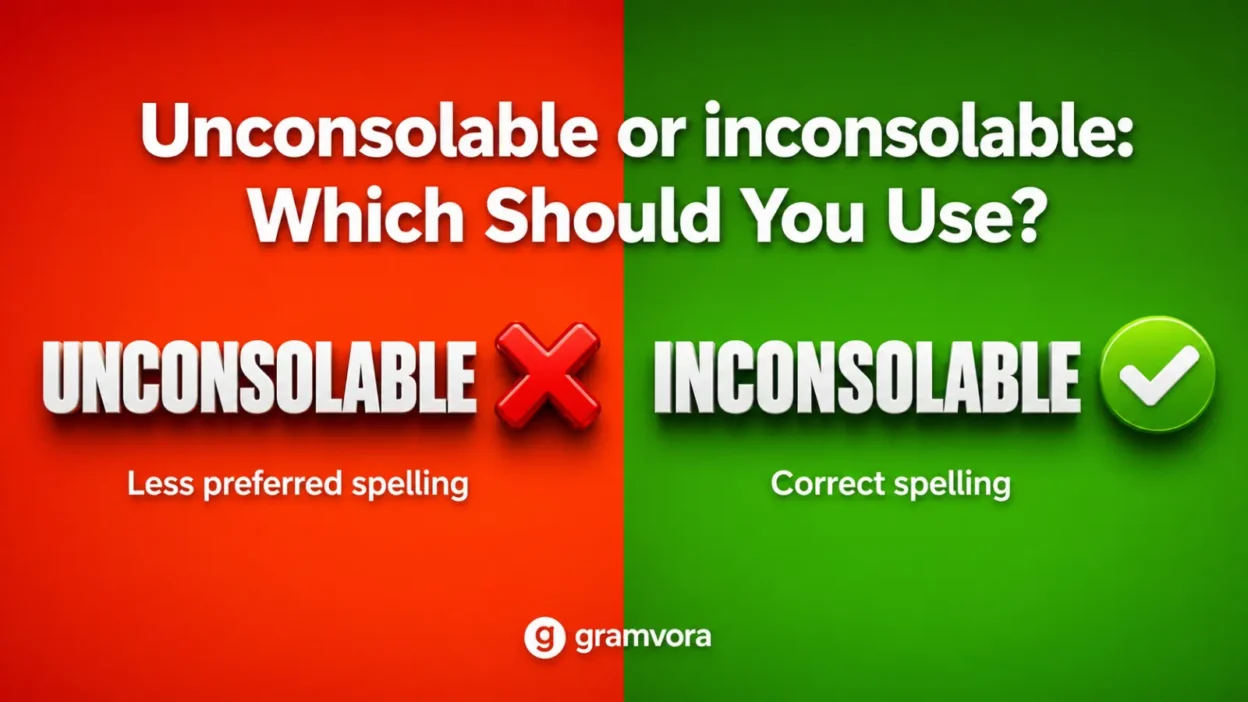
Use inconsolable in standard US English.
unconsolable exists, and many readers will understand it, but it is rare. In most writing, it will look unusual or like a mistake. inconsolable is the natural, expected word when you mean someone is so upset, sad, or grief-stricken that they cannot be comforted.
So the best answer is simple: write inconsolable.
Quick Answer
inconsolable is the correct choice for normal writing.
Use it when a person is beyond comfort:
“She was inconsolable after her dog died.”
Avoid unconsolable in school papers, work messages, published writing, and formal sentences. It has the same basic idea, but it is not the form most US readers expect.
The difference is not a deep meaning difference. It is mainly a usage difference:
- unconsolable: rare and usually best avoided
- inconsolable: standard, common, and preferred
Why People Confuse Them
The confusion makes sense.
English often uses un- to mean “not,” as in unhappy, unable, and unfair. So unconsolable looks logical. It seems like it should mean “not able to be consoled.”
But English does not always follow the most obvious pattern. The established word is inconsolable. It also means “not able to be consoled,” but it is the form that sounds normal to most readers.
That is why unconsolable can feel right when you type it, while inconsolable is the word you should usually keep.
Key Differences At A Glance
| Context | Best Choice | Why |
|---|---|---|
| School essay | inconsolable | It is the standard form. |
| Work email | inconsolable | It sounds polished and natural. |
| News-style writing | inconsolable | Readers expect this form. |
| Fiction or memoir | inconsolable | It carries strong emotion clearly. |
| Casual text | inconsolable | It still looks more natural. |
| Discussing the word itself | unconsolable | Use it only when naming or explaining the rare form. |
| Quoting someone’s wording | unconsolable | Keep the original wording if accuracy matters. |
Meaning and Usage Difference
Both words point to the same basic meaning: unable to be comforted.
The practical difference is usage.
inconsolable is the standard adjective. It describes a person, mood, cry, grief, or reaction that comfort does not seem to reach.
Examples:
“She was inconsolable after the funeral.”
“The toddler was inconsolable when his blanket went missing.”
unconsolable means nearly the same thing, but it is rare. Because it is not the expected form, it may distract readers. Some may think it is simply a misspelling of inconsolable.
Pronunciation is not a major issue here. The more useful point is recognition: readers are much more likely to recognize inconsolable right away.
Tone, Context, and Formality
inconsolable works in serious, emotional, formal, and everyday writing.
unconsolable can sound awkward in the same places. Even if the meaning is clear, the word may pull attention away from the sentence.
Compact comparison:
- unconsolable: understandable, rare, distracting in most polished writing
- inconsolable: standard, natural, emotionally strong, widely accepted
Which One Should You Use?
Use inconsolable almost every time.
Choose it for:
School writing:
“The character becomes inconsolable after the loss.”
Work or professional writing:
“The family was inconsolable after hearing the news.”
Personal writing:
“My sister was inconsolable after her cat died.”
Creative writing:
“He sat on the porch, inconsolable, long after everyone had gone inside.”
Use unconsolable only when you are talking about the word itself or preserving someone’s exact wording.
For example:
“Some people write unconsolable, but inconsolable is the better choice.”
When One Choice Sounds Wrong
unconsolable often sounds wrong because readers expect inconsolable.
This sentence may be understood, but it looks odd:
“She was unconsolable after the accident.”
This version is smoother:
“She was inconsolable after the accident.”
The first sentence may make readers pause and wonder whether the word was typed by mistake. The second sentence lets the emotion carry the sentence without distraction.
That is the main reason to avoid unconsolable. It does not help the sentence. It usually gets in the way.
Common Mistakes (and Quick Fixes)
Mistake: “He was unconsolable after the breakup.”
Fix: “He was inconsolable after the breakup.”
Mistake: “The baby was unconsoleable.”
Fix: “The baby was inconsolable.”
Mistake: “She felt inconsolably after the loss.”
Fix: “She felt inconsolable after the loss.”
Mistake: “He cried in an inconsolable way for hours.”
Better: “He cried inconsolably for hours.”
Use inconsolable for the adjective. Use inconsolably for the adverb.
Everyday Examples
“The little girl was inconsolable when her balloon floated away.”
“After the final whistle, some fans were angry, but others were inconsolable.”
“He was inconsolable after losing his wedding ring at the beach.”
“My neighbor’s son was inconsolable when their old dog died.”
“She tried to comfort him, but he remained inconsolable.”
“The family looked exhausted and inconsolable outside the hospital.”
“You do not need a huge tragedy to use the word, but the feeling should be intense. If someone is just disappointed, annoyed, or mildly sad, inconsolable is probably too strong.”
Dictionary-Style Word Details
Verb
unconsolable: Not commonly used as a verb in standard US English. It is mainly an adjective.
inconsolable: Not used as a verb. It is an adjective.
Use the verb console when you mean “to comfort someone.”
Example: “Her friends tried to console her.”
Noun
unconsolable: Not commonly used as a noun in standard US English.
inconsolable: Not normally used as a noun. It is an adjective.
Related noun forms include consolation and comfort, depending on the sentence.
Example: “No words of comfort helped.”
Synonyms
unconsolable: Closest plain alternatives: heartbroken, devastated, grief-stricken, distraught. Because unconsolable is rare, inconsolable is usually the better direct replacement.
inconsolable: Close synonyms include heartbroken, devastated, grief-stricken, distraught, and disconsolate.
Useful antonyms include comforted, consoled, calm, and reassured. These work best when the sentence is truly about comfort after sadness or distress.
Example Sentences
unconsolable: “The word unconsolable appears sometimes, but many readers expect inconsolable.”
unconsolable: “In edited writing, unconsolable may look like an error.”
“She was inconsolable after the loss of her father.”
“The child became inconsolable when he could not find his mom.”
“After trying to stay strong all day, he was inconsolable by nightfall.”
Word History
unconsolable: The word is listed in major references, so it should not be treated as imaginary. Still, it is rare in modern use. Its history is not needed for most writers choosing between the two forms.
inconsolable: This is the established form in modern standard English. It comes from the idea of being unable to be consoled. For today’s reader, the important point is not its origin but its accepted use.
Phrases Containing
unconsolable: There are no common fixed phrases with unconsolable in standard US English.
“inconsolable grief”
“inconsolable after the loss”
“an inconsolable child”
“inconsolable crying”
“remained inconsolable”
These phrases work because inconsolable often describes deep grief, intense distress, or crying that comfort does not stop.
FAQs
What is the correct word: unconsolable or inconsolable?
The correct and standard word is inconsolable. It means someone is unable to be comforted or calmed because of deep sadness, grief, or distress. Unconsolable is rare and generally considered nonstandard in modern English.
Does unconsolable mean the same as inconsolable?
Although some people use unconsolable to mean the same thing as inconsolable, it is not the preferred choice. In everyday and formal writing, inconsolable is the accepted and widely recognized term.
How do you use inconsolable in a sentence?
You can use inconsolable to describe someone experiencing overwhelming sadness or emotional pain. For example:
- “She was inconsolable after hearing the tragic news.”
- “The child became inconsolable after losing his favorite toy.”
Why is inconsolable spelled with “in” instead of “un”?
The prefix in- often means “not” or “without.” In inconsolable, it means “not able to be consoled.” English developed this word from Latin roots, which is why in- is used instead of un-.
Can I use unconsolable in formal writing?
It is better to avoid unconsolable in formal writing because many readers and editors may consider it incorrect or unusual. Choose inconsolable for essays, articles, professional writing, and academic contexts.
What are synonyms for inconsolable?
Common synonyms include heartbroken, devastated, grief-stricken, overwhelmed, crushed, and unable to be comforted. The best synonym depends on the level and type of emotion being described.
Conclusion
Use inconsolable.
unconsolable may be understood, but it is rare and can look wrong to many US readers. inconsolable is the standard adjective for someone who cannot be comforted.