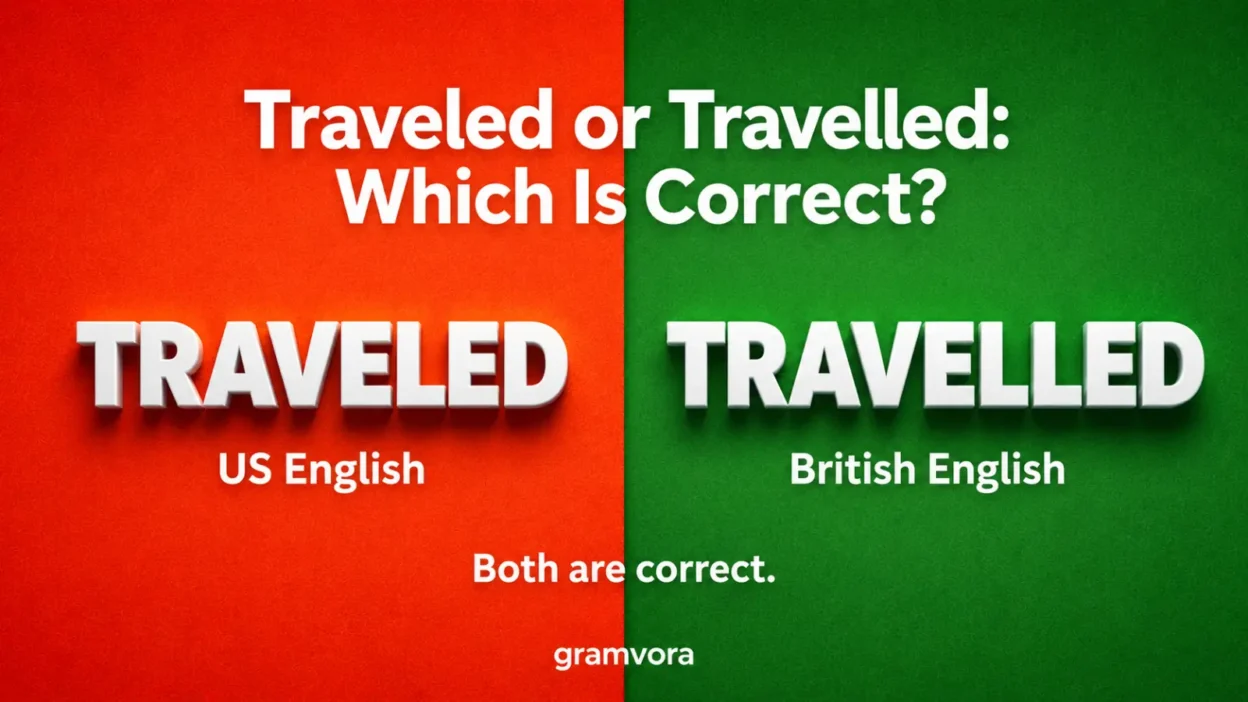
Both traveled and travelled are correct spellings. For a US audience, traveled is the better choice.
The difference is not meaning. It is not tense. It is not formality. The real difference is regional spelling.
In American English, write traveled with one “l.” In British English and many other non-US styles, travelled with two “l”s is common.
Quick Answer
Use traveled in US English.
Use travelled when writing for readers who expect British spelling.
Examples:
• US: We traveled to Chicago for the conference.
• British style: We travelled to London for the conference.
Both mean “went from one place to another.” Both can also work as adjectives, as in well-traveled or well-travelled.
Why People Confuse Them
People confuse traveled and travelled because both spellings appear in edited English.
They also sound the same. The extra “l” in travelled does not change pronunciation.
The confusion grows because the base word travel ends in “l.” When English adds endings like -ed or -ing, some styles double the final “l,” while American English usually does not in this word.
That is why US readers expect:
• traveled
• traveling
• traveler
British-style writing often uses:
• travelled
• travelling
• traveller
Key Differences At A Glance
| Context | Best Choice | Why |
|---|---|---|
| US school paper | traveled | Standard American spelling |
| US business email | traveled | Natural for American readers |
| US news or web copy | traveled | Matches US editorial style |
| British publication | travelled | Matches British spelling |
| International document with British style | travelled | Keeps the spelling consistent |
| Same document after choosing US style | traveled | Avoids mixing spellings |
The safest US choice is traveled.
Meaning and Usage Difference
Traveled and travelled mean the same thing.
They are usually the past tense and past participle forms of the verb travel.
Examples:
• We traveled by train.
• She has traveled across the country.
• They travelled by train.
• She has travelled across the country.
They can also be adjectives.
Examples:
• a heavily traveled highway
• a well-traveled consultant
• a heavily travelled road
• a well-travelled writer
For US writing, keep the one-“l” form: traveled.
Tone, Context, and Formality
Neither spelling is more formal by meaning.
The “right” choice depends on the English style your reader expects.
In the United States, travelled may look unusual or foreign to many readers. It is not wrong in a global sense, but it can look mismatched in a US resume, school essay, article, or company email.
In British-style writing, traveled may look too American.
Compact comparison:
• traveled: American spelling; best for US readers
• travelled: British-style spelling; best for British-style documents
• Same meaning: yes
• Same pronunciation: yes
• Same grammar role: usually yes
• Main issue: consistency
Which One Should You Use?
Choose traveled if you write in American English.
That includes most US:
• emails
• resumes
• essays
• reports
• articles
• marketing copy
• travel writing
Choose travelled only when your document follows British spelling or your audience expects that style.
The key is consistency. Do not write traveled in one sentence and travelled in the next unless you are quoting someone or preserving a title.
When One Choice Sounds Wrong
For US readers, travelled can look out of place.
Awkward in US style:
• I travelled to Denver last week.
Better for US style:
• I traveled to Denver last week.
For British-style readers, the reverse may happen.
Natural in British style:
• I travelled to Manchester last spring.
The word choice does not change the event. It changes the spelling style.
Common Mistakes (and Quick Fixes)
Mistake 1: Treating travelled as wrong everywhere.
Fix: It is correct in British-style English.
Mistake 2: Treating traveled as casual.
Fix: It is standard in US English, including formal writing.
Mistake 3: Mixing both in one document.
Fix: Pick one style and stay with it.
Mistake 4: Thinking pronunciation changes.
Fix: Both are pronounced the same: “TRAV-uld.”
Mistake 5: Using travelled in a US resume.
Fix: Use traveled unless the employer or document style calls for British spelling.
Everyday Examples
US English:
• I traveled to Austin for a wedding.
• The team traveled together after the game.
• She has traveled for work since January.
• That is a heavily traveled stretch of highway.
• He is a well-traveled photographer.
British-style English:
• I travelled to Edinburgh for a wedding.
• The team travelled together after the match.
• She has travelled for work since January.
• That is a heavily travelled road.
• He is a well-travelled photographer.
In US writing, the first set is the one to follow.
Dictionary-Style Word Details
Verb
• traveled: The American English past tense and past participle of travel.
Example: We traveled through Arizona last summer.
• travelled: The British-style past tense and past participle of travel.
Example: They travelled through Wales last summer.
Both forms describe the same action.
Noun
• traveled: Not commonly used as a noun in standard US English. It is mainly a verb form or adjective.
• travelled: Not commonly used as a noun in standard English. It is mainly a verb form or adjective.
The noun is travel, as in “Travel can be tiring.”
Synonyms
For the verb meaning, closest plain alternatives include:
• traveled: went, journeyed, toured, crossed, visited
• travelled: went, journeyed, toured, crossed, visited
These are not always exact swaps. For example, visited needs a place or person, and crossed usually suggests moving across an area or border.
Clear antonyms are limited. In some sentences, stayed, remained, or settled may work as opposites, but they are not direct opposites in every context.
Example Sentences
• traveled: We traveled to Seattle for a client meeting.
• traveled: The package traveled through three states before delivery.
• traveled: She is a well-traveled nurse who has worked in several cities.
• travelled: We travelled to York for a family event.
• travelled: The news travelled quickly through the village.
• travelled: He is a well-travelled writer with readers abroad.
Word History
• traveled: This spelling reflects the American preference for one “l” in this form of travel.
• travelled: This spelling reflects the British-style preference for doubling the final “l” in this form.
The broader history of English spelling is complex, so the useful point for modern writers is simple: US style uses traveled; British-style writing commonly uses travelled.
Phrases Containing
• traveled: well-traveled, heavily traveled, widely traveled, less traveled, traveled road
• travelled: well-travelled, heavily travelled, widely travelled, less travelled, travelled road
For US readers, write the road less traveled, well-traveled, and heavily traveled.
FAQs
1. Is it traveled or travelled?
Both traveled and travelled are correct spellings, but they are used in different varieties of English. Traveled is the standard spelling in American English, while travelled is standard in British English.
2. Which is correct in American English: traveled or travelled?
Traveled is the preferred spelling in American English.
Example:
I traveled to California last summer.
3. Which is correct in British English?
Travelled is the standard British English spelling.
Example:
She travelled across Europe last year.
4. What is the difference between traveled and travelled?
There is no difference in meaning. Both are the past tense and past participle of travel. The difference is mainly regional spelling.
- American English: traveled
- British English: travelled
5. Is travelled wrong in American English?
Not necessarily, but travelled is not the usual American spelling. For US audiences, traveled is the more appropriate choice.
6. Is traveled wrong in British English?
No, but traveled is generally associated with American spelling. In standard British English, travelled is preferred.
7. Why does American English use traveled with one “l”?
American English generally uses one l when adding endings to words such as travel in forms like traveled and traveling.
British English traditionally doubles the final l:
- travel → travelled
- travel → travelling
8. Should I write traveling or travelling?
The same regional difference applies:
- traveling = American English
- travelling = British English
Example:
I am traveling to New York.
I am travelling to London.
9. Is traveled the preferred spelling for a US website?
Yes. If your website is written primarily for an American audience, use traveled for consistency with standard US English.
Conclusion
For American English, choose traveled.
Travelled is also correct, but it belongs mainly in British-style writing. The two words have the same meaning, the same pronunciation, and the same basic grammar role.