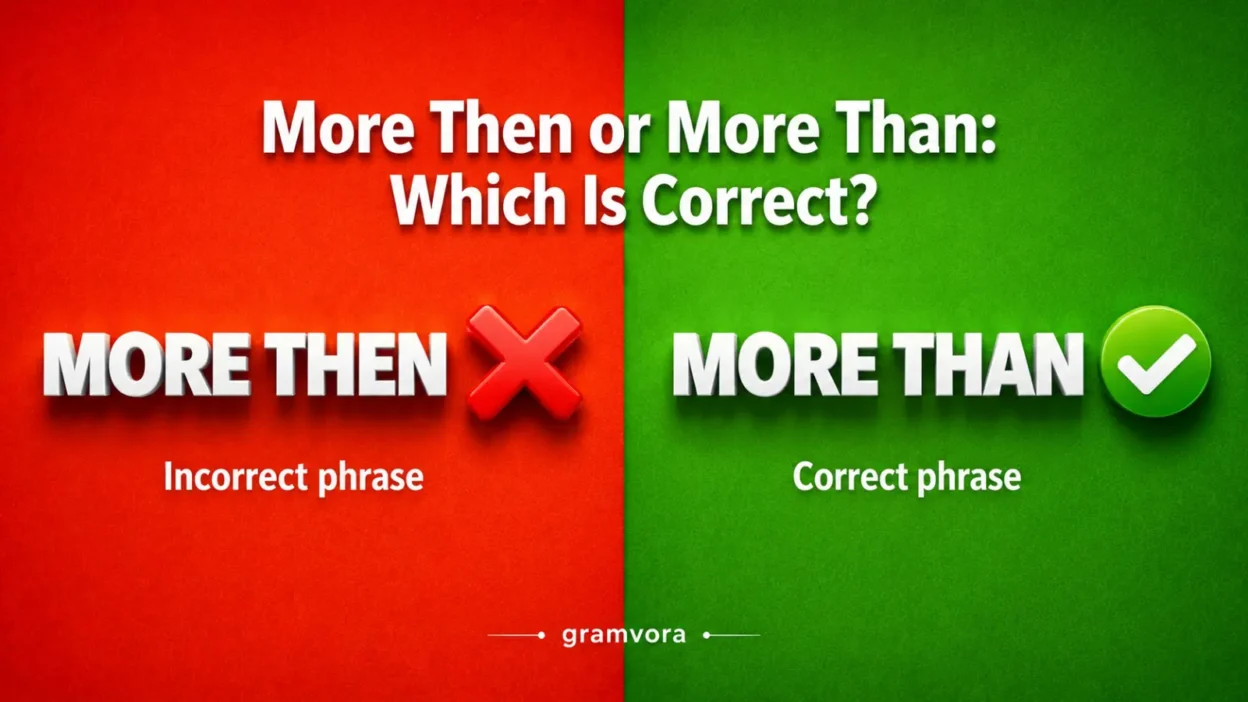
The correct choice is more than when you are making a comparison.
Use more than for amounts, numbers, degree, preference, and comparison. Use more then only when the words happen to sit next to each other and then means “at that time” or “next.” That is much less common.
Most of the time, if you are asking “more then or more than,” you want more than.
Quick Answer
Use more than when you mean “greater than,” “over,” “beyond,” or “to a higher degree.”
Correct: I waited more than 20 minutes.
Correct: This costs more than I expected.
Correct: She is more than ready.
Do not use more then for comparison.
Incorrect: I waited more then 20 minutes.
Incorrect: This costs more then I expected.
More then can work only when then keeps its time meaning.
Correct but uncommon: We needed more then than we need now.
That sentence means “we needed more at that time than we need now.” It is grammatical, but it is not the normal phrase people mean.
Why People Confuse Them
Than and then look almost the same. They also sound very close in fast speech.
The mistake often happens because more creates a comparison. The next word should usually be than, but many people type then by habit.
A simple reminder helps:
Than compares.
Then tells when or what comes next.
So when more compares one amount, person, thing, or idea with another, choose more than.
Key Differences At A Glance
| Context | Best Choice | Why |
|---|---|---|
| Numbers | more than | It compares an amount with a number. |
| Cost or value | more than | It means the amount is greater. |
| Feelings or degree | more than | It means “very” or “beyond.” |
| Preference | more than | It compares one choice with another. |
| Time sequence | more then | Only if “then” means “at that time” or “next.” |
| Everyday comparison | more than | This is the standard phrase. |
Compact comparison:
• More than = comparison, amount, degree, or “beyond.”
• More then = not the comparison phrase; only possible when then keeps a time or sequence meaning.
Meaning and Usage Difference
More than is the standard phrase for comparison.
It can compare numbers:
We have more than 50 volunteers.
It can compare degree:
That movie was more than a little intense.
It can show that something goes beyond a basic label:
She is more than a manager; she is a mentor.
More then is not a standard comparison phrase. In normal comparison sentences, it is a mistake.
Still, more and then can appear side by side when they are doing separate jobs.
Example: I wanted more then, but I do not want more now.
Here, more means “a larger amount,” and then means “at that time.” The phrase is not acting like more than.
Pronunciation does not need much attention here. The real problem is spelling and meaning, not a major sound difference.
Tone, Context, and Formality
More than works in casual, school, business, and formal writing.
You can use it in a text:
I need more than five minutes.
You can use it in an email:
The update took more than expected.
You can use it in a report:
Sales increased by more than 12 percent.
More then looks wrong in most polished writing when it is meant as a comparison. It can make a sentence look rushed or unedited.
The only safe use is a sentence where then clearly means “at that time” or “next.” Even then, the wording may sound awkward, so many writers rewrite it.
Awkward: We spent more then than we do today.
Clearer: We spent more at that time than we do today.
Which One Should You Use?
Use more than in nearly every normal comparison.
Choose more than when you are talking about:
amounts: more than $100
numbers: more than 30 people
time length: more than an hour
degree: more than ready
emotion: more than happy
comparison: more than I thought
Use more then only when your sentence has a time idea.
Example: I had more then, before rent went up.
That means the speaker had more at that earlier time. It does not mean “greater than.”
For clear writing, you can often replace then with at that time. If the sentence still makes sense, then may be right.
When One Choice Sounds Wrong
More then sounds wrong when a comparison follows it.
Wrong: There were more then 200 people at the event.
Right: There were more than 200 people at the event.
Wrong: I like this plan more then the old one.
Right: I like this plan more than the old one.
Wrong: She is more then qualified.
Right: She is more than qualified.
More than sounds wrong if you mean “more at that time.”
Wrong: I wanted more than, but now I am fine.
Right: I wanted more then, but now I am fine.
Clearer: I wanted more at that time, but now I am fine.
Common Mistakes (and Quick Fixes)
Mistake: Using more then before a number.
Fix: Use more than.
Incorrect: The meeting lasted more then two hours.
Correct: The meeting lasted more than two hours.
Mistake: Using more then before a noun phrase.
Fix: Use more than.
Incorrect: He is more then a coworker.
Correct: He is more than a coworker.
Mistake: Using more then before an adjective.
Fix: Use more than.
Incorrect: I am more then grateful.
Correct: I am more than grateful.
Mistake: Thinking more then is just an informal version.
Fix: It is not the informal comparison form. More than is correct in both casual and formal writing.
Everyday Examples
I need more than coffee to get through this morning.
The repair cost more than the car is worth.
She has more than enough experience for the job.
We waited more than an hour for the table.
That answer was more than fair.
I like the blue jacket more than the black one.
He was more than happy to help.
They collected more than 500 cans for the food drive.
Possible but less common:
I had more then than I have now.
Clearer:
I had more at that time than I have now.
Dictionary-Style Word Details
Verb
• more then: Not commonly used as a verb phrase in standard US English. More is not acting as a verb here, and then is not a verb.
• more than: Not commonly used as a verb phrase in standard US English. It is a comparison phrase, not an action word.
Noun
• more then: Not commonly used as a noun phrase. In rare wording, then can point to a time, but more then is not a normal noun phrase.
• more than: Not commonly used as a noun phrase. It usually works inside a comparison or degree expression.
Synonyms
• more then: No true synonym as a comparison phrase because it is not the correct comparison form. When then means time, the closest plain alternative is more at that time.
• more than: Closest plain alternatives include over, greater than, above, beyond, and in excess of. These do not fit every sentence, so choose by context.
Helpful opposite for more than in amount comparisons: less than.
Example Sentences
• more then: I had more then than I do now.
• more then: She wanted more then, before she understood the cost.
• more than: The class had more than 25 students.
• more than: I respect her more than anyone else on the team.
• more than: We are more than ready to begin.
• more than: The delay was more than a minor problem.
Word History
• more then: This is not a separate established comparison phrase with its own word history. It is usually a mix-up of than and then, unless then is being used in its time sense.
• more than: This phrase combines more, a word used for a greater amount or degree, with than, the comparison word. The basic parts are long-established in English, but no special origin story is needed to use the phrase correctly.
Phrases Containing
• more then: No common standard phrases use more then as the comparison form. Possible wording depends on a sentence where then means “at that time,” such as more then than now, though that often sounds awkward.
• more than: Common phrases include more than enough, more than likely, more than happy, more than once, more than ever, and more than expected.
Conclusion
For comparisons, the correct phrase is more than.
Use more than when you mean a greater amount, a higher degree, or a stronger comparison.