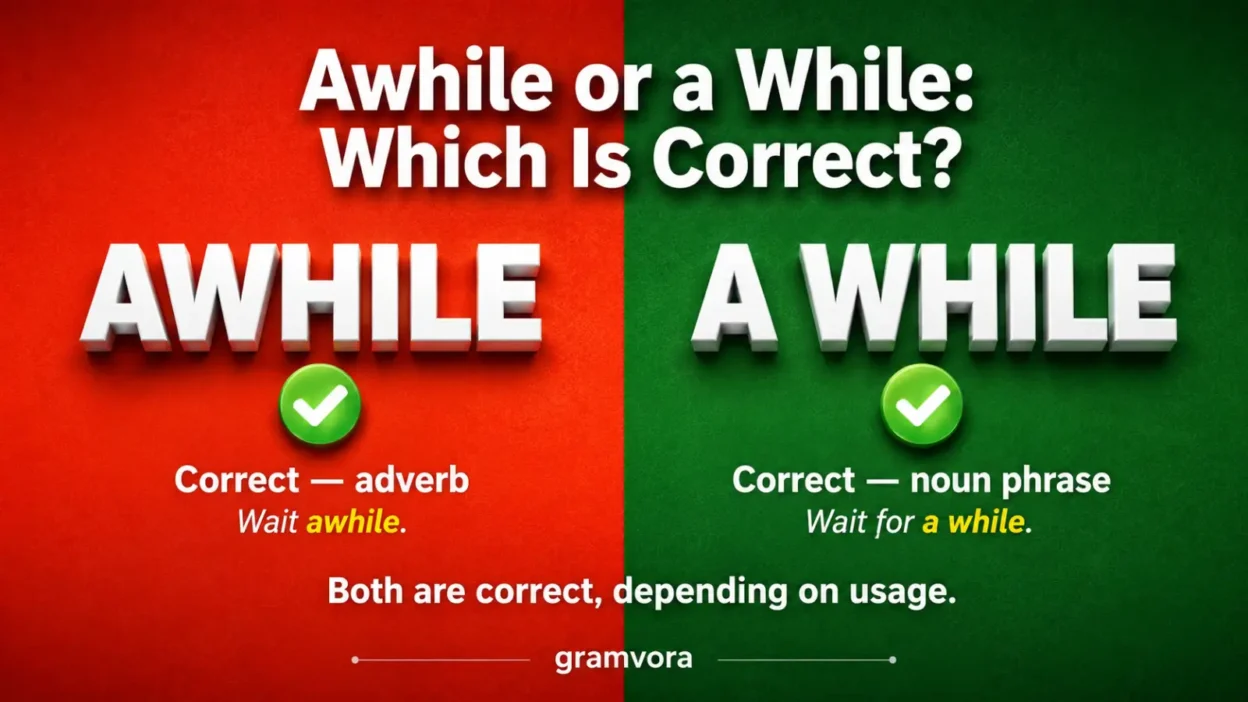
Both awhile and a while are correct, but they do not work the same way.
The choice depends on grammar, not just spelling. Awhile is one word and usually works as an adverb. A while is two words and works as a noun phrase.
That small space changes how the expression fits in a sentence.
Quick Answer
Use awhile when you mean for a short time and the word modifies an action.
Example:
Stay awhile after the meeting.
Use a while when you mean a period of time, especially after words like for, in, after, or with phrases like a while ago.
Example:
Stay for a while after the meeting.
The safest quick check is this: if you already have for, use a while.
Why People Confuse Them
People confuse awhile and a while because they sound the same.
Both are usually pronounced like uh-WILE. In speech, no one hears the space. The difference only shows up in writing.
They also have close meanings. Both point to time. That makes the choice feel like a spelling issue, but it is really a grammar issue.
Key Differences At A Glance
| Context | Best Choice | Why |
|---|---|---|
| After a verb with no preposition | awhile | It means “for a short time.” |
| After “for” | a while | A noun phrase can follow a preposition. |
| After “in” | a while | It refers to a period before something happens. |
| With “ago” | a while | “Ago” needs the noun phrase. |
| With “back” | a while | “A while back” means some time ago. |
| After “take” | a while | You take a period of time. |
| In very formal writing | a while is often safer | It fits more sentence patterns. |
Compact comparison:
- awhile = one-word adverb
- a while = two-word noun phrase
- awhile can often be replaced by for a while
- a while can often be replaced by a short time or an hour
- for awhile is usually avoided in careful writing
- for a while is the standard choice
Meaning and Usage Difference
Awhile means for a short time or for a period of time. It usually tells how long an action continues.
Examples:
Please wait awhile.
We talked awhile before dinner.
In both sentences, awhile modifies the action: wait, talked.
A while means a period of time. It often appears after a preposition.
Examples:
Please wait for a while.
We talked for a while before dinner.
Here, a while is the thing being referred to: a stretch of time.
A helpful test is to replace the phrase with a specific time expression.
I’ll be back in a while.
I’ll be back in ten minutes.
That works, so a while fits.
Tone, Context, and Formality
There is no major tone difference between awhile and a while by itself. Both are normal in American English.
The difference is mostly structure.
Still, a while is often the safer choice in formal writing because it works in more places. It is correct after prepositions, with ago, with back, and in phrases like once in a while.
Awhile is fine when it clearly modifies a verb.
Examples:
The kids played awhile before lunch.
She rested awhile after work.
These sound natural, not old-fashioned or overly formal.
Which One Should You Use?
Use awhile when the sentence would still make sense with for a while inserted in the same place.
Correct:
Sit awhile.
Meaning: Sit for a while.
Correct:
Read awhile before bed.
Meaning: Read for a while before bed.
Use a while after a preposition.
Correct:
Sit for a while.
I’ll call you in a while.
After a while, the room got quiet.
Use a while with ago and back.
Correct:
We met a while ago.
I changed jobs a while back.
Use a while after verbs like take, spend, and last when you mean a period of time.
Correct:
The repair took a while.
She spent a while reading the report.
The outage lasted a while.
When One Choice Sounds Wrong
For awhile sounds wrong in careful writing because awhile already carries the idea of for.
Avoid:
We waited for awhile.
Use:
We waited for a while.
Or:
We waited awhile.
In awhile is also usually wrong when you mean something will happen after some time.
Avoid:
I’ll be there in awhile.
Use:
I’ll be there in a while.
The phrase a while ago is correct. Awhile ago is not the standard choice because awhile needs to modify an action.
Avoid:
I saw her awhile ago.
Use:
I saw her a while ago.
Common Mistakes (and Quick Fixes)
Mistake: I haven’t seen him in awhile.
Fix: I haven’t seen him in a while.
Mistake: Let’s talk for awhile.
Fix: Let’s talk for a while.
Mistake: Awhile back, we lived in Denver.
Fix: A while back, we lived in Denver.
Mistake: The update took awhile.
Better in careful writing: The update took a while.
Mistake: Stay for awhile after class.
Fix: Stay for a while after class.
Also correct: Stay awhile after class.
Everyday Examples
Awhile examples:
Can you wait awhile while I grab my keys?
The dog slept awhile on the porch.
Stay awhile and have some coffee.
She paused awhile before answering.
We walked awhile before turning back.
A while examples:
I’ll be offline for a while.
It’s been a while since we ordered pizza.
The flight was delayed for a while.
I’ll text you in a while.
A while later, everyone started laughing.
Both can appear in similar ideas:
We rested awhile.
We rested for a while.
Both sentences are correct. The first uses an adverb. The second uses a noun phrase after for.
Dictionary-Style Word Details
Verb
awhile: Not commonly used as a verb in standard US English. It is used as an adverb.
a while: Not a verb. It is a noun phrase made from a plus while.
Noun
awhile: Not used as a noun in standard US English.
a while: A noun phrase meaning a period of time. It can appear after prepositions or in time expressions.
Examples:
for a while
in a while
a while ago
Synonyms
awhile: Closest plain alternatives include briefly, for a short time, and for a little while. These are not always exact matches, so choose based on the sentence.
a while: Closest plain alternatives include a short time, some time, a period of time, and a little while.
Clear antonyms do not fit every use. In some sentences, permanently may contrast with awhile, but it is not a direct opposite in all contexts.
Example Sentences
awhile:
Let’s sit awhile before we head home.
He stared awhile at the old photo.
The baby cried awhile, then fell asleep.
a while:
The line took a while to move.
I’ll be ready in a while.
We haven’t visited them in a while.
Word History
awhile: The word is tied to the older time word while, but the useful modern point is grammatical: awhile works as an adverb.
a while: This is the article a plus the noun while. In modern use, it means a period of time.
Exact first-use details are not needed to choose correctly, and this comparison should not depend on unsupported date claims.
Phrases Containing
awhile:
stay awhile
wait awhile
rest awhile
linger awhile
read awhile
a while:
for a while
in a while
after a while
a while ago
a while back
once in a while
quite a while
Conclusion
The difference between awhile and a while is simple once you look at the sentence structure.
Use awhile when it means for a short time and modifies an action.
Use a while when you mean a period of time, especially after for, in, or after, or in phrases like a while ago, a while back, and once in a while.