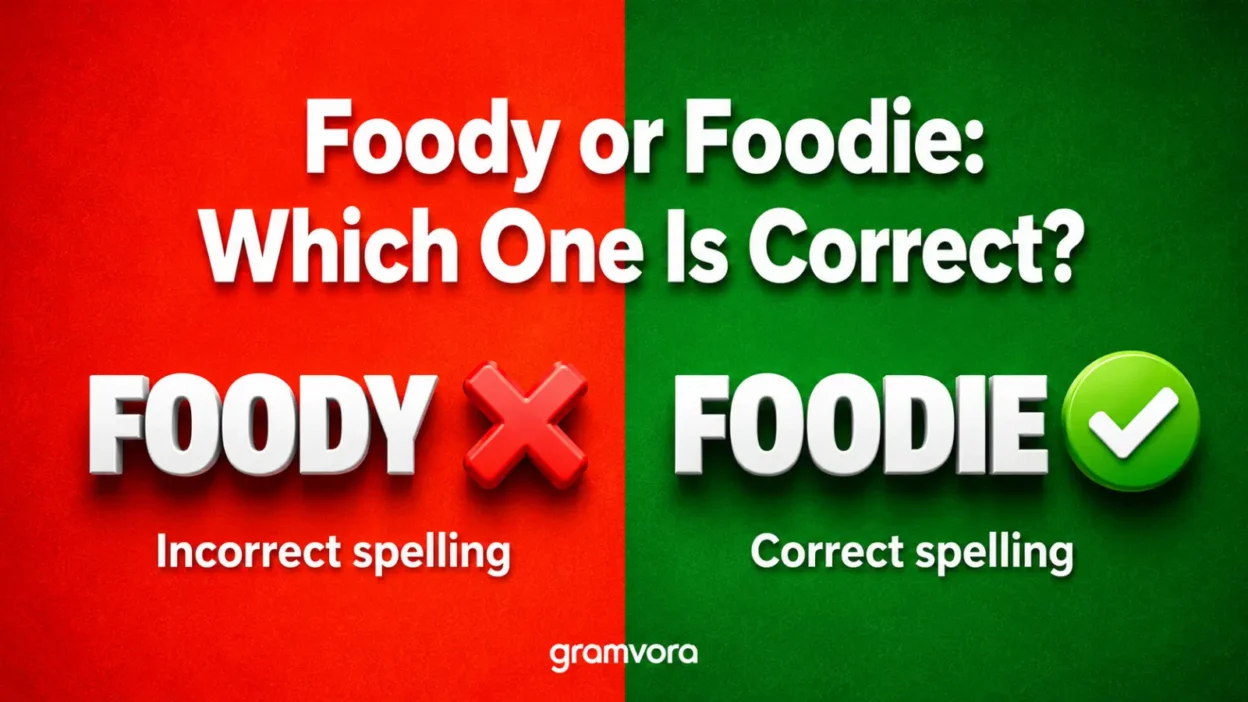
If you are choosing between foody or foodie, use foodie in almost every normal US-English sentence.
A foodie is a person who loves food, enjoys trying dishes, talks about restaurants, or cares about cooking and flavors.
Foody does appear in some dictionaries and in some informal writing, but it is not the safest spelling for a person who loves food. In polished writing, school writing, work writing, restaurant content, and everyday US use, foodie is the better choice.
Quick Answer
Foodie is the word most readers expect.
Use foodie when you mean “a person who is very interested in food.”
Example:
Maya is a foodie who plans every trip around local restaurants.
Use foody only if you are copying a name, quoting someone, or using it in a rare adjective sense. For most readers, “foody” looks like a misspelling of “foodie.”
Why People Confuse Them
People confuse foody and foodie because they sound the same: FOO-dee.
The ending sound can be spelled more than one way in English. Words like sleepy, messy, and spicy end in -y, so foody may look possible. But the accepted noun for a food lover is usually spelled with -ie: foodie.
The confusion is also easy because foody is not completely impossible. It can appear as an informal alternate form, and it can also appear as a rare adjective related to food. Still, that does not make it the best choice when you mean “food lover.”
Key Differences At A Glance
| Context | Best Choice | Why |
|---|---|---|
| A person who loves food | foodie | This is the standard and expected noun. |
| A restaurant fan | foodie | Readers understand it right away. |
| A social media bio | foodie | It sounds natural and familiar. |
| A formal article or school essay | foodie | It looks cleaner and more accepted. |
| A brand name or playful spelling | foody | Use it only when that exact spelling is intended. |
| A rare adjective meaning food-related | foody | Possible, but uncommon in modern US writing. |
Meaning and Usage Difference
The real difference is simple: foodie is the normal word for a person, while foody is rare and less standard.
Compact comparison:
- foody: rare, informal, or used as a nonstandard spelling; sometimes an adjective.
- foodie: common noun for a person who loves food; also sometimes used before another noun, as in “foodie trip.”
A foodie might try a new taco place, read restaurant menus for fun, cook special meals at home, or plan a weekend around a farmers market.
A foody might mean the same thing in some informal places, but many US readers will pause because the spelling looks unusual.
Tone, Context, and Formality
Foodie is informal, but it is still widely understood. It works in casual speech, blogs, restaurant writing, captions, newsletters, and lifestyle articles.
Examples:
This neighborhood is great for foodies.
My brother is the foodie in our family.
We booked a foodie tour in New Orleans.
Foody feels less polished when used for a person. It may look playful, but it can also look accidental. In US writing, that makes it risky unless the spelling is part of a name or a deliberate style choice.
For a clear, natural tone, choose foodie.
Which One Should You Use?
Use foodie when you are writing about a person who enjoys food.
Correct:
She is a foodie who loves trying new ramen spots.
Better than:
She is a foody who loves trying new ramen spots.
Use foody only when the exact spelling matters.
Example:
The restaurant’s name includes the word “Foody,” so keep the brand spelling as written.
For most readers, the choice is not close. Foodie is the word that sounds natural and looks correct.
When One Choice Sounds Wrong
Foody sounds wrong when you use it as the main noun for a food lover in regular writing.
Awkward:
I’m a foody, so I always check the menu first.
Natural:
I’m a foodie, so I always check the menu first.
Awkward:
This city is perfect for foodys.
Natural:
This city is perfect for foodies.
The plural also matters. The plural of foodie is foodies, not foodys.
Common Mistakes (and Quick Fixes)
Mistake: Using foody when you mean a food lover.
Fix: Use foodie.
Mistake: Writing foodys as the plural.
Fix: Write foodies.
Mistake: Treating foody and foodie as equally safe in all writing.
Fix: Use foodie unless you have a special reason not to.
Mistake: Thinking foodie must mean a snob.
Fix: It can simply mean someone who enjoys food a lot. Tone depends on the sentence.
Everyday Examples
I’m not a chef, but I’m definitely a foodie.
Austin has become a favorite weekend spot for foodies.
Her birthday gift was easy: a cookbook, a spice set, and a dinner reservation.
My dad is a foodie, but he still loves simple diner pancakes.
That food truck festival is packed with foodies every summer.
The word foody would look odd in most of those sentences unless it was part of a name or a playful spelling.
Dictionary-Style Word Details
Verb
foody: Not commonly used as a verb in standard US English.
foodie: Not commonly used as a verb in standard US English.
Do not write “I foodie around town” in normal writing. Say “I try restaurants,” “I explore food spots,” or “I love finding new places to eat.”
Noun
foody: Sometimes listed as an informal alternate spelling of foodie, but it is not the best standard choice for US writing.
foodie: A noun meaning a person who is very interested in food, cooking, restaurants, or different kinds of food.
Example:
Jordan is a foodie who knows every good bakery in town.
Synonyms
foody: Closest plain alternatives: foodie, food lover, food enthusiast. Because foody is uncommon, it is usually better to replace it with foodie.
foodie: Closest plain alternatives: food lover, food enthusiast, gourmet, culinary enthusiast.
Gourmet can sound more formal or refined than foodie, so it is not always an exact match.
Clear antonyms are hard because the word describes an interest, not a fixed category. A plain opposite idea would be someone who is not interested in food, but that is not a neat one-word antonym.
Example Sentences
foody:
The cafe used “Foody” in its name, so we kept the spelling.
That sentence works because the spelling is part of a name.
foodie:
My sister is a foodie who always finds the best brunch spots.
This is a great city for foodies.
He planned a foodie weekend with tacos, bakeries, and a cooking class.
Word History
foody: The history of foody is less clear in everyday US use. It can be formed from food plus -y, and it has been used as an adjective meaning related to food or fit for food. As a noun for a food lover, it is less standard than foodie.
foodie: The noun foodie is built from food plus -ie. It has been recorded since around 1980 and became a common informal word for someone with a strong interest in food.
Phrases Containing
foody: No major everyday phrases require foody in standard US English. You may see it in names, playful spellings, or rare adjective use.
foodie: Common phrases include foodie culture, foodie scene, foodie trip, foodie friend, foodie destination, and foodie gift.
Examples:
Chicago has a strong foodie scene.
This cookbook makes a great foodie gift.
Conclusion
Use foodie when you mean a person who loves food.
Foody is not the best choice for normal US writing. It may appear as an informal alternate spelling, a rare adjective, or part of a name, but it will often look like a mistake.