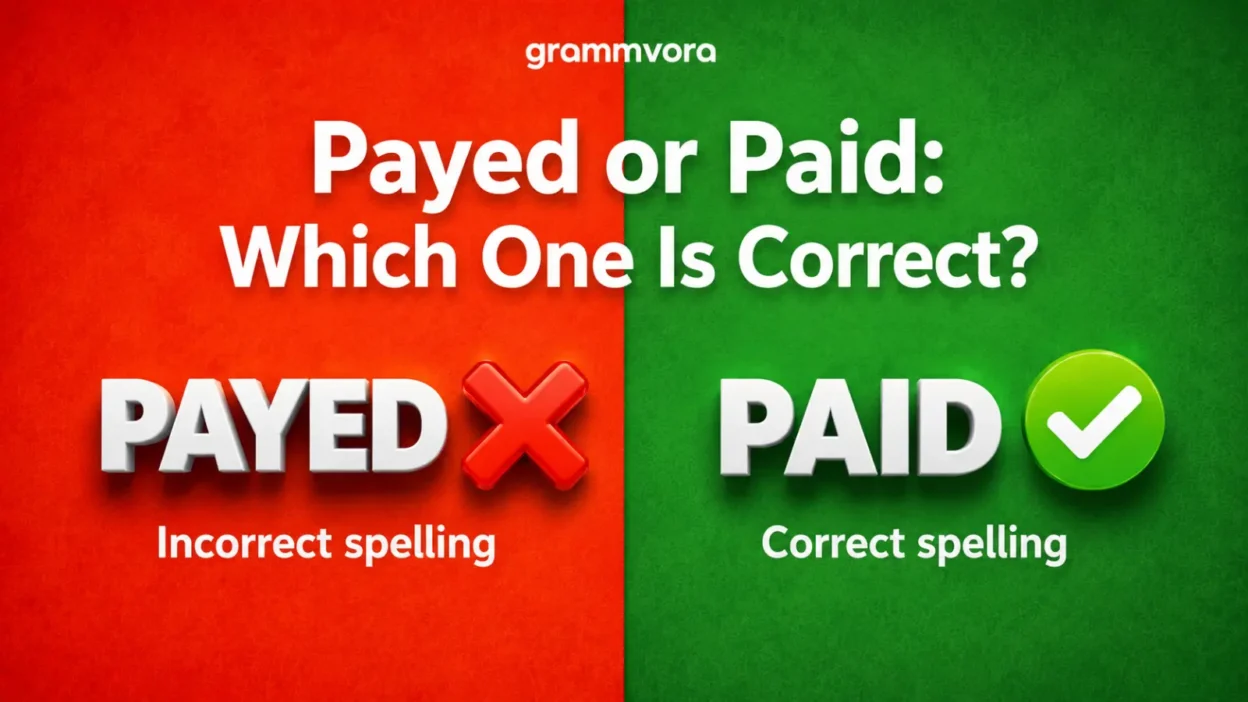
The correct choice is usually paid.
Use paid when you mean someone gave money, received money, settled a bill, got wages, or suffered a cost. Use payed only in rare nautical or boat-related uses, such as letting out a rope or coating part of a boat.
So, for normal writing in the US, write paid.
Quick Answer
Paid is the correct past tense and past participle of pay in everyday English.
Correct: I paid the invoice yesterday.
Correct: She was paid for the project.
Correct: We paid attention in class.
Payed is not the right choice for money, work, bills, attention, respect, or consequences.
Rare correct use: The sailor payed out the rope.
That rare use is so specific that most people will never need payed in regular writing.
Why People Confuse Them
People confuse payed and paid because many English verbs form the past tense by adding -ed.
Walk becomes walked.
Talk becomes talked.
Play becomes played.
So, payed looks like it should be the normal past tense of pay. But pay is irregular in its common money-related meaning. The standard form is paid.
Another reason is pronunciation. Payed and paid sound the same: “payd.” The difference is in spelling and use, not sound.
Key Differences at a Glance
| Context | Best Choice | Why |
|---|---|---|
| Money, bills, wages, rent, loans | paid | This is the standard past form of pay. |
| Work or services | paid | It means someone received money for work. |
| Attention, respect, compliments | paid | These are common fixed uses with paid. |
| Consequences or costs | paid | “Paid the price” uses paid. |
| Letting out rope or cable | payed | This is a rare nautical use. |
| Coating a boat with waterproof material | payed | This is a rare boat-related use. |
Meaning and Usage Difference
Paid means that money was given, money was received, or a cost was met.
Examples:
- I paid my phone bill.
- The company paid its employees early.
- He paid for the tickets online.
Paid also works in common non-money phrases.
Examples:
- She paid attention during the meeting.
- They paid their respects at the funeral.
- He paid the price for skipping practice.
Payed is much narrower. It is mainly used when someone lets out rope, cable, or chain in a controlled way, often around boats. It can also refer to coating part of a boat with a waterproof material.
Examples:
- The crew payed out the rope slowly.
- The old boat was payed before it went back into the water.
In everyday US English, these uses are rare.
Tone, Context, and Formality
Paid is normal in casual, business, school, legal, and professional writing.
You can use it in emails, resumes, reports, invoices, job posts, class essays, and text messages.
Examples:
- I paid the deposit.
- This is a paid internship.
- The account has been paid in full.
Payed sounds wrong in almost every everyday sentence because readers expect paid. It may look like a spelling mistake unless the sentence is clearly about rope, cable, or boat work.
There is no useful US-versus-UK difference for normal writing. In both US and UK English, paid is the standard choice for money and most common meanings.
Which One Should You Use?
Use paid unless you are writing about a rare nautical action.
Here is the safest rule:
If money, work, attention, respect, debt, time off, or consequences are involved, use paid.
Use payed only when the action means letting out rope, cable, or chain, or coating a boat with waterproof material.
Extra Comparison
| Feature | Payed | Paid |
|---|---|---|
| Common in everyday writing | No | Yes |
| Correct for money | No | Yes |
| Correct for wages | No | Yes |
| Correct for “paid attention” | No | Yes |
| Correct for rope or boat use | Yes, in rare nautical uses | Sometimes seen, but payed is the traditional nautical form |
For most readers, paid will be right nearly every time.
When One Choice Sounds Wrong
Payed sounds wrong when the sentence is about money.
Wrong: I payed my rent.
Correct: I paid my rent.
Wrong: She was payed every Friday.
Correct: She was paid every Friday.
Wrong: We payed for dinner.
Correct: We paid for dinner.
Paid may sound ordinary even in some “pay out” sentences because modern writers sometimes use paid out for both money and rope. But if you are using the old nautical spelling, payed out the rope is the form many usage guides point to.
Common Mistakes and Quick Fixes
| Mistake | Correction |
|---|---|
| payed attention | paid attention |
| payed the bill | paid the bill |
| payed vacation | paid vacation |
| payed ad | paid ad |
| payed off my loan | paid off my loan |
| payed the price | paid the price |
A simple way to remember it: if you could connect the sentence to money, effort, or a personal cost, choose paid.
Everyday Examples
- I paid the electric bill before the due date.
- She paid for the groceries with her debit card.
- The client paid the designer after the final draft.
- My new job offers paid sick leave.
- He finally paid off his student loan.
- They paid close attention during the safety talk.
- We paid our respects to the family.
- The mistake was small, but the team still paid the price.
- The crew payed out the rope as the boat moved away from the dock.
- Before the launch, the workers payed the seams of the wooden boat.
Dictionary-Style Word Details
Payed
Verb:
A rare past-tense form of pay in special nautical or boat-related meanings. It can mean to let out rope, cable, or chain, or to coat a boat surface with waterproof material.
Noun:
Payed is not commonly used as a noun in standard US English.
Synonyms:
Let out, released, slackened, fed out, coated.
Paid
Verb:
The standard past tense and past participle of pay for money, work, bills, attention, respect, and most common uses.
Adjective:
Paid can also describe something that involves payment.
Examples:
- paid work
- paid leave
- paid subscription
- paid advertisement
Noun:
Paid is not commonly used as a noun by itself. The related base word pay is a noun, as in “weekly pay,” but paid is usually a verb form or adjective.
Synonyms:
Settled, covered, compensated, reimbursed, salaried, wage-earning.
Clear antonyms fit some uses of paid, such as unpaid in “unpaid leave” or “unpaid bill.” A clear everyday antonym for payed depends on the nautical action, such as tightened or pulled in for rope.
Example Sentences
Payed: The sailor payed out more rope as the boat drifted back.
Payed: The repair crew payed the seams before the boat returned to the water.
Paid: I paid the rent online this morning.
Paid: She has a paid role at the nonprofit.
Paid: The students paid attention during the lesson.
Word History
Payed survives mainly in narrow nautical and boat-related uses. In modern everyday writing, it is not the standard form for money or general uses of pay.
Paid is the standard modern past tense and past participle of pay in ordinary English. It is the form readers expect for money, work, bills, attention, respect, and common phrases.
The older history of these forms is more detailed than most writers need. For practical US writing today, the safe distinction is simple: paid is the normal form, while payed is rare and specialized.
Phrases Containing Payed and Paid
Phrases with Payed
- payed out the rope
- payed out the cable
- payed the seams
Phrases with Paid
- paid attention
- paid vacation
- paid leave
- paid in full
- paid off the loan
- paid the bill
- paid the price
- paid respects
FAQs
Is payed a real word?
Yes, payed is a real word, but it is rare. It is mainly used in nautical or boat-related contexts, such as letting out rope or coating a boat.
Is paid correct for money?
Yes. Paid is the correct form when talking about money, bills, wages, rent, loans, or purchases.
Is “payed attention” correct?
No. The correct phrase is paid attention.
Wrong: She payed attention.
Correct: She paid attention.
Is it paid vacation or payed vacation?
The correct phrase is paid vacation.
Is it paid off or payed off?
Use paid off when talking about loans, debt, effort, or success.
Examples:
- I paid off my loan.
- Her hard work paid off.
Should I use payed in everyday writing?
Usually, no. In everyday writing, paid is almost always the correct choice.
Conclusion
For almost every sentence, paid is correct.
Use paid for money, wages, bills, work, attention, respect, leave, ads, loans, and consequences. It is the standard form in modern US English.
Use payed only in rare nautical or boat-related uses, such as letting out rope or coating part of a boat.
The safest rule is simple: when in doubt, write paid.