In everyday American English, small spelling choices can make a big difference in how professional or clear your writing appears. The pair “matt or mat” creates frequent confusion because the words look and sound nearly identical. Whether you’re writing a product description for home goods, sending a casual email about a friend, or drafting content for a fitness blog, picking the right term matters.
This comprehensive guide breaks down every aspect of the comparison. You’ll learn the precise contexts where each spelling belongs, why the confusion happens so often, and how to avoid common errors that trip up even experienced writers. By the end, you’ll have the confidence to choose correctly every time without second-guessing.
The distinction isn’t just about one extra letter. It involves differences in parts of speech, proper noun conventions, everyday objects, and even regional preferences within English. American English has developed clear preferences that set it apart from British usage in some cases. Understanding these nuances helps you communicate more effectively with US audiences.
Quick Answer
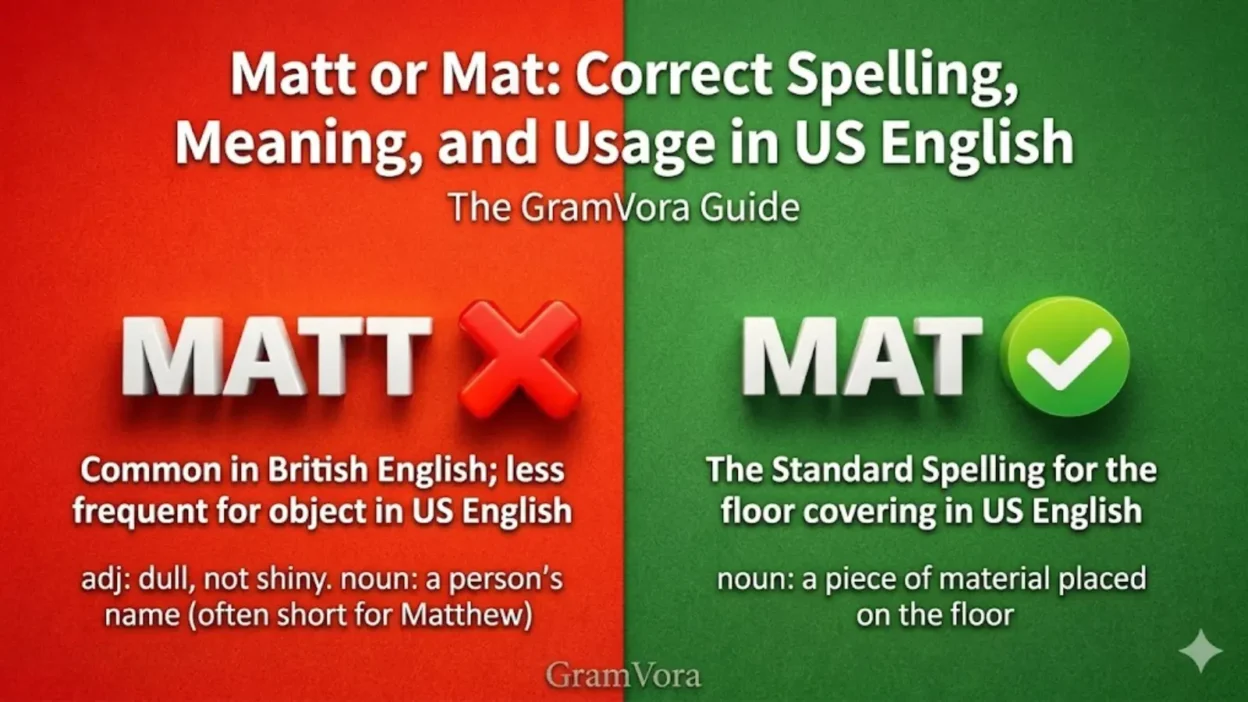
Use “mat” (one t) when referring to a physical object such as a floor mat, yoga mat, doormat, or table mat. It also works as a verb meaning to become tangled.
Use “Matt” (two t’s, capitalized) when referring to the common male given name, a short form of Matthew.
For describing a non-shiny or dull surface finish in the United States, the preferred spelling is “matte” (with an e), not “matt” or “mat.” “Matt” for finishes appears more often in British English.
In short: one “t” for things you step on or place objects on, two “t”s for the person’s name, and “matte” for flat, non-reflective surfaces in American writing.
Why People Confuse Them
The primary reason for confusion is that “matt” and “mat” are homophones. They are pronounced exactly the same way: /mæt/. When spoken aloud, there’s no way to tell them apart, so spelling relies entirely on context and rules.
Visual similarity adds to the problem. The words differ by just one letter, making it easy to mistype “yoga matt” instead of “yoga mat” during fast writing. Autocorrect sometimes fails to catch these because both versions exist as valid words in different contexts.
Another factor is exposure to British English online. Many international websites, design blogs, and product listings from the UK use “matt finish,” which leads American writers to wonder if they should follow suit. Meanwhile, the popularity of the name Matt in American culture — think actors like Matt Damon or athletes — keeps the two-t version prominent in personal contexts.
Social media and user-generated content amplify the mix-ups. Comments on shopping sites or fitness forums often show both spellings used interchangeably, creating doubt for readers trying to learn the standard.
Finally, the overlap with “matte” (the US-preferred finish term) creates a three-way spelling tangle that many people simplify incorrectly. These overlapping influences make the comparison trickier than it first appears.
Key Differences At A Glance
| Context | Best Choice | Why It Fits Best |
|---|---|---|
| Physical floor covering or exercise pad | mat | Standard noun for protective or decorative material |
| Male given name | Matt | Conventional spelling for short form of Matthew |
| Non-shiny paint, lipstick, or photo finish (US) | matte | Preferred American spelling for dull surfaces |
| Tangled mass (hair, fibers) | mat | Describes matted or tangled state |
| Table protector | mat | Common in dining and home decor contexts |
Additional Compact Bullet Comparison
- Mat: Practical, everyday noun and verb focused on objects and actions.
- Matt: Primarily functions as a proper noun for people.
- Regional note: US English strongly favors “matte” over “matt” for finishes to avoid name confusion.
Matt vs Matte: What’s the Difference?
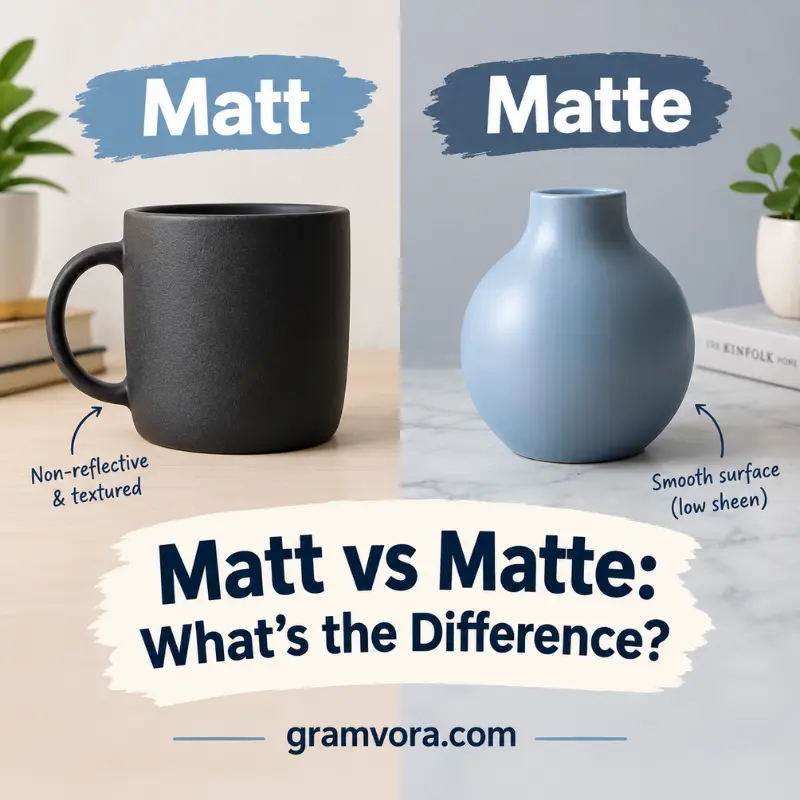
The main difference between Matt and matte is their meaning and usage.
| Word | Meaning | Example |
|---|---|---|
| Matt | A male name, usually short for Matthew | Matt is my neighbor. |
| Matte | A dull, non-shiny finish | I prefer matte paint. |
In American English, use Matt for a person’s name and matte for a non-glossy finish.
Meaning and Usage Difference
Mat serves as both a noun and a verb in standard US English. As a noun, it most commonly refers to a piece of material placed on the floor for protection, wiping feet, or providing cushioning during activities. Examples include welcome mats at entrances, yoga mats in studios, and wrestling mats in gyms. Smaller versions protect tables from hot dishes or scratches.
In its extended sense, “mat” describes a dense, tangled layer, such as a mat of hair that needs brushing or a mat of seaweed on a beach. This usage highlights something compacted or interwoven.
As a verb, “mat” means to become tangled or to cause something to form a dense mass. You might say that wet fur mats easily or that certain fabrics mat after washing.
Matt, by contrast, functions almost exclusively as a proper noun in American English. It is the standard short form of Matthew, a very common male name. While “matt” occasionally appears in older texts or British sources as an adjective for dull finishes, modern US style guides and dictionaries recommend “matte” instead. Using “Matt” as anything other than a name can confuse readers who expect it to refer to a person.
Parts of speech play a key role in the distinction. “Mat” is versatile and appears in both noun and verb positions. “Matt” stays limited to naming conventions and requires capitalization when used as a name. This grammatical difference helps writers decide quickly once they identify the intended meaning.
Pronunciation remains identical for the base forms, but context and surrounding words usually clarify intent when spoken. In writing, however, the spelling choice becomes critical for precision.
Matts or Mats: Which Is Correct?
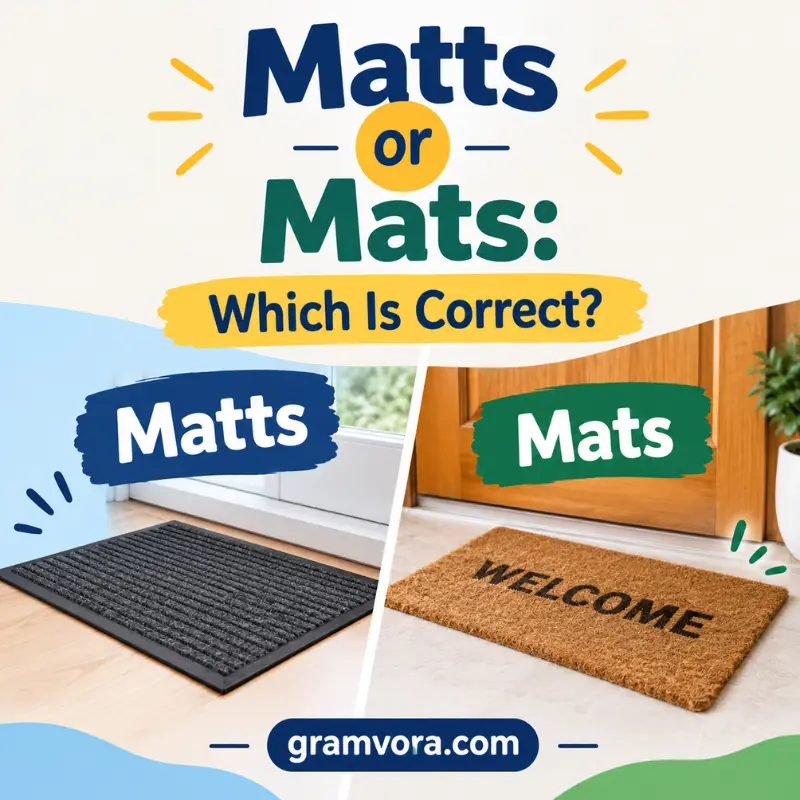
Mats is the correct plural of mat when you are talking about floor coverings, exercise mats, or similar objects.
Example:
- The gym has several yoga mats.
- We bought two new mats for the house.
Matts may be used informally when referring to more than one person named Matt, but this usage is uncommon.
Example:
- There are two Matts in our class.
Tone, Context, and Formality
Both terms maintain a neutral, straightforward tone suitable for most communication. “Mat” carries a practical, functional feel appropriate for home improvement articles, fitness instructions, or product descriptions. It sounds everyday and approachable without being overly casual.
“Matt” as a name feels personal and friendly. In American culture, it evokes familiarity — the guy next door, a colleague, or a celebrity. This makes it common in personal stories, social media posts, and casual correspondence.
In formal business or academic writing, precision matters most. Describing office decor, you would write about “anti-fatigue mats” rather than anything resembling a name. For design specifications, “matte finish” reads as professional in the US, while “matt finish” might signal British influence or inconsistency.
Context determines formality level. A blog post about home organization can freely use “mat” in lists of must-have items. A professional email mentioning your coworker Matt requires the capitalized form. Mixing them creates jarring shifts that careful readers notice.
No significant pronunciation differences affect tone, but the visual spelling influences perceived correctness and attention to detail.
How Do You Spell Matt?
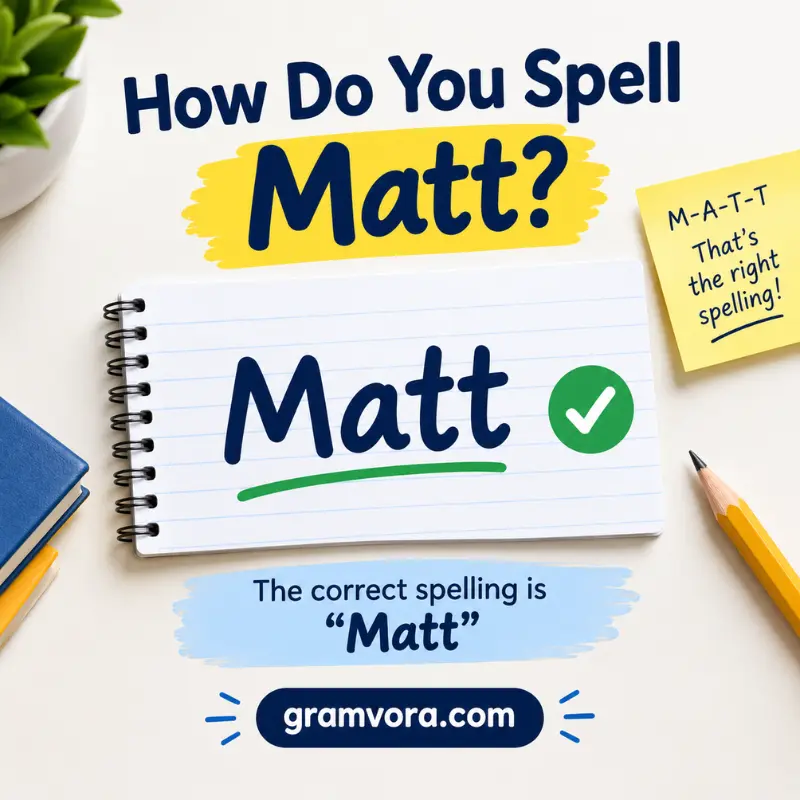
The name Matt is spelled M-A-T-T. It is commonly used as a short form of the name Matthew.
Example:
- Matt works at the local bookstore.
- I spoke to Matt yesterday.
If you mean a floor covering, however, the correct spelling is mat with one t.
Which One Should You Use?
Choose based on clear context questions. Ask yourself: Am I talking about a physical item or surface? Use “mat.” Am I referring to a specific person? Use “Matt.” Am I describing how something looks (non-shiny)? Use “matte” in American English.
For home and fitness products, “mat” is almost always the correct choice. Retailers like Target or Amazon list thousands of items as “yoga mat” or “bath mat.” Following this convention helps your writing match what customers expect to see.
When discussing people, “Matt” follows standard name capitalization rules. Short names like this appear frequently in American media, so readers recognize it instantly.
In creative or design fields, lean toward “matte” for US audiences. Interior designers, photographers, and makeup brands consistently use this spelling. It avoids any accidental association with a person’s name.
If writing for an international audience, consider noting regional differences briefly, but default to US standards unless specified otherwise. Consistency within a single document builds reader trust.
When One Choice Sounds Wrong
Certain combinations immediately signal an error to native American English speakers. “I need a new yoga matt” sounds incorrect because it attaches the name-like spelling to an object. Readers might briefly picture a person instead of a product.
Similarly, “My friend mat invited us over” looks like a missing capital letter or typo. Proper names demand capitalization.
Describing products as having a “matt finish” in a US catalog feels slightly off. Many readers would assume it’s either a British import or an unintentional misspelling of “matte.”
In sports reporting, “He pinned his opponent on the Matt” creates an absurd mental image of wrestling a person instead of using the padded surface. These mismatches pull readers out of the flow and reduce credibility.
Even in fiction, using the wrong form can confuse character descriptions or scene settings. A well-edited manuscript maintains these distinctions throughout.
Common Mistakes (and Quick Fixes)
One frequent error is writing “yoga matt” in product reviews or shopping lists. Quick fix: Remember that objects use the shorter “mat” spelling — one t only.
Another common slip is using “matt” for paint or photo descriptions in American contexts. Fix: Switch to “matte” to match US dictionary preferences and avoid name confusion.
Writers sometimes forget to capitalize “Matt” when using it as a name. Fix: Treat it like any other proper noun — always capitalize.
Plural forms cause issues too, such as writing “exercise matts.” Fix: The plural of mat is simply “mats.”
In tangled descriptions, some people write “matted hair” correctly but then inconsistently use “matt” elsewhere. Fix: Keep the verb form tied to “mat” consistently.
Proofreading tip: Search your document for both spellings and check each instance against context. Reading aloud can help identify where meaning breaks down.
Everyday Examples
Here are realistic situations showing correct usage in modern American life:
- “Make sure to wipe your feet on the welcome mat before tracking mud inside the house.”
- “Matt promised to bring snacks to the game night at his apartment.”
- “The new laptop has a matte screen that cuts down on reflections in bright rooms.”
- “After swimming, I always lay out my beach mat on the sand.”
- “The wrestler’s coach rolled up the mat after practice ended.”
- “My dog gets a bad mat behind his ears if I don’t brush him regularly.”
- “Sarah asked Matt to help move the heavy table mats before the dinner party.”
- “I prefer matte nail polish because it lasts longer without chipping.”
- “The kids spent hours playing on the colorful mats at the indoor playground.”
- “Hey Matt, did you remember to buy that new car mat for the driver’s side?”
These examples reflect how the words appear naturally in conversations, emails, social posts, and articles across the United States.
Additional scenarios include workplace safety (“anti-slip mats in the kitchen”), home renovation (“installing new entrance mats”), personal stories (“My buddy Matt just got engaged”), and beauty tips (“matte foundation works better for oily skin”).
Dictionary-Style Word Details
Verb
- Mat: Commonly used. Means to tangle or form a dense mass. Example: “Humidity can cause fine hair to mat quickly if not conditioned properly.”
- Matt: Not used as a verb in standard US English. No common verb form exists for this spelling.
Noun
- Mat: Very common. Refers to floor coverings, protective pads, table protectors, or tangled layers. Supported across major dictionaries as the primary term for these objects.
- Matt: Primarily the male given name. Occasionally appears as a variant for dull finishes in some sources, but “matte” dominates in current American usage.
Synonyms
- Mat: Closest plain alternatives include rug (for larger floor versions), pad (especially for exercise), doormat, and place mat. No single word covers every meaning perfectly.
- Matt: Matthew (full form of the name). For finish meanings: flat, dull, or non-glossy (when using matte).
Antonyms are context-specific. For shiny vs non-shiny: glossy or satin. For tangled vs smooth: none direct, but “smooth” or “separated” can work for hair contexts.
Example Sentences
- Please remove your shoes and step onto the clean mat provided.
- Matt excelled in both academics and sports during high school.
- The photographer chose a matte background to reduce glare in the portrait.
- Don’t let the yarn mat together while you’re knitting.
- She placed elegant bamboo mats under each plate setting.
- Matt laughed when his friends teased him about his new haircut.
- The gym installed new foam mats for the cycling classes.
- A thick mat of pine needles covered the forest floor.
Word History
“Mat” for floor coverings traces back to practical woven materials used for centuries. The name Matt developed as a common shortening of Matthew, which has ancient Hebrew roots meaning “gift of God.” The finish-related terms (“matte” or “matt”) come from French influences describing dull surfaces. Exact crossover points between spellings are not always precisely documented, but American English settled on distinctions that prioritize clarity.
Phrases Containing
- Mat: welcome mat, yoga mat, on the mat (sports or discussion), mouse mat (less common now), bath mat, place mat.
- Matt: Common in casual address like “Hey Matt!” or references to public figures. No unique fixed phrases beyond typical name usage.
FAQs
Is it spelled Matt or Mat?
Both Matt and mat are correct, but they have different meanings. Matt is usually a male name and a common short form of Matthew. Mat is a noun that refers to a small piece of material placed on a floor or other surface.
What does Matt mean?
Matt is most commonly used as a given name or nickname for Matthew. In standard American English, it is usually capitalized because it is a proper name.
What does mat mean?
A mat is a flat piece of material used to cover or protect a surface. Common examples include a door mat, yoga mat, bath mat, and exercise mat.
Is Matt a correct spelling of Matthew?
Yes. Matt is the standard and widely accepted shortened form of Matthew in American English.
Can Mat be a person’s name?
Yes, Mat can occasionally be used as a name or nickname, but Matt is much more common as the shortened form of Matthew in the United States.
What is the difference between Matt and mat?
The main difference is meaning. Matt usually refers to a person’s name, while mat refers to an object used for covering, cushioning, cleaning, or protecting a surface.
Should Matt be capitalized?
Yes, when Matt is a person’s name, it should always begin with a capital letter. The common noun mat is normally written in lowercase unless it begins a sentence or appears in a title.
Is “mat” or “matt” correct for a floor covering?
Mat is correct for a floor covering. For example, you would write door mat, bath mat, or floor mat. Matt would be incorrect in this context unless it refers to a person’s name.
Is it “Matts” or “mats”?
Use mats when talking about more than one mat, such as “two yoga mats.” Matts may refer informally to several people named Matt, although this use is uncommon.
Is Matt the same as matte?
No. Matt is usually a person’s name, while matte describes a surface or finish that is dull and non-shiny. For example, matte paint has little or no gloss.
What is the plural of mat?
The plural of mat is mats. Simply add -s, as in “The gym has several exercise mats.”
How do you use Matt and mat in a sentence?
For Matt, you could write: “Matt arrived early for the meeting.” For mat, you could write: “Please leave your shoes on the mat near the door.”
Conclusion
Understanding matt or mat ultimately comes down to respecting context, audience expectations, and American English conventions. “Mat” handles the practical world of objects and actions we encounter daily. “Matt” belongs to people and personal identity. For surfaces, “matte” provides the cleanest choice for US readers.
Mastering this comparison improves everything from casual texts to professional documents. Small details like these separate clear writing from confusing copy. Next time you face the choice, pause briefly to consider the meaning behind the word. Is it something physical? A person’s name? A description of appearance? The right answer usually becomes obvious with that simple check.
Consistent, accurate word choice builds credibility and makes your message more effective. Keep practicing with real examples in your own writing, and the distinction will soon feel natural. Clear communication strengthens connections in both personal and professional American settings.