The confusion between heros or heroes happens more often than most people think, especially in casual writing and social media. At first glance, both look like they could be correct. They even sound the same when spoken, which makes the mistake harder to notice.
But in standard English, only one form is accepted when you want to describe more than one hero. This is not just a small spelling preference. It follows a clear grammar rule about how plural nouns are formed, especially words ending in “o.”
Understanding heros or heroes helps you avoid a simple but noticeable writing error. Once you know the rule, it becomes easy to choose the correct form every time without hesitation.
Quick Answer
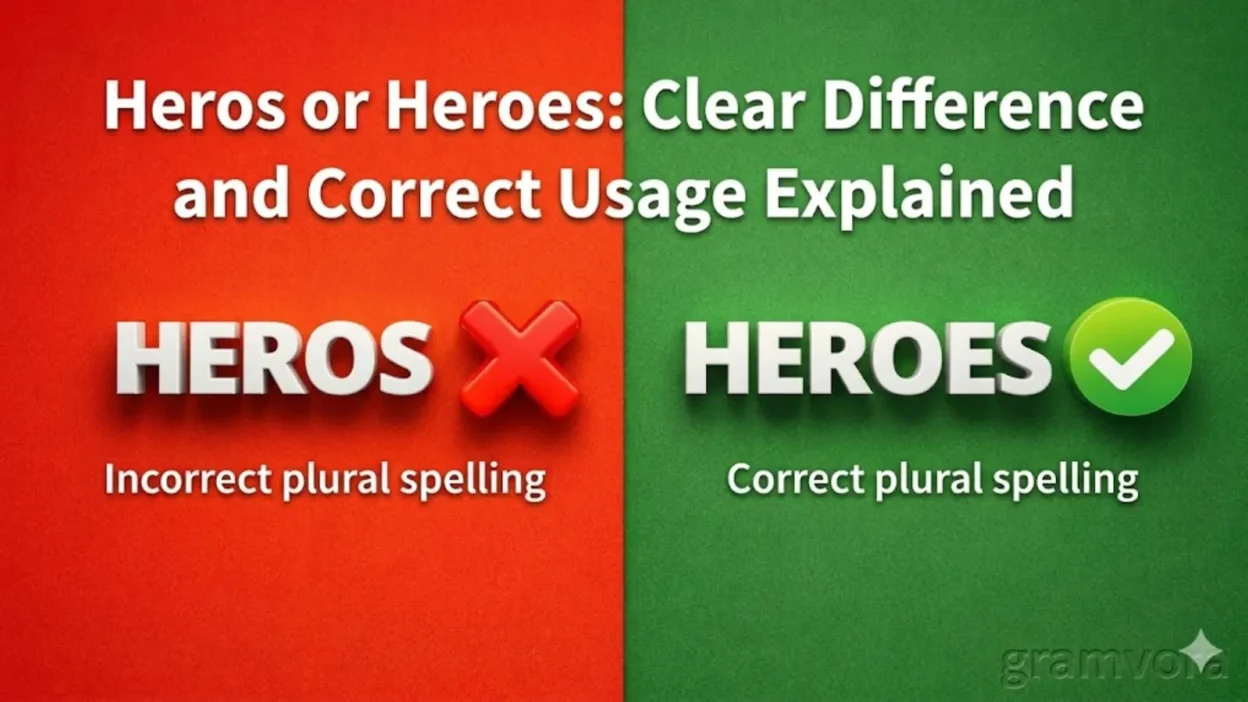
The correct plural form is heroes.
“heros” is not considered correct in standard English writing.
Why People Confuse Them
The confusion starts with how English handles plural nouns. In most cases, you just add “s” to make a word plural, like “book → books” or “car → cars.” This makes “heros” seem logical at first glance.
However, English has extra spelling rules for certain endings. Words that end in “o” do not always follow the simple “add s” pattern. Some require “-es” instead.
Since “hero” ends in “o,” many learners are unsure whether to write “heros” or “heroes.” The pronunciation gives no clear clue, so the mistake continues even among fluent speakers.
Another reason for confusion is informal writing online, where spelling rules are often ignored or overlooked. This makes incorrect forms look more familiar than they actually are in proper grammar.
Key Differences At A Glance
| Feature | heros | heroes |
|---|---|---|
| Correct usage | Incorrect spelling in standard English | Correct plural form of “hero” |
| Grammar status | Not accepted in formal writing | Standard plural noun form |
| Meaning clarity | Intended meaning but wrong form | Correct meaning and structure |
| Usage level | Casual mistakes, typos | All formal and informal contexts |
Meaning and Usage Difference
The base word hero refers to a person admired for courage, bravery, or outstanding actions. It can describe real people, fictional characters, or even everyday individuals who help others in important ways.
When you try to make it plural, the correct form is heroes, meaning more than one hero.
- heros: Not a recognized plural form in standard English
- heroes: Correct plural form used in all writing styles
The difference is not in meaning but in spelling structure. Both aim to refer to multiple brave or admired individuals, but only “heroes” follows accepted grammar rules.
This makes “heros” a spelling error rather than a different word.
Tone, Context, and Formality
In English writing, correctness depends on audience and setting. Some mistakes may be acceptable in casual texting, but “heros” is generally seen as incorrect everywhere.
- heros: Looks incorrect in schoolwork, business writing, and published content
- heroes: Suitable for all levels of writing, from casual to professional
Even in informal conversation, using “heroes” is expected. Because this word is widely known, readers quickly notice the incorrect form and may assume it is a mistake.
In formal contexts like essays, articles, or reports, using “heros” can reduce credibility. That is why “heroes” should always be your default choice.
Which One Should You Use?
Always use heroes when referring to more than one hero.
Use it in situations like:
- school assignments
- storytelling or creative writing
- news or reporting
- everyday communication
Avoid “heros” completely. It does not follow standard English rules and is considered a spelling mistake.
A simple way to remember it is: when “hero” becomes plural, it needs an extra “e” before the “s.”
When One Choice Sounds Wrong
“heros” often looks incorrect immediately to readers familiar with English spelling rules. Even if the meaning is clear, the form creates a distraction.
Example:
- Incorrect: The firefighters were praised as community heros.
- Correct: The firefighters were praised as community heroes.
The incorrect version may still be understood, but it interrupts reading flow and appears unprofessional.
This is especially important in public writing, where spelling mistakes are more noticeable.
Common Mistakes (and Quick Fixes)
Mistake 1: Choosing “heros” because it looks simpler
Fix: Remember that the plural of “hero” is irregular—hero → heroes follows a specific English spelling rule.
Issue 2: Assuming all plural nouns just add “s”
Fix: Not every word follows the simple “add -s” rule. Some nouns ending in “o,” like heroes and potatoes, take “-es.”
Problem 3: Relying only on pronunciation
Fix: English spelling does not always match sound. Correct spelling rules are more important than how a word is pronounced.
Error 4: Using informal online spelling habits
Fix: Avoid casual or internet-based spelling in formal writing. Always prefer standard dictionary-approved forms.
Everyday Examples
- The firefighters are real-life heroes in the community.
- Children often admire superheroes as fictional heroes.
- Doctors and nurses are everyday heroes in hospitals.
- The movie showed soldiers as national heroes.
- Many teachers are quiet heroes in students’ lives.
These examples show how “heroes” is naturally used in real communication.
Dictionary-Style Word Details
Verb
- heros: Not used as a verb in English
- heroes: Not used as a verb in standard English usage
The word “hero” and its plural “heroes” function only as nouns.
Noun
- heros: Incorrect plural form; not accepted in standard English
- heroes: Plural noun meaning more than one hero
“Heroes” is used for both real and fictional individuals admired for courage or achievement.
Synonyms
- heros: none (not a valid form)
- heroes: champions, protectors, saviors, defenders (closest plain alternatives depending on context)
These synonyms depend on the situation, but none replace the exact meaning fully.
Example Sentences
- heros: Not used in standard writing and should be corrected
- heroes: The firefighters were honored as local heroes.
- heroes: She grew up reading stories about ancient heroes.
- heroes: Many healthcare workers are considered everyday heroes.
Word History
- heros: Not recognized as a standard historical form in English grammar development
- heroes: Established plural form of “hero,” following English spelling patterns for nouns ending in “o”
Over time, English adopted the “-es” ending for clarity in pronunciation and structure.
Phrases Containing
- heros: no standard phrases exist
- heroes: unsung heroes, everyday heroes, war heroes, national heroes, local heroes
These phrases are commonly used in speech, writing, and storytelling.
FAQs:
1. Is “heros” ever correct in English?
No. “heros” is not correct in standard English. The accepted plural form of “hero” is “heroes.”
2. Why is it spelled “heroes” and not “heros”?
English adds “-es” to some nouns ending in “o” to form the plural. “Hero” follows this rule, so it becomes “heroes.”
3. What is the singular form of heroes?
The singular form is “hero.” Example: He is a hero in his community.
4. Can I use “heros” in informal writing?
It’s still considered incorrect. Even in informal writing, “heroes” is the proper and expected form.
5. Is “heroes” singular or plural?
“Heroes” is plural. It refers to more than one hero.
6. Are there other words like hero that change to “-oes”?
Yes. Some nouns ending in “o” also take “-es,” such as “potato → potatoes” and “tomato → tomatoes.”
7. What is a simple way to remember the correct spelling?
Think: hero + es = heroes. The extra “e” helps make the plural correct.
8. Does “heroes” change pronunciation?
No. “heroes” and “heros” sound almost the same, which is why the spelling mistake is common.
9. Is “heroes” used for both real and fictional people?
Yes. It can describe real people (like firefighters) or fictional characters (like superheroes).
10. What is the most common mistake with this word?
The most common mistake is dropping the “e” and writing “heros” instead of “heroes.”
Conclusion
The difference between heros or heroes is simple once you understand the rule: only “heroes” is correct in standard English. The form “heros” is a spelling mistake that appears when people assume plural nouns always take a simple “s.”
By remembering the “hero → heroes” pattern, you can avoid one of the most common spelling errors in English. This small detail makes your writing clearer, more accurate, and more confident in any situation.