If you’ve ever typed “time flies” and then wondered if it should be “time flys,” you’re not alone. This is one of those English phrases that looks simple but still confuses many writers.
The issue is not about meaning. Most people understand the idea of time passing quickly. The real confusion comes from spelling and grammar patterns.
In this guide, you’ll learn the correct form, why it is correct, and why the other version is wrong. You’ll also see real examples so you can confidently use it in writing without hesitation.
Quick Answer
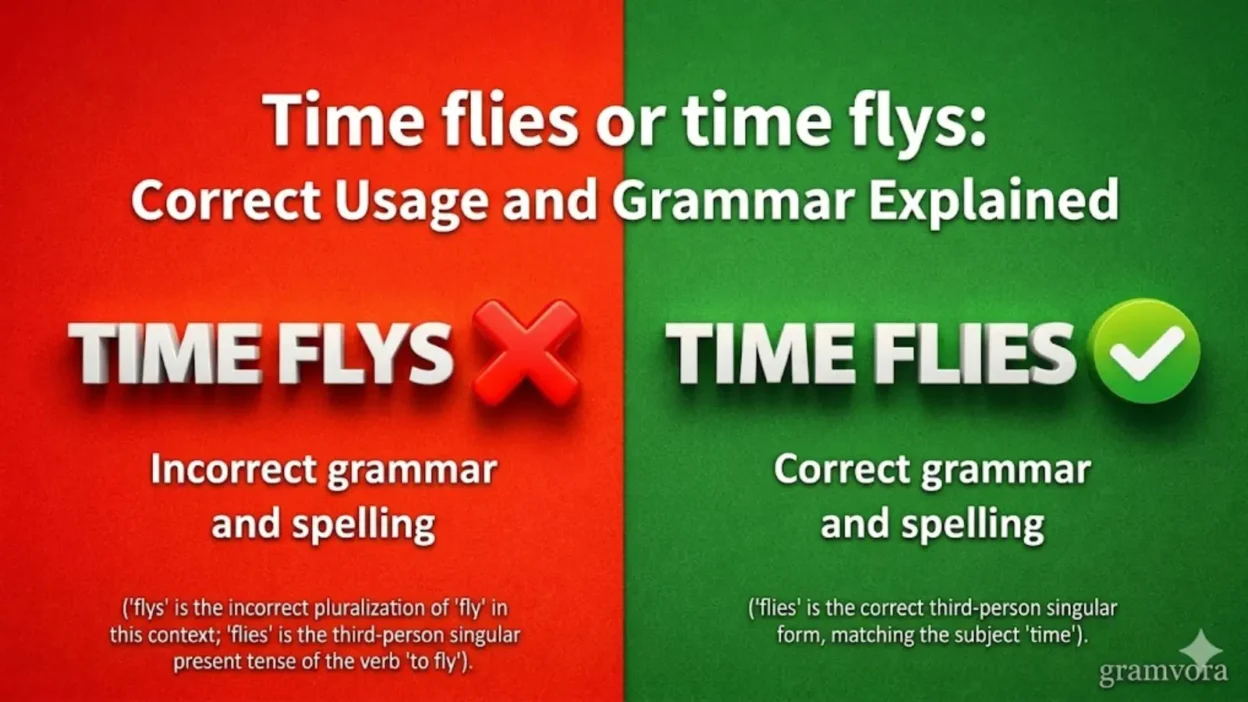
The correct phrase is time flies.
“Time flys” is incorrect in standard English.
The reason is simple: “fly” becomes “flies” when used in present tense with a singular subject like “time.”
Why People Confuse Them
This confusion happens because English spelling rules don’t always match what people expect.
Many learners assume that adding “-s” to a verb always creates the correct form. So they think:
- fly → flys (sounds logical at first glance)
But English doesn’t work that way for all verbs.
When a verb ends in a consonant + “y,” the “y” often changes to “i” before adding “es.” That’s why:
- fly → flies
- try → tries
- carry → carries
So “time flies” follows a normal grammar pattern, while “time flys” ignores it.
Another reason for confusion is fast typing and informal writing. On social media, people often skip careful spelling, which makes incorrect forms more visible.
Key Differences At A Glance
| Feature | time flies | time flys |
|---|---|---|
| Correctness | Correct | Incorrect |
| Grammar form | Present tense verb | Misspelling |
| Meaning | Time passes quickly | No accepted meaning |
| Usage | Standard English | Not used in formal writing |
| Reader perception | Natural | Error or typo |
Meaning and Usage Difference
The phrase time flies is an idiom. It means time seems to pass very quickly.
It is not literal. Time does not actually fly. Instead, it describes human perception.
We use it when moments feel short, even if they are not.
Examples of meaning:
- A weekend ends quickly
- A vacation feels short
- A year passes in what feels like days
On the other hand, time flys has no recognized meaning in standard English. It is simply a spelling mistake created by misunderstanding grammar rules.
Tone, Context, and Formality
“Time flies” works in all types of communication.
You can use it in:
- Casual conversations
- School essays
- Emails
- Social media captions
- Professional writing
It has a natural, friendly tone. It is commonly used in spoken English because it feels expressive and relatable.
“Time flys” should never be used. In any context, it looks like an error rather than a style choice.
Even in informal texting, correct spelling is preferred because this phrase is very recognizable.
Which One Should You Use?
Always use time flies.
It is the only grammatically correct option.
Think of it as a fixed expression. You don’t change it based on preference.
A simple rule:
- If you are describing time passing → use “flies”
- Never use “flys” in this phrase
Once you remember this, you will avoid one of the most common English writing mistakes.
When One Choice Sounds Wrong
“Time flys” stands out immediately to native readers.
It creates a mental pause because the spelling does not match expected grammar patterns.
Even if the reader understands your message, the mistake can:
- Distract from your writing
- Reduce clarity
- Make text feel less polished
“Time flies” sounds smooth and natural. It is instantly recognized as correct English.
Common Mistakes (and Quick Fixes)
Here are the most common errors people make with this phrase:
Mistake 1: Adding “-s” directly
❌ time flys
✔ time flies
Fix: Remember “fly” changes to “flies,” not “flys.”
Mistake 2: Treating it like a plural noun
Some people think “flies” refers to insects, not grammar.
But in this phrase, “flies” is a verb, not a noun.
Mistake 3: Overthinking the phrase
Learners sometimes try to analyze the meaning too deeply and forget it is an idiom.
Fix: Treat it as a fixed expression meaning “time passes quickly.”
Mistake 4: Typing errors in fast writing
Auto-correct or fast typing often leads to “flys.”
Fix: Slow down when writing common phrases.
Everyday Examples
Here are real, natural examples you might see in daily English:
- Time flies when you’re busy with work.
- Wow, time flies during the holiday season.
- It’s strange how time flies as you get older.
- Time flies when you’re talking with friends.
- I can’t believe how fast time flies this year.
Incorrect usage examples:
- ❌ Time flys when you’re busy.
- ❌ I feel like time flys so fast.
Even though the meaning is still understandable, the spelling is wrong.
Dictionary-Style Word Details
Verb
- time flies: A present-tense verb phrase describing time passing quickly.
- time flys: Not recognized as a verb phrase in standard English.
In grammar terms, “flies” is the third-person singular form of “fly.”
Noun
- time flies: Not a noun. It functions as a verb phrase in an idiomatic expression.
- time flys: Not a noun and not used in standard English.
Synonyms
- time flies: time passes quickly, time goes fast, time slips by, time moves quickly (closest plain alternatives)
- time flys: no valid synonyms (incorrect form)
These alternatives are not exact idioms but help express similar meaning.
Example Sentences
- time flies: Time flies when you’re having a good conversation.
- time flies: It’s amazing how time flies during summer break.
- time flies: Time flies, and suddenly the year is over.
- time flys: Not correct in standard usage.
Word History
- time flies: The expression comes from the idea of time moving quickly in human perception. It has been used in English for a long time in different forms of writing and speech. The exact origin is not clearly documented.
- time flys: No historical development exists because it is a spelling error rather than an established form.
Phrases Containing
- time flies: time flies when you’re having fun, how time flies, time flies so fast
- time flys: no recognized phrases include this spelling
FAQs
1. Which is correct: time flies or time flys?
The correct form is time flies. “Time flys” is a spelling mistake and not used in standard English.
2. What does “time flies” mean?
It means time passes very quickly, especially when you are busy or enjoying something.
3. Why is it “flies” and not “flys”?
Because the verb “fly” changes to “flies” in present tense when used with a singular subject like “time.”
4. Is “time flys” ever correct?
No. “Time flys” is always incorrect in standard English writing.
5. Is “time flies” an idiom?
Yes, it is a common English idiom used to describe how fast time seems to pass.
6. Can I use “time flies” in formal writing?
Yes. It is neutral and acceptable in both formal and informal contexts.
7. Why do people write “flys” instead of “flies”?
Because “flys” looks simpler and people mistakenly assume English just adds “s” for plurals or verb forms, but English spelling rules change “y” to “i + es.”
Conclusion
The correct form is always time flies, never “time flys.”
The difference comes down to a simple grammar rule where “fly” changes to “flies” in present tense. Once you understand this rule, the confusion disappears completely.
This phrase is widely used in English because it captures a feeling everyone experiences: time moving faster than expected.
So next time you write it, you won’t hesitate—you’ll confidently choose time flies.