If you’ve ever stopped mid-sentence and wondered whether to write gray or grey, you’re not alone. These two spellings cause confusion for students, writers, editors, and even native English speakers.
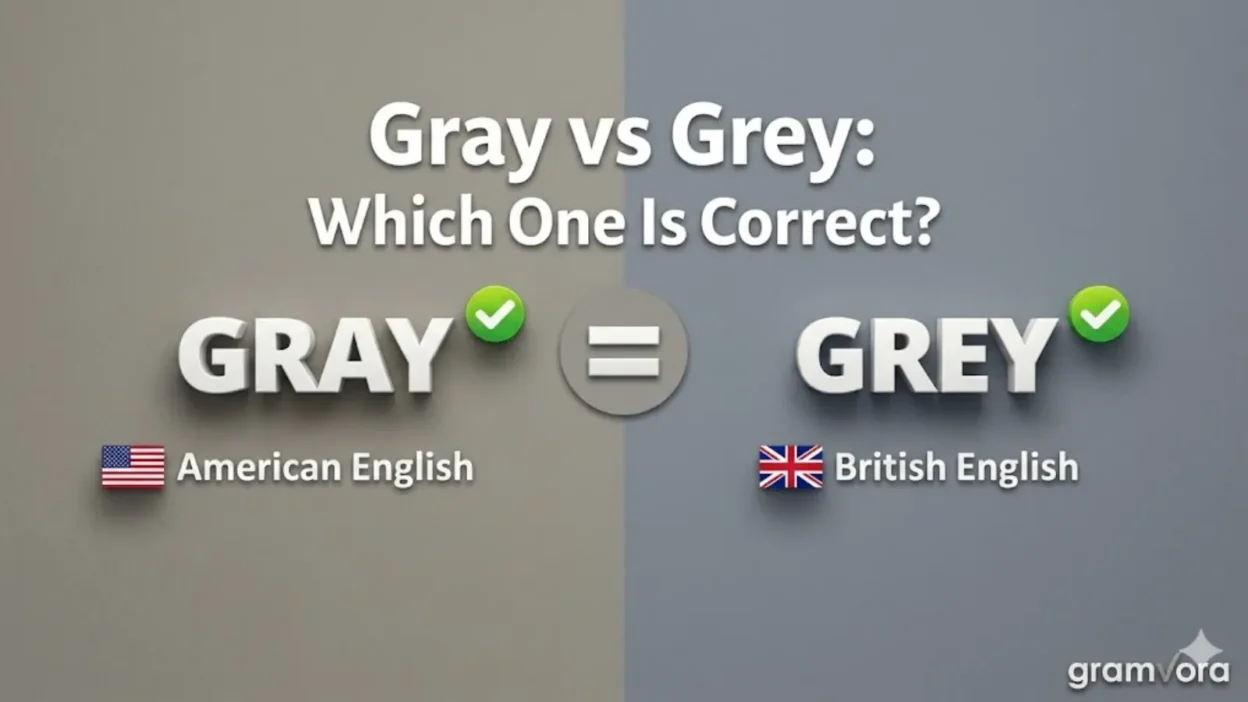
The good news is simple: both gray and grey are correct.
Unlike many commonly confused words, these terms have the same meaning, the same pronunciation, and the same grammatical functions. The primary difference comes down to regional spelling preferences.
In American English, gray is generally preferred.
In British English, grey is generally preferred.
That sounds straightforward, but there are several important details worth understanding. Certain proper names use one spelling exclusively. Some style guides recommend consistency rules. Readers often wonder whether one spelling sounds more professional than the other.
This guide explains everything you need to know about gray vs grey so you can choose the right spelling confidently every time.
Quick Answer
If your audience is in the United States, choose gray.
If your audience is in the United Kingdom, choose grey.
For international audiences, either spelling can work as long as you remain consistent throughout the piece.
What Does Gray Mean?
Gray is the American English spelling of a color that falls between black and white.
The word can describe:
- A color
- Hair color
- Weather conditions
- Mood or atmosphere
- Unclear situations
Examples:
- The walls are painted light gray.
- His hair turned gray during his forties.
- Gray clouds covered the city.
- The contract contains several gray areas.
In American publications, newspapers, schools, and businesses, gray is usually the standard spelling.
What Does Grey Mean?
Grey means exactly the same thing as gray.
It refers to the same color and can be used in the same situations.
Examples:
- The sky looked grey before the storm.
- She bought a grey sweater.
- The artist worked mainly with shades of grey.
- The policy remains a grey area.
The main distinction is that grey is more commonly used in British English and many other countries that follow British spelling conventions.
Why People Get Confused
Many word pairs are confusing because they have similar meanings but different uses.
Gray and grey are different.
They are confusing because they mean the same thing.
Readers naturally assume that different spellings must indicate different meanings. In most cases, however, they do not.
Both words:
- Describe the same color
- Share the same pronunciation
- Function as the same parts of speech
- Appear in formal and informal writing
- Have the same dictionary definitions
The confusion comes from seeing both forms in books, websites, advertisements, and media.
The Main Difference Between Gray and Grey
The difference can be summarized in one sentence:
Gray is preferred in American English, while grey is preferred in British English.
Everything else is largely identical.
| Feature | Gray | Grey |
|---|---|---|
| Meaning | Same | Same |
| Pronunciation | Same | Same |
| Part of Speech | Same | Same |
| American English | Preferred | Less Common |
| British English | Less Common | Preferred |
| Formal Writing | Accepted | Accepted |
| Informal Writing | Accepted | Accepted |
This is one of the rare situations where spelling preference is the primary distinction.
Gray vs Grey in American English
American English overwhelmingly favors gray.
You’ll commonly see gray used in:
- Newspapers
- Government documents
- School textbooks
- Academic writing
- Business communications
- Online publications
Examples:
- Gray paint
- Gray skies
- Gray hair
- Gray matter
- Gray area
Using gray in American writing helps maintain consistency with standard US spelling conventions.
Gray vs Grey in British English
British English generally prefers grey.
Writers in the UK commonly use:
- Grey skies
- Grey trousers
- Grey hair
- Grey stone
- Grey clouds
If your audience is primarily British, grey often looks more natural.
Do Gray and Grey Have Different Pronunciations?
No.
Both words are pronounced exactly the same way.
They rhyme with:
- Day
- Play
- Stay
- Way
There is no pronunciation difference between gray and grey.
This is another reason people often assume they are identical.
Are Gray and Grey Different Parts of Speech?
No.
Both spellings function in the same grammatical ways.
They can be:
Adjectives
- A gray jacket
- A grey jacket
Nouns
- Gray is popular in modern design.
- Grey is common in contemporary architecture.
Verbs
Though less common, both forms can function as verbs.
Examples:
- His beard began to gray.
- The fabric slowly greyed with age.
Which Spelling Do Dictionaries Prefer?
Most American dictionaries list gray as the primary American spelling.
Most British dictionaries list grey as the preferred British spelling.
Importantly, reputable dictionaries generally recognize both spellings as correct.
The difference is preference, not correctness.
Is One More Professional Than the Other?
No.
Neither spelling is more professional.
Professionalism depends on consistency and audience expectations.
For example:
- An American business report should usually use gray.
- A British company report should usually use grey.
The spelling itself does not affect professionalism.
What matters is using the version that matches your readers.
Gray and Grey in Design and Color Discussions
Color professionals frequently encounter both spellings.
Interior designers, graphic designers, artists, and photographers often work with international clients.
In these situations:
- American brands often use gray.
- British brands often use grey.
Color shades remain identical regardless of spelling.
For example:
- Dark gray
- Light gray
- Charcoal gray
And:
- Dark grey
- Light grey
- Charcoal grey
The color itself does not change.
Gray and Grey in Everyday Expressions
Many common expressions use gray or grey.
Gray Area
A gray area refers to something uncertain or not clearly defined.
Example:
The regulation leaves a gray area regarding remote work policies.
Gray Matter
Gray matter refers to brain tissue and is often used figuratively to mean intelligence.
Example:
That puzzle really made me use my gray matter.
Grey Area
British writers often use the same expression with grey.
Example:
The law contains several grey areas.
The meaning remains unchanged.
When Only One Spelling Is Correct
This is where things become slightly more complicated.
Proper names must keep their official spelling.
You cannot change them based on region.
Earl Grey Tea
Correct:
- Earl Grey tea
Not:
- Earl Gray tea
Greyhound
Correct:
- Greyhound
Not:
- Grayhound
Grey’s Anatomy
Correct:
- Grey’s Anatomy
Not:
- Gray’s Anatomy
African Grey Parrot
Correct:
- African Grey Parrot
Not:
- African Gray Parrot
Whenever a spelling is part of an official name, always use the official version.
Scientific Usage of Gray
There is one notable exception where gray is not simply a regional preference.
In science, Gray is the official unit used to measure absorbed radiation dose.
Example:
The patient received a radiation dose measured in grays.
In this context, Gray is a specific scientific term and should not be replaced with grey.
Common Mistakes People Make
Mistake 1: Thinking Grey Is Wrong
Many Americans assume grey is incorrect.
It is not.
Grey is a standard English spelling.
Mistake 2: Thinking Gray Is Wrong
Many British writers assume gray is incorrect.
It is not.
Gray is a standard English spelling.
Mistake 3: Mixing Both Spellings
Avoid writing:
- The gray walls matched the grey carpet.
Choose one spelling style and stick with it.
Better:
- The gray walls matched the gray carpet.
Or:
- The grey walls matched the grey carpet.
Mistake 4: Changing Proper Names
Always keep official spellings intact.
Incorrect:
- Earl Gray Tea
Correct:
- Earl Grey Tea
Memory Trick for Gray and Grey
A popular memory aid is:
Gray contains A for America.
Grey contains E for England.
While not a strict rule, this trick helps many people remember which spelling is generally preferred in each region.
Examples of Gray in Sentences
- The gray sofa fits perfectly in the living room.
- We drove through gray winter weather.
- Her gray coat matched her scarf.
- The report identified several gray areas.
- The gray paint gave the room a modern appearance.
- Gray clouds gathered over the city.
- His gray hair became more noticeable each year.
- The mountain looked gray from a distance.
- Gray remains a popular color choice in offices.
- The building featured gray stone walls.
Examples of Grey in Sentences
- The grey sky suggested rain was coming.
- She wore a grey sweater to work.
- The artist preferred shades of grey.
- The castle stood against a grey horizon.
- Grey clouds drifted over the coastline.
- The room featured elegant grey furnishings.
- A grey mist covered the hills.
- The editor used British spelling throughout the document.
- The old photograph showed varying shades of grey.
- Grey remains popular in modern design.
Gray vs Grey in Publishing
Publishers typically follow style consistency.
American publications usually use gray.
British publications usually use grey.
Editors rarely switch between forms unless a quotation or proper name requires it.
Consistency helps maintain a polished appearance.
Gray vs Grey in Education
Students often ask which spelling teachers expect.
The answer depends on location.
In the United States:
- Gray is usually expected.
In the United Kingdom:
- Grey is usually expected.
If you’re unsure, check your institution’s style guide or use the dominant spelling standard of your region.
Should You Ever Use Both?
Generally, no.
Using both spellings in the same article can look inconsistent.
Exceptions include:
- Quotations
- Proper names
- Brand names
- Book titles
- Television titles
Outside those situations, choose one style and maintain it.
FAQs
Is gray more correct than grey?
No. Both spellings are correct.
Is grey British and gray American?
Generally, yes. That is the most common distinction.
Do gray and grey mean different things?
No. They have the same meaning.
Is there a pronunciation difference?
No. Both words are pronounced the same way.
Which spelling should Americans use?
Gray is typically preferred in American English.
Which spelling should British writers use?
Grey is typically preferred in British English.
Can I use either spelling online?
Yes, but consistency is recommended.
Conclusion
The debate over gray vs grey is much simpler than many people expect.
The main distinction is regional preference.
If you’re writing for an American audience, gray is usually the best choice.
If you’re writing for a British audience, grey is usually the better fit.
Most importantly, choose one spelling style and use it consistently throughout your writing. That approach keeps your work clear, professional, and easy for readers to follow.