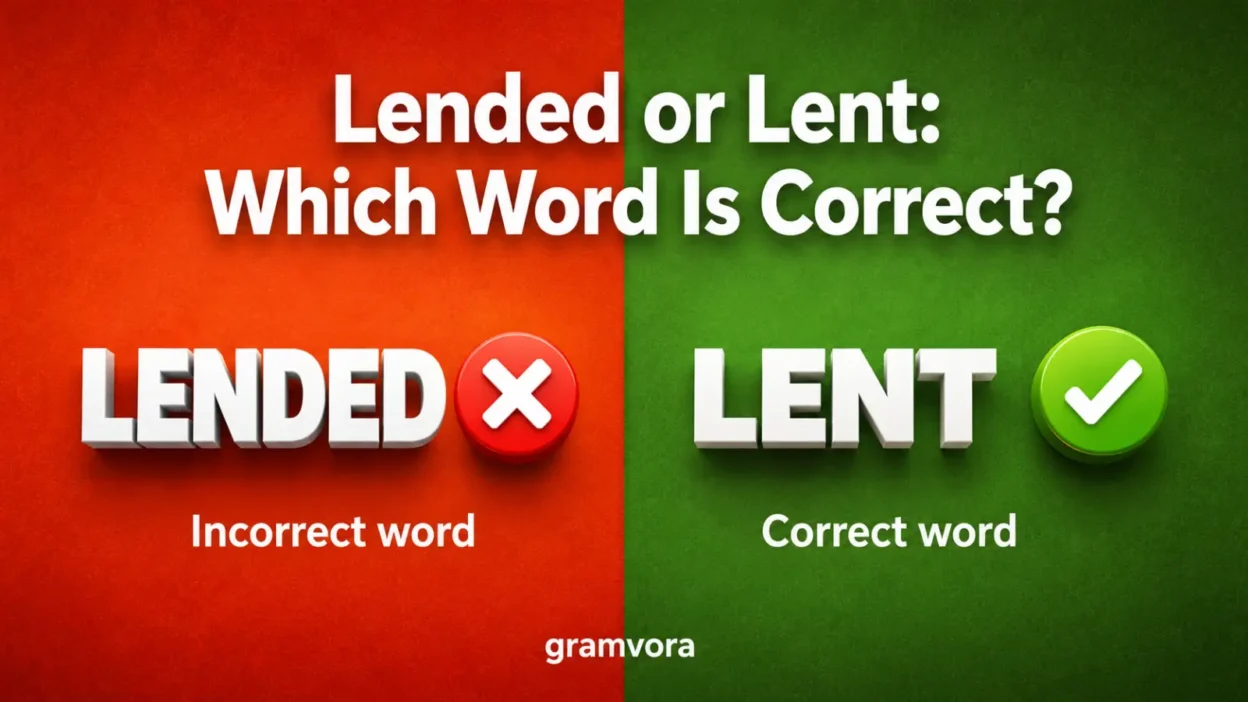
The correct choice is lent, not lended, in standard US English. Use lent when you mean that someone gave something to another person for a short time and expected it back.
Example: “Maya lent me her charger during class.”
The confusion happens because many English verbs form the past tense with -ed. Walk becomes walked, help becomes helped, and call becomes called. Lend does not follow that regular pattern. It is an irregular verb, so its past tense and past participle form is lent.
That means lended may sound logical, but it will usually look wrong in edited writing, schoolwork, business emails, and published content.
Quick Answer
Use lent as the past tense and past participle of lend.
Correct: “He lent me his notes.”
Correct: “She has lent her car to her brother before.”
Incorrect in standard English: “He lended me his notes.”
So, for the choice lended or lent, choose lent almost every time.
Why People Confuse Them
People confuse lended and lent because English has many regular verbs. A regular verb takes -ed in the past tense, so it feels natural to say lended after hearing forms like needed, ended, or handed.
The problem is that lend works more like send and bend. We say sent, bent, and lent, not sended, bended in most standard uses, or lended.
Another reason for the mistake is that lended is easy to understand. A listener can usually guess the meaning. Still, being understandable does not make it the standard form.
In polished writing, lent is the safe and correct choice.
Key Differences At A Glance
- Lended: A nonstandard past form of lend. Avoid it in standard writing.
- Lent: The standard past tense and past participle of lend.
- Main rule: Say lent after subjects like I, you, he, she, we, and they.
- With helping verbs: Use lent after has, have, or had.
- Best fix: Replace lended with lent.
Meaning and Usage Difference
Lent means gave something to someone temporarily, usually with the expectation that it would be returned.
Examples:
“She lent me five dollars.”
“The library lent tablets to students.”
“We have lent our ladder to the neighbors twice.”
Lended tries to express the same meaning, but standard English does not treat it as the normal past form of lend. It is usually a mistake made by applying the regular -ed pattern to an irregular verb.
The difference is not about meaning. It is about grammar and standard usage. Lent is the accepted form. Lended is the form most editors, teachers, and careful readers would correct.
Tone, Context, and Formality
Lent works in casual, formal, academic, and professional writing. You can use it in a text message, a school essay, a work email, or a news article.
Lended may appear in speech or informal writing, but it sounds unpolished to many readers. In school or business contexts, it can make the sentence look careless.
Use lent in these contexts:
| Context | Best Choice | Why |
|---|---|---|
| School writing | lent | It is the standard past tense. |
| Work emails | lent | It sounds polished and correct. |
| Casual texting | lent | It is still the natural choice. |
| Legal or financial writing | lent | It avoids a grammar distraction. |
| Published content | lent | Editors expect the standard form. |
Which One Should You Use?
Use lent whenever you need the past tense or past participle of lend.
Say:
“I lent my jacket to Ava.”
“He has lent money to friends before.”
“The company lent support to the local event.”
Do not use lended in standard US English.
Write:
Incorrect: “My dad lended me his truck.”
Correct: “My dad lent me his truck.”
Incorrect: “They have lended us the equipment.”
Correct: “They have lent us the equipment.”
A simple memory trick is this: lend becomes lent, just as send becomes sent.
When One Choice Sounds Wrong
Lended sounds wrong when it appears where a past tense verb should be.
Awkward: “She lended me a book.”
Natural: “She lent me a book.”
It also sounds wrong after helping verbs.
Awkward: “I have lended him my phone before.”
Natural: “I have lent him my phone before.”
The mistake becomes even more noticeable in fixed expressions.
Awkward: “They lended a hand after the storm.”
Natural: “They lent a hand after the storm.”
Because lent is short and familiar, readers expect it. Lended interrupts the sentence and draws attention to the verb form instead of the message.
Common Mistakes (and Quick Fixes)
One common mistake is adding -ed because the speaker knows the present form is lend.
Mistake: “Can you believe she lended him her car?”
Fix: “Can you believe she lent him her car?”
Another mistake is using lended after has or have.
Mistake: “The school has lended laptops to students.”
Fix: “The school has lent laptops to students.”
A third mistake is confusing lent with borrowed. The giver lends. The receiver borrows.
Correct: “Jake lent me his pen.”
Correct: “I borrowed Jake’s pen.”
Everyday Examples
Here are natural examples using lent correctly:
“My roommate lent me her umbrella this morning.”
“The bank lent them money for the renovation.”
“I lent Carlos my headphones during the flight.”
“She has lent her notes to three classmates.”
“Our neighbor lent us a snow shovel last winter.”
“The coach lent support to the new training plan.”
“The museum lent the painting to another gallery.”
“My sister lent me her car while mine was in the shop.”
“The teacher lent a hand with the fundraiser.”
“The quiet music lent the room a calm feeling.”
Dictionary-Style Word Details
Verb
lended: Not the standard past tense or past participle of lend in US English. Avoid it in edited writing.
lent: The standard past tense and past participle of lend.
Examples:
Present: “I lend books to my friends.”
Past: “I lent a book to my friend.”
Past participle: “I have lent books before.”
Noun
lended: Not commonly used as a noun in standard US English.
lent: Lowercase lent is not commonly used as a noun in this word-choice comparison. Capitalized Lent is a separate word that names a Christian season before Easter. That religious noun is not the same as the verb form in “I lent you my pen.”
Synonyms
lended: No useful standard synonyms, because it is not the standard form to use.
lent: Closest plain alternatives include loaned, gave temporarily, provided temporarily, or let someone borrow.
Use these carefully. Loaned can work in many literal contexts, especially with money or objects. It does not always fit figurative phrases like lent a hand or lent support.
Clear opposites depend on context. For money or objects, possible opposites include borrowed, kept, or withheld, but each one changes the sentence structure.
Example Sentences
lended: “He lended me ten dollars” is not standard. Use “He lent me ten dollars.”
lent: “He lent me ten dollars” is standard.
lended: “The library has lended tablets” is not standard. Use “The library has lent tablets.”
lent: “The library has lent tablets to students” is standard.
lended: “They lended a hand” sounds wrong in standard writing.
lent: “They lent a hand” is the natural expression.
Word History
lended: This form likely appears because speakers apply the regular -ed pattern to lend. It is understandable, but it is not the accepted standard form.
lent: This is the established past tense and past participle of lend. The details of older English word history are not needed to use the word correctly today. For modern writing, the practical pattern is simple: lend, lent, lent.
Phrases Containing
lended: No common standard phrases use lended.
lent: Common phrases include:
“lent a hand”
“lent support”
“lent credibility”
“lent weight to the claim”
“lent itself to the project”
These phrases use lent because they are past forms of expressions with lend.
FAQs
Is it lended or lent?
The correct standard word is lent. Use lent as the past tense and past participle of lend. For example, write “She lent me her notebook,” not “She lended me her notebook.”
Is lended a real word?
Lended may appear in casual speech or informal writing, but it is not the standard past tense of lend. In school, business, and edited writing, lent is the correct choice.
What is the past tense of lend?
The past tense of lend is lent. The full pattern is lend, lent, lent. Example: “I lend books often” becomes “I lent a book yesterday.”
Is “has lended” correct?
No. The correct form is has lent. Use lent after helping verbs such as has, have, or had. Correct example: “She has lent money to friends before.”
Why is lent correct instead of lended?
Lend is an irregular verb, so it does not form the past tense by adding -ed. That is why the correct form is lent, not lended.
Can I use lended in casual conversation?
People may understand lended, but it can still sound wrong or unpolished. Lent is better in both casual and formal English.
What is an example of lent in a sentence?
Here is a clear example: “My neighbor lent me a ladder for the weekend.” In this sentence, lent means the neighbor gave the ladder temporarily and expected it back.
What is the difference between lent and borrowed?
The giver lent something. The receiver borrowed it. Example: “Maria lent me her charger” means Maria gave it temporarily. “I borrowed Maria’s charger” means I received it temporarily.
Is “lent me money” correct?
Yes. “She lent me money” is correct. It means she gave you money temporarily, usually with the expectation that you would pay it back.
Which should I use in formal writing, lended or lent?
Use lent in formal writing. Lent is the standard form for essays, emails, reports, articles, and professional communication.
Conclusion
For lended or lent, the correct standard choice is lent. Use lent as both the simple past tense and the past participle of lend.
Write “She lent me her book,” not “She lended me her book.” Write “They have lent us their support,” not “They have lended us their support.