
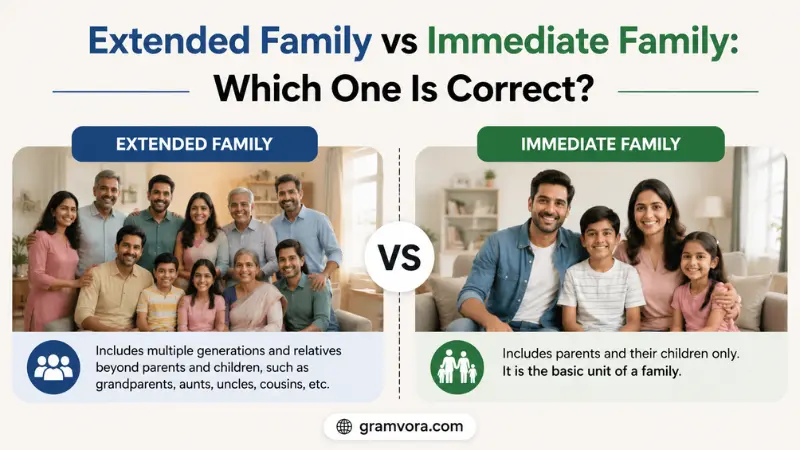
Both extended family and immediate family are correct phrases. The difference is the range of relatives they describe.
In ordinary American English, immediate family usually refers to your closest family group, such as your spouse, parents, siblings, and children. Extended family refers to relatives beyond that closer group, such as grandparents, aunts, uncles, cousins, nieces, and nephews.
The boundary is not perfectly fixed. A workplace policy, government program, or other formal document may define “immediate family” more broadly or more narrowly for a specific purpose.
Quick Answer
Use immediate family when you mean your closest core family members.
Use extended family when you mean the wider circle of relatives beyond that core.
For example:
- “My immediate family is coming to the wedding.”
- “My extended family is coming to the reunion.”
Your spouse, parents, siblings, and children are commonly described as immediate family. Grandparents, aunts, uncles, and cousins are commonly described as extended family.
Neither phrase is more correct than the other. The right choice depends on which group of relatives you mean.
Why People Confuse Them
Family relationships do not always fit into one universal list.
For example, someone may be extremely close to a grandparent and rarely speak to a sibling. That difference in emotional closeness does not normally change the standard word choice. A grandparent can still be part of the extended family in ordinary usage even when that person is one of the most important people in someone’s life.
Living arrangements can also cause confusion. A grandparent, aunt, uncle, or cousin may live in the same home as you. That does not automatically make the person “immediate family” in everyday American English.
Formal definitions create another complication. A workplace policy may decide that grandparents or in-laws count as immediate family for a particular benefit. Another policy may use a narrower list.
So there is a useful distinction between ordinary usage and a definition written for a particular rule.
Key Differences At A Glance
| Feature | extended family | immediate family |
|---|---|---|
| Basic idea | Wider family circle | Closer family circle |
| Common examples | Grandparents, aunts, uncles, cousins, nieces, nephews | Spouse, parents, siblings, children |
| Usual scope | Broader | Narrower |
| Household required? | No | No |
| Fixed membership in every context? | No | No |
| Common in everyday US English? | Yes | Yes |
| Context | Best Choice | Why |
| Talking about your spouse and children | immediate family | They are normally part of the closest family group. |
| Talking about your parents and siblings | immediate family | These relatives are commonly included in the phrase. |
| Talking about cousins at a reunion | extended family | Cousins normally belong to the wider family circle. |
| Talking about aunts and uncles | extended family | They are generally outside the closest core group. |
| Referring to relatives under a workplace policy | Use the policy’s wording | The policy may define the category differently. |
Meaning and Usage Difference
Immediate family is a noun phrase for the closest family relationships. Major American dictionaries commonly include parents, siblings, a spouse, and children in this group.
The phrase does not necessarily mean everyone who lives with you. It describes a family relationship, not simply a household arrangement.
Extended family is also a noun phrase. It describes a larger family group that goes beyond the closest family circle. Grandparents, aunts, uncles, and cousins are common examples.
The two phrases therefore work as a useful contrast:
immediate family = closer family group
extended family = wider family group
Still, the categories can overlap in specific settings. For example, a formal policy might include a grandparent as immediate family even though many speakers would call a grandparent extended family in ordinary conversation.
Tone, Context, and Formality
Neither phrase is unusually formal. Both are normal in everyday US English.
You might say:
- “I’m spending Thanksgiving with my immediate family.”
- “We’re having a reunion with our extended family.”
- “Only immediate family attended the private service.”
- “We’re inviting our extended family to the celebration.”
The important difference is not tone. It is scope.
The phrase immediate family can become especially important in formal writing because rules often need to specify exactly which relatives receive a particular benefit or exception. In those cases, do not assume that the everyday definition automatically applies.
If a form or policy gives its own definition, follow that definition.
Which One Should You Use?
Choose immediate family when the sentence focuses on your closest family relationships.
Use immediate family for:
- your spouse
- your parents
- your children
- your siblings
Choose extended family when you are talking about relatives beyond that closer group.
Use extended family for:
- grandparents
- aunts
- uncles
- cousins
- nieces and nephews
- other relatives outside the closest group
If you are unsure because a specific organization is asking for “immediate family,” check its definition rather than relying on a general family tree.
When One Choice Sounds Wrong
Consider this sentence:
“My cousins are part of my immediate family.”
In ordinary US English, that sounds unusual because cousins are normally described as extended family.
A more natural version is:
“My cousins are part of my extended family.”
Now consider:
“My wife and children are part of my extended family.”
This is also unusual if you mean your closest family group. A more natural choice is:
“My wife and children are part of my immediate family.”
The key is not whether you love someone more or less. The key is which family circle you are identifying.
There can be exceptions, especially when a particular organization defines its categories differently.
Common Mistakes (and Quick Fixes)
Mistake: Treating the terms as synonyms
They are related, but they are not interchangeable in ordinary usage.
Fix: Use immediate family for the closer group and extended family for the wider group.
Mistake: Assuming extended family means people who live far away
Distance is not the deciding factor. Your extended family can live next door, across town, or across the country.
Fix: Focus on the family relationship, not physical distance.
Mistake: Assuming everyone uses the same list
There is no single list that controls every everyday or formal use of “immediate family.”
Fix: In ordinary conversation, use the common meaning. In a formal setting, follow the definition provided by that organization.
Mistake: Thinking emotional closeness changes the category
A person can be extremely close to a cousin or grandparent and still normally describe that relative as extended family.
Fix: Separate emotional closeness from the usual meaning of the phrase.
Mistake: Assuming living together changes the phrase
A relative does not automatically become immediate family simply because they share your home.
Fix: Look at the relationship and the context.
Everyday Examples
Here are natural examples in American English:
- “My immediate family is flying in for the graduation.”
This points to the speaker’s closest family group. - “We’re hosting a barbecue for our extended family.”
This suggests a wider group of relatives. - “Her parents and siblings are her immediate family.”
The sentence uses the phrase in its common sense. - “Several cousins came with their extended family.”
The phrase refers to a wider network of relatives. - “Only immediate family members were invited to the small ceremony.”
Here, the phrase creates a narrower boundary. - “We see our extended family every summer.”
The phrase naturally refers to relatives beyond the closest family group. - “His immediate family lives in Ohio, while his extended family is spread across several states.”
The contrast works naturally even though some relatives may live nearby. - “My grandmother is part of my extended family, although we’re very close.”
This shows that emotional closeness does not necessarily change the usual category.
Dictionary-Style Word Details
Verb
- extended family: Not commonly used as a verb. It is a noun phrase.
- immediate family: Not commonly used as a verb. It is a noun phrase.
The words extended and immediate can have other grammatical roles in English, but the two expressions being compared here function as family-related noun phrases.
Noun
- extended family: A noun phrase for a broader family group that includes relatives beyond the closest family circle.
- immediate family: A noun phrase for a person’s closest family group, commonly including a spouse, parents, siblings, and children.
Both can be singular in form when referring to the group:
- “My extended family is large.”
- “My immediate family is small.”
They can also appear in plural forms when referring to multiple groups:
- “Several extended families attended.”
- “The two immediate families met before the wedding.”
Synonyms
Neither phrase has one exact synonym that works in every context.
- extended family: Closest plain alternatives include wider family and wider family circle, depending on the sentence.
- immediate family: Closest plain alternatives include closest family or close family group, although these do not always carry exactly the same meaning.
The phrases themselves are usually clearer than replacing them with a looser alternative.
As for opposites, the two expressions provide a natural contrast, but they are not strict dictionary antonyms in every use.
Example Sentences
- extended family: “Our extended family gathers at my aunt’s house every December.”
- immediate family: “Her immediate family supported her during the move.”
- extended family: “He invited his cousins and other extended family members.”
- immediate family: “The announcement was first shared with her immediate family.”
Word History
Both expressions are established English noun phrases.
The dating of their development varies by dictionary source, so there is no need to rely on a single precise first-use date to understand the modern distinction. Modern dictionary descriptions consistently support the basic contrast: immediate family identifies the closer family group, while extended family covers relatives beyond that group.
The important point for modern US English is current usage, not a disputed historical boundary.
Phrases Containing
Common expressions include:
- immediate family member
- immediate family members
- immediate family only
- extended family member
- extended family members
- extended family gathering
- with my extended family
- spend time with immediate family
These phrases are natural in both conversation and general American writing.
FAQs
What is the difference between immediate family and extended family?
Immediate family usually means your closest family members, such as your spouse, parents, children, and siblings. Extended family generally means relatives beyond that core group, such as grandparents, aunts, uncles, and cousins.
Are grandparents immediate family or extended family?
In everyday US English, grandparents are usually considered extended family. However, a workplace, government agency, or other organization may define “immediate family” differently for a specific purpose.
Are cousins immediate family or extended family?
Cousins are generally considered extended family in American English.
Are aunts and uncles immediate or extended family?
Aunts and uncles are normally part of your extended family.
Are siblings considered immediate family?
Yes. Siblings are commonly included in your immediate family.
Is a spouse considered immediate family?
Yes. A spouse is generally considered part of your immediate family.
Are nieces and nephews extended family?
Yes. Nieces and nephews are generally considered extended family.
Does extended family mean people who live far away?
No. Extended family refers to the type of family relationship, not physical distance. Extended family members can live nearby or far away.
Can a grandparent be considered immediate family?
Yes, depending on the context. In everyday usage, grandparents are commonly described as extended family, but a specific policy or organization may include them in its definition of immediate family.
Is “immediate family” more formal than “extended family”?
No. Both phrases are normal in everyday American English. The difference is mainly about which family members are included, not formality.
Which is correct: “my immediate family” or “my extended family”?
Both are correct. Use immediate family for your closer family group and extended family for the wider group of relatives.
Are immediate family and extended family synonyms?
No. They are related terms with different scopes. Immediate family refers to the closer family circle, while extended family generally covers relatives beyond that circle.
Conclusion
Extended family and immediate family are both correct, but they describe different family circles.
Use immediate family for the closer group, commonly including a spouse, parents, siblings, and children. Use extended family for the wider group, commonly including grandparents, aunts, uncles, cousins, nieces, nephews, and other relatives beyond that core.
The most important exception is context. A workplace rule, government program, or other formal document may define “immediate family” differently for its own purposes.
For ordinary US English, the simplest choice is:
Immediate family = the closer family circle.
Extended family = the wider family circle.
That distinction will work naturally in most everyday conversations and general writing.


