
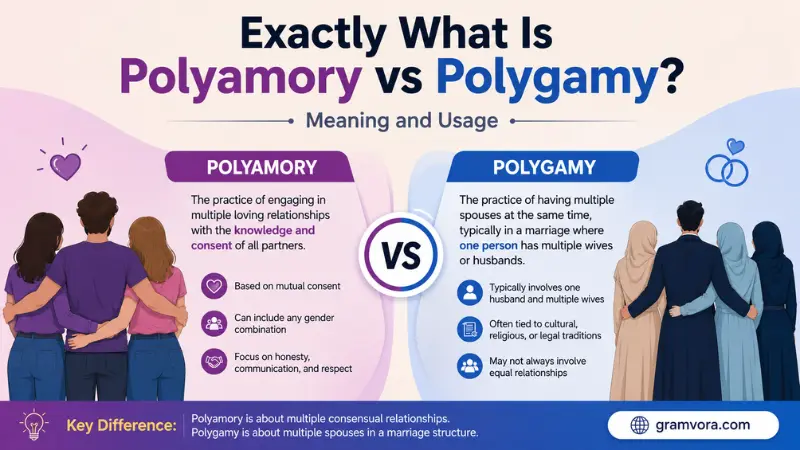
If you are asking what is polyamory vs polygamy, the key difference is straightforward: polyamory concerns multiple romantic relationships, while polygamy concerns having more than one spouse.
The words overlap because both involve more than one partner. However, they are not interchangeable. The relationship being described determines which term is more accurate.
Quick Answer
Use polyamory when you mean multiple romantic or intimate relationships that are openly known and consensual.
Use polygamy when you specifically mean marriage involving more than one spouse at the same time.
A person can be polyamorous without having multiple spouses. Likewise, a situation involving multiple spouses is more precisely described as polygamy.
The easiest question to ask is: Is having more than one spouse the defining feature?
- If yes, use polygamy.
- If the focus is multiple consensual romantic relationships, use polyamory.
Why People Confuse Them
The confusion is understandable. Both words begin with poly-, a word element associated with “many,” and both describe relationship arrangements involving more than two people.
Their second elements point toward different ideas. Polygamy is built around marriage, while polyamory is associated with love or romantic relationships.
The terms can also overlap. For example, someone may be married to one person and have another consensual romantic partner. That can be polyamory without being polygamy.
The important point is that the number of people alone does not determine the word.
Key Differences At A Glance
| Context | Best Choice | Why |
|---|---|---|
| One person has multiple spouses | Polygamy | Multiple spouses are central to the meaning. |
| Multiple consensual romantic relationships | Polyamory | Marriage is not required. |
| Discussion of plural marriage | Polygamy | The subject is specifically marriage. |
| Dating multiple people openly | Polyamory | The focus is multiple romantic relationships. |
| One spouse plus other agreed romantic partners | Polyamory | There is not necessarily more than one spouse. |
| Marriage involving several spouses | Polygamy | Multiple spouses define the arrangement. |
Meaning and Usage Difference
Polygamy is a noun for marriage in which a person has more than one spouse at the same time.
For example:
The class discussed polygamy in different societies.
The word itself does not mean only “one man with several wives.” That is a particular form of polygamy. The broader term covers multiple-spouse marriage.
Polyamory is also a noun. It refers to having more than one romantic or intimate relationship at the same time, generally with the knowledge and consent of the people involved.
For example:
They talked about polyamory before deciding what kind of relationship they wanted.
Marriage is not required for polyamory. A person can be unmarried, married to one partner, or involved in another arrangement while still using the term polyamory when multiple consensual romantic relationships are the focus.
Pronunciation can also help distinguish the words:
- polyamory: roughly pol-ee-AM-uh-ree
- polygamy: roughly puh-LIG-uh-mee
Tone, Context, and Formality
Both words are standard English nouns. Neither is simply slang or an informal spelling.
Polygamy commonly appears when the subject is marriage, family structure, law, history, culture, or religion. It is especially useful when multiple spouses are the specific subject.
Polyamory is more commonly used when discussing romantic relationships, intimacy, relationship agreements, and consensual non-monogamy.
Neither word is automatically more formal than the other. The better choice depends on what you are describing.
It is also important not to build the definition around assumptions about gender. Polygamy is the broader term for multiple-spouse marriage; more specific gender-based terms exist for particular arrangements.
Which One Should You Use?
Choose polygamy if the sentence is about having more than one spouse.
Choose polyamory if the sentence is about multiple romantic relationships that are openly understood and consensual.
Compare these examples:
The documentary examined polygamy in a historical community.
Here, the focus is multiple-spouse marriage.
Jordan practices polyamory and has two romantic partners.
Here, the sentence does not claim that Jordan has multiple spouses.
If marriage is central to the sentence, polygamy is usually the better choice. If the focus is multiple consensual romantic relationships, polyamory is usually more precise.
When One Choice Sounds Wrong
Polygamy can sound wrong when no multiple-spouse marriage is involved.
For example:
She is practicing polygamy because she is dating two people.
If the people involved are not spouses, polyamory may be the intended word.
A better version would be:
She practices polyamory because she has two consensual romantic relationships.
The reverse mistake is also possible. If a writer is specifically discussing a marriage with multiple spouses, replacing polygamy with polyamory can remove an important part of the meaning.
Still, some situations can fit both terms. The concepts are not mutually exclusive. The safest approach is to identify what the sentence is emphasizing.
Common Mistakes (and Quick Fixes)
Mistake: Treating polygamy as a general word for every relationship involving several people.
Fix: Use polygamy when multiple spouses or plural marriage are involved.
Mistake: Assuming polyamory means multiple marriages.
Fix: Polyamory does not require marriage.
Mistake: Assuming polygamy always means one husband and several wives.
Fix: That is one specific form. Polygamy is the broader term.
Mistake: Treating polyamory as another word for secret cheating.
Fix: Contemporary definitions of polyamory generally emphasize openness, knowledge, and consent.
Mistake: Assuming a married person cannot be polyamorous.
Fix: Marriage does not automatically prevent someone from having consensual romantic relationships with other people.
Everyday Examples
Polyamory
- They discussed polyamory before changing their relationship agreements.
- Her podcast explores communication in polyamorous relationships.
- He explained that polyamory does not require marrying every partner.
- The couple decided that polyamory was not right for them.
Polygamy
- The documentary examined the history of polygamy.
- The textbook discussed polygamy as a form of plural marriage.
- The class compared monogamy and polygamy.
- The article focused on laws involving polygamy.
These examples show why context matters. Multiple romantic relationships point toward polyamory, while multiple spouses point toward polygamy.
Dictionary-Style Word Details
Verb
- Polyamory: Polyamory is a noun and is not commonly used as a verb in standard US English.
- Polygamy: Polygamy is primarily a noun and is not commonly used as a verb in ordinary modern US English.
Natural expressions include practice polyamory and practice polygamy.
Noun
- Polyamory: The practice or state of having more than one romantic or intimate relationship at the same time, generally with knowledge and consent.
- Polygamy: The state or practice of having more than one spouse at the same time.
Both words commonly function as nouns naming relationship arrangements or practices.
Synonyms
Neither word has a perfect replacement in every sentence.
- Polyamory: Closest plain alternative: multiple consensual romantic relationships. A broader expression such as consensual non-monogamy should not automatically be treated as an exact synonym.
- Polygamy: Closest plain alternative: plural marriage.
Terms describing particular forms of polygamy are more specific and should not be treated as exact replacements for the broader word.
Example Sentences
Polyamory:
The discussion focused on communication and polyamory.
Polyamory:
She explained that polyamory can involve multiple romantic partners without requiring multiple marriages.
Polygamy:
The lecture examined polygamy as a form of plural marriage.
Polygamy:
The book compared monogamy and polygamy in different societies.
Word History
Polygamy is the older English term. Its history traces through Latin and Greek forms associated with multiple or repeated marriage.
Polyamory is a much more recent English formation. Merriam-Webster records its first known use in 1992, while Dictionary.com places its first recorded use in the early 1990s.
The different histories fit the modern distinction: polygamy developed as a term centered on marriage, while polyamory developed as a term centered on multiple romantic relationships.
Phrases Containing
Common phrases with polyamory include:
- practice of polyamory
- polyamory and monogamy
- discussion of polyamory
- polyamorous relationship
Common phrases with polygamy include:
- practice of polygamy
- history of polygamy
- laws concerning polygamy
- polygamous marriage
The related adjectives are polyamorous and polygamous.
FAQs
1. What is the difference between polyamory and polygamy?
Polyamory refers to having multiple romantic or intimate relationships with the knowledge and consent of everyone involved. Polygamy refers specifically to having more than one spouse at the same time.
2. Is polyamory the same as polygamy?
No. The terms are related but not interchangeable. Polyamory focuses on multiple consensual romantic relationships, while polygamy focuses on multiple spouses.
3. Can you be polyamorous without being married?
Yes. Polyamory does not require marriage. A person can have multiple consensual romantic relationships without being married to any of their partners.
4. Does polygamy always mean having multiple wives?
No. Polygamy is the broader term for having multiple spouses. Some specific forms describe particular gender arrangements, but polygamy itself is not limited to one gender pattern.
5. Can a married person be polyamorous?
Yes. Being married does not automatically prevent someone from practicing polyamory. The important distinction is whether the person’s other romantic relationships are openly understood and consensual.
6. Is polyamory considered cheating?
Polyamory itself is not defined as cheating. A key part of the modern meaning of polyamory is that the people involved know about and consent to the relationships.
7. Which word should I use for multiple spouses?
Use polygamy when you are specifically talking about marriage involving more than one spouse.
8. Which word should I use for dating multiple people?
Polyamory is generally the more appropriate term when you mean multiple consensual romantic relationships. Dating several people does not automatically mean someone is practicing polygamy.
9. Can polyamory and polygamy overlap?
Yes. A person involved in a plural marriage could also describe their relationships as polyamorous if multiple consensual romantic relationships are part of the arrangement. The terms emphasize different aspects of the relationship structure.
10. Is “polyamorous marriage” the same as polygamy?
Not necessarily. A marriage involving multiple spouses fits the meaning of polygamy, while polyamorous describes a broader approach to having multiple romantic relationships. The exact context determines which term is more precise.
Conclusion
The answer to what is polyamory vs polygamy comes down mainly to the feature being described.
Polyamory refers to multiple consensual romantic or intimate relationships and does not require marriage.
Polygamy refers specifically to having more than one spouse at the same time.
The two concepts can overlap, but they are not interchangeable. When multiple spouses are the central fact, choose polygamy. When multiple consensual romantic relationships are the focus, choose polyamory.


[…] The historical development of the individual words is not necessary to understand the modern distinction, and exact first-use dates are not needed for normal US-English usage. […]