
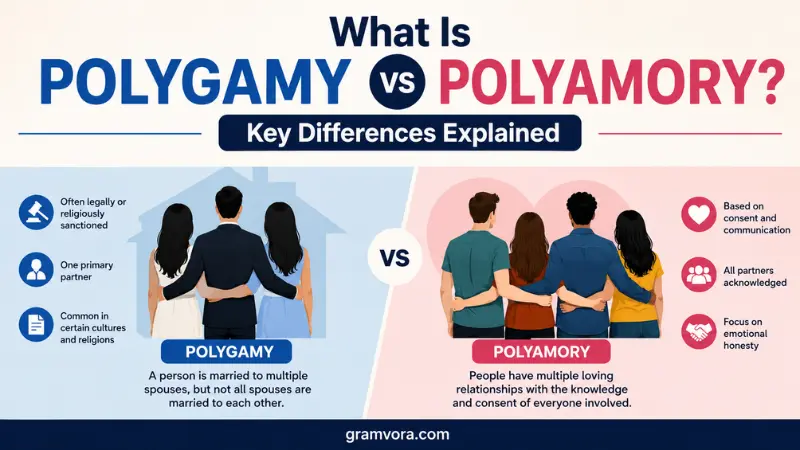
Polygamy and polyamory both involve more than two people, so it is easy to mix them up. The words also begin with poly-, which means “many.”
But they are not the same term.
The clearest difference is that polygamy is specifically about having more than one spouse, while polyamory refers to having multiple romantic or sexual relationships at the same time. Polyamory does not require marriage.
Quick Answer
If you are asking what is polygamy vs polyamory, use the words this way:
- Polygamy = marriage to more than one person at the same time.
- Polyamory = having more than one romantic or sexual relationship at the same time, generally with the knowledge and agreement of those involved.
So, polygamy is marriage-centered, while polyamory is relationship-centered.
For example:
- “The community practiced polygamy.”
- “They openly practice polyamory.”
A person can be polyamorous without being married to multiple people. By contrast, the defining feature of polygamy is having multiple spouses.
Why People Confuse Them
The confusion is understandable because both words describe forms of relationships involving multiple people.
They also share the prefix poly-, meaning “many.” The endings point toward different ideas: -gamy is associated with marriage, while -amory relates to love or loving relationships.
There is also some overlap in dictionary cross-references. Merriam-Webster lists polyamory among related words for polygamy and polygamy among related words for polyamory. That does not make them interchangeable. Their core definitions still differ.
Key Differences At A Glance
| Context | Best Choice | Why |
|---|---|---|
| More than one spouse | Polygamy | The word specifically refers to marriage involving multiple spouses. |
| Multiple romantic relationships | Polyamory | It describes multiple romantic or sexual relationships. |
| Multiple wives | Polygamy | This is a common form of polygamy; more specifically, it can be called polygyny. |
| Multiple husbands | Polygamy | This falls under polygamy; more specifically, it can be called polyandry. |
| Multiple partners without multiple marriages | Polyamory | Marriage is not required for polyamory. |
| Talking about an open romantic relationship | Polyamory | The term focuses on multiple relationships rather than multiple spouses. |
The main distinction is simple, but the terms can overlap in real-world situations. Someone could be married and also describe their relationship structure as polyamorous. The words answer different questions: polygamy describes multiple spouses, while polyamory describes multiple romantic relationships.
A second quick comparison
| Feature | Polygamy | Polyamory |
| Main focus | Marriage | Romantic or sexual relationships |
| Multiple spouses required? | Yes, by definition | No |
| Marriage required? | Yes | No |
| Consent emphasized in common definitions? | Not necessarily in the word itself | Common definitions often emphasize openness or agreement |
| Common grammatical role | Noun | Noun |
Meaning and Usage Difference
Polygamy is a noun for the practice or condition of being married to more than one person at the same time. Merriam-Webster also recognizes the broader sense of marriage in which a spouse may have more than one mate.
For example:
“The documentary examined the history of polygamy.”
Here, the writer is talking about a marriage system involving multiple spouses.
Polyamory is also a noun. It refers to the practice or state of having multiple romantic or sexual relationships at the same time. Major dictionaries commonly describe openness, awareness, or agreement among the people involved as part of the concept.
For example:
“They decided to explore polyamory together.”
That sentence does not say that anyone has multiple spouses. It describes a relationship structure involving multiple romantic connections.
One useful way to remember the distinction is:
Polygamy asks, “How many spouses?”
Polyamory asks, “How many romantic relationships?”
The distinction is not a claim that every polyamorous relationship looks the same. Polyamory can take different forms. The important point for word choice is that marriage is central to polygamy, while it is not required by polyamory.
Tone, Context, and Formality
Both polygamy and polyamory are standard nouns in US English. Neither is inherently slang.
Polygamy often appears in discussions of marriage, family structures, religion, history, anthropology, and social practices.
Examples:
- “The book examines polygamy in several societies.”
- “The law addresses marriage and polygamy.”
- “The researcher studied polygamy as a form of marriage.”
Polyamory is more likely to appear in discussions of modern relationships, dating, sexuality, relationship structures, and consensual non-monogamy.
Examples:
- “She identifies as polyamorous.”
- “They talked about whether polyamory would work for them.”
- “The podcast discussed communication in polyamorous relationships.”
Pronunciation is worth noting because the words can sound similar when spoken quickly:
- polygamy: puh-LIG-uh-mee
- polyamory: pol-ee-AM-uh-ree
The stress pattern helps distinguish them in conversation. Cambridge gives US pronunciations of approximately /pəˈlɪɡ.ə.mi/ for polygamy and /ˌpɑː.liˈæm.ɚ.i/ for polyamory.
Which One Should You Use?
Choose polygamy when your sentence is specifically about marriage involving more than one spouse.
Choose polyamory when you mean multiple romantic or sexual relationships, especially when marriage is not the defining feature.
Compare:
- “They practice polygamy.” → They have a marriage arrangement involving multiple spouses.
- “They practice polyamory.” → They have multiple romantic or sexual relationships.
If you are describing a relationship that involves several romantic partners but no multiple-spouse marriage, polyamory is the more precise choice.
If the central fact is that someone is married to several people, polygamy is the appropriate word.
When One Choice Sounds Wrong
Some substitutions make a sentence misleading.
Less precise:
“They practice polyamory because one person has three wives.”
Better:
“They practice polygamy because one person has three wives.”
The first sentence uses a broader relationship term when the specific fact being described is multiple marriage.
Another example:
Less precise:
“They practice polygamy because they have several romantic partners but only one spouse.”
Better:
“They practice polyamory because they have several romantic partners.”
Here, there is no multiple-spouse marriage, so polygamy does not accurately describe the situation.
Be careful with the opposite mistake, too. Do not assume that every polyamorous relationship involves several marriages. It does not.
Also, do not automatically define polygamy as “one man with many wives.” That is a common form called polygyny, but polygamy is the broader term for marriage involving multiple spouses.
Common Mistakes (and Quick Fixes)
Mistake 1: Treating polygamy and polyamory as exact synonyms
Fix: Use polygamy for multiple spouses and polyamory for multiple romantic or sexual relationships.
Mistake 2: Assuming polyamory always means multiple marriages
Fix: Marriage is not required for polyamory.
Mistake 3: Defining polygamy only as one husband with several wives
Fix: That is more specifically polygyny. Polygamy is the broader marriage term.
Mistake 4: Assuming polyamory is only about sex
Fix: Polyamory can involve romantic and emotional relationships as well as sexual relationships.
Mistake 5: Assuming the word “polyamory” automatically describes every form of non-monogamy
Fix: Use the term when multiple romantic or sexual relationships are actually what you mean. Do not use it as a catch-all for every relationship arrangement involving more than two people.
Everyday Examples
Here are some natural US-English examples:
- “The documentary explored polygamy as a marriage system.”
- “The family was part of a polygamous community.”
- “She is interested in learning more about polyamory.”
- “They describe their relationship as polyamorous.”
- “The couple discussed whether they wanted to explore polyamory.”
- “The article distinguishes polygamy from other forms of non-monogamy.”
- “Polygamy involves multiple spouses.”
- “Polyamory can involve multiple romantic relationships without multiple marriages.”
A useful pair to remember is:
Polygamy = multiple spouses.
Polyamory = multiple romantic or sexual relationships.
That distinction will resolve most everyday questions about the two words.
Dictionary-Style Word Details
Verb
- Polygamy: Not commonly used as a verb in standard US English. The related verb polygamize is listed by Merriam-Webster, but it is uncommon in everyday writing.
- Polyamory: Not commonly used as a verb in standard US English. Use the noun polyamory or an appropriate adjective such as polyamorous instead.
Noun
- Polygamy: A noun meaning marriage in which a person has more than one spouse at the same time. It is normally treated as an uncountable noun when referring to the practice generally.
- Polyamory: A noun referring to the practice or state of having multiple romantic or sexual relationships at the same time. It is generally used as an uncountable noun.
Synonyms
- Polygamy: Closest plain alternatives include plural marriage and, in specific contexts, multiple-spouse marriage. Polygyny and polyandry are related but more specific terms, so they are not exact synonyms.
- Polyamory: There is no single perfect everyday synonym. Multiple consensual romantic relationships is a close plain-language description, but it is a description rather than an exact replacement.
Antonyms: Monogamy can serve as a meaningful contrast for both terms because it refers to having only one spouse or one sexual/romantic partner at a time, depending on context.
Example Sentences
- Polygamy: “The article examines the history of polygamy.”
- Polygamy: “Polygamy involves marriage to more than one person at the same time.”
- Polyamory: “They openly discuss polyamory with their partners.”
- Polyamory: “Polyamory does not require a person to have multiple spouses.”
Word History
- Polygamy: Merriam-Webster traces the word to Greek polygamía through Late Latin and gives a first known use of 1538.
- Polyamory: Merriam-Webster gives a first known use of 1992 and describes the formation as related to polyamorous plus the noun-forming ending -y.
The histories explain why the words look related, but their modern meanings should still be kept separate.
Phrases Containing
- Polygamy: “practice of polygamy,” “polygamous marriage,” “polygamy laws,” “history of polygamy”
- Polyamory: “practice of polyamory,” “polyamorous relationship,” “polyamory community,” “exploring polyamory”
These common combinations reflect the central difference: polygamy commonly modifies or describes marriage, while polyamory commonly describes a relationship structure or practice.
FAQs
1. What is the main difference between polygamy and polyamory?
Polygamy refers to marriage involving more than one spouse. Polyamory refers to having multiple romantic or sexual relationships at the same time, with the knowledge or agreement of the people involved.
2. Is polygamy the same as polyamory?
No. The terms are related but not identical. Polygamy focuses on multiple spouses, while polyamory focuses on multiple romantic or sexual relationships.
3. Can someone be polyamorous without being married?
Yes. Polyamory does not require marriage. A person can have multiple romantic relationships without being married to multiple partners.
4. Does polygamy always mean one man with multiple wives?
No. Polygamy is the broader term for marriage involving multiple spouses. One man with multiple wives is more specifically called polygyny.
5. Does polyamory mean having multiple spouses?
Not necessarily. Polyamory can involve multiple romantic relationships without multiple marriages. Marriage is not what defines polyamory.
6. Is polyamory always about sex?
No. Polyamory can involve romantic, emotional, and sexual relationships. The key idea is having multiple consensual romantic relationships rather than simply having multiple sexual partners.
7. Which word should I use for multiple marriages?
Use polygamy when you are specifically talking about marriage involving more than one spouse.
8. Which word should I use for multiple romantic relationships?
Use polyamory when you mean having multiple romantic or sexual relationships at the same time.
9. Is polygamy a noun or an adjective?
Polygamy is a noun. The related adjective is polygamous. For example: “The study examined polygamy” and “They discussed polygamous marriage.”
10. Is polyamory a noun or an adjective?
Polyamory is a noun. The related adjective is polyamorous. For example: “They practice polyamory” and “They have a polyamorous relationship.”
Conclusion
So, what is polygamy vs polyamory?
Polygamy means marriage involving more than one spouse. Polyamory means having multiple romantic or sexual relationships at the same time, without requiring multiple marriages.
They overlap because both involve relationships with more than one person, but they are not interchangeable.
When marriage and multiple spouses are the focus, choose polygamy. When multiple romantic or sexual relationships are the focus, choose polyamory.


