
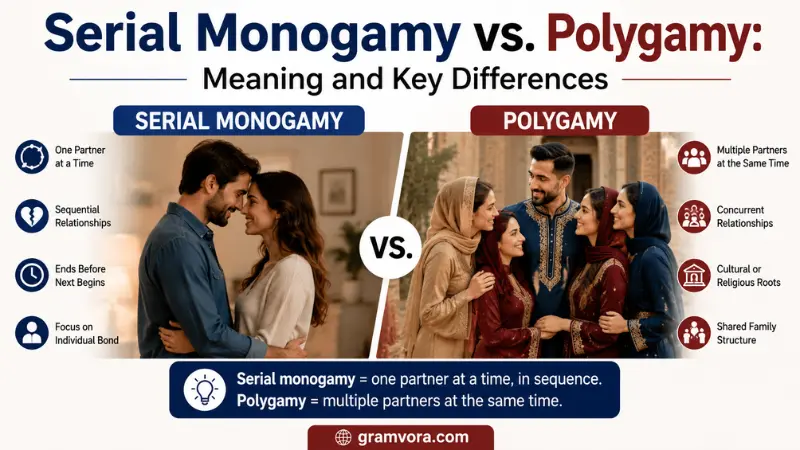
Serial monogamy and polygamy both involve the idea of having more than one partner over the course of a life, but they describe very different relationship patterns.
The key difference is timing. Serial monogamy involves one partner at a time, with relationships occurring one after another. Polygamy involves more than one spouse at the same time.
So, both terms are correct. The right choice depends on whether the relationships are successive or simultaneous.
Quick Answer
Use serial monogamy when someone has a series of exclusive relationships, with only one partner at a time.
Use polygamy when someone is married to more than one spouse at the same time.
For example:
- “After two divorces and remarriages, he has practiced serial monogamy.”
- “The community permits polygamy, so some people have multiple spouses at the same time.”
The easiest way to remember the distinction is:
Serial monogamy = one at a time.
Polygamy = more than one at the same time.
Why People Confuse Them
The confusion comes from the fact that both terms can involve more than one partner over a person’s lifetime.
Someone practicing serial monogamy may have several spouses or long-term partners over many years. However, each relationship occurs separately. One relationship ends before another begins, at least in the relationship pattern being described.
Polygamy is different because the defining feature is simultaneous marriage to multiple spouses.
There is also some specialized disagreement about how relationship patterns should be classified. In some academic discussions, repeated marriages can be considered a broader form of multiple partnering. In ordinary US English, however, serial monogamy and polygamy normally communicate different situations.
Key Differences At A Glance
| Feature | Serial monogamy | Polygamy |
|---|---|---|
| Number of partners at one time | One | More than one spouse |
| Relationship pattern | Successive | Simultaneous |
| Multiple partners over a lifetime | Yes | May be yes |
| Main idea | One exclusive relationship after another | Multiple spouses at the same time |
| Standard grammatical role | Noun phrase | Noun |
Quick comparison:
Serial monogamy emphasizes the sequence of relationships. Polygamy emphasizes having multiple spouses concurrently.
Meaning and Usage Difference
Serial monogamy is a noun phrase. It describes a pattern in which a person has one romantic, sexual, or marital partner at a time but may have different partners at different points in life.
For example:
After ending her first marriage, she eventually remarried and continued a pattern of serial monogamy.
The phrase does not necessarily mean that every relationship is short. The important point is that the relationships occur one after another rather than simultaneously.
Polygamy is also a noun. It refers to marriage involving more than one spouse at the same time.
For example:
The article discussed societies where polygamy is part of the recognized marriage system.
The central distinction is therefore not simply the number of people involved over a lifetime. It is whether multiple spouses exist at the same time.
Tone, Context, and Formality
Both terms are established English nouns, but their typical contexts differ.
Serial monogamy often appears in discussions of relationships, sociology, psychology, anthropology, and modern dating patterns. In casual conversation, people may simply describe someone as having “one relationship after another.”
Polygamy is more directly associated with marriage systems and social or cultural practices. It can appear in legal, historical, religious, sociological, and general news discussions.
“Serial monogamy” can sometimes sound analytical or academic when used in everyday conversation. “Polygamy” is more familiar as a general term for a marriage arrangement involving multiple spouses.
Pronunciation can also help distinguish them:
- serial monogamy: roughly “SEER-ee-ul muh-NOG-uh-mee”
- polygamy: roughly “puh-LIG-uh-mee”
The pronunciation of polygamy is especially useful to know because the stress falls on the second syllable.
Which One Should You Use?
Choose serial monogamy if you are describing:
- Several exclusive relationships over time
- Multiple marriages occurring one after another
- A person who has one partner at a time but changes partners over the years
- A relationship pattern involving successive partnerships
Choose polygamy if you are describing:
- More than one spouse at the same time
- A marriage system that permits multiple spouses concurrently
- A person who has multiple simultaneous spouses
The choice is not mainly about whether someone has had several partners. It is about when those relationships overlap.
When One Choice Sounds Wrong
Calling a series of separate marriages polygamy can be misleading in ordinary US English because polygamy normally points to multiple spouses at the same time.
For example:
He married three different people over 30 years, one after another.
Serial monogamy fits this description better.
By contrast, if a person is simultaneously married to several spouses, calling that serial monogamy would be inaccurate because the relationships are not occurring one at a time.
A useful correction is:
- Several marriages, one after another → serial monogamy
- Several spouses at the same time → polygamy
Common Mistakes (and Quick Fixes)
Mistake 1: Treating the terms as exact synonyms
Incorrect idea: “Serial monogamy and polygamy mean having several spouses.”
Better: Serial monogamy involves successive relationships; polygamy involves multiple spouses at the same time.
Mistake 2: Assuming several ex-spouses automatically means polygamy
Having several former spouses does not by itself mean a person was practicing polygamy.
Better:
She has been married three times, but only to one spouse at a time.
Mistake 3: Using serial monogamy for simultaneous relationships
If several spouses are present at the same time, serial monogamy is not the clearest term.
Better:
The marriage system allows multiple spouses at the same time.
Mistake 4: Thinking “serial” means cheating
Serial monogamy describes the sequence of relationships. It does not automatically mean that someone was unfaithful or had overlapping relationships.
Everyday Examples
Here are natural examples showing the difference:
Serial monogamy:
After his first marriage ended, he eventually married again.
She has had three serious relationships, but only one partner at a time.
His dating history is an example of serial monogamy.
They divorced after ten years, and she later entered another exclusive relationship.
Polygamy:
The documentary examined communities where polygamy is practiced.
Polygamy involves having more than one spouse at the same time.
The discussion focused on the social structure of a polygamous marriage.
The writer carefully distinguished simultaneous spouses from relationships that happen one after another.
Notice that the first group focuses on sequence, while the second focuses on simultaneous spouses.
Dictionary-Style Word Details
Verb
- Serial monogamy: Not commonly used as a verb in standard US English. It is a noun phrase.
- Polygamy: Not commonly used as a verb in standard US English. It is a noun. Related forms such as polygamous and polygamist are used in other grammatical roles.
Noun
- Serial monogamy: An uncountable noun phrase describing a pattern of successive exclusive relationships.
- Polygamy: An uncountable noun describing marriage involving more than one spouse at the same time.
Examples:
Serial monogamy can involve several relationships over a lifetime.
Polygamy involves more than one spouse at the same time.
Synonyms
Exact synonyms are limited because each term carries a specific meaning.
- Serial monogamy: Closest plain alternative: “a series of one-partner relationships.” This explains the meaning but is not a replacement in every sentence.
- Polygamy: Closest plain alternative: “multiple-spouse marriage.” This is a straightforward explanation rather than a perfect synonym.
For polygamy, monogamy is a genuine contrasting term because monogamy involves one spouse or partner at a time.
Example Sentences
- Serial monogamy: “Her relationship history followed a pattern of serial monogamy.”
- Serial monogamy: “He has had several long-term partners, but only one at a time.”
- Polygamy: “The book examines the history of polygamy in different societies.”
- Polygamy: “The law does not recognize a marriage involving multiple spouses at the same time.”
Word History
Serial monogamy is a relatively modern expression. Dictionary sources place its first recorded use in the 1970–75 period.
Polygamy is much older. Merriam-Webster records its first known use as 1538, with the word ultimately connected to Greek roots relating to multiple marriage.
The historical difference in age does not determine their modern meanings. In contemporary US English, the important distinction remains the difference between successive and simultaneous relationships.
Phrases Containing
- Serial monogamy: “a pattern of serial monogamy,” “serial monogamy over a lifetime,” “practice serial monogamy”
- Polygamy: “practice polygamy,” “polygamy is permitted,” “polygamous marriage,” “history of polygamy”
These phrases show how each term normally functions as a noun describing a relationship or marriage pattern.
FAQs
1. What is the difference between serial monogamy and polygamy?
Serial monogamy means having one partner at a time but having different partners in succession. Polygamy means being married to more than one spouse at the same time.
2. Is serial monogamy the same as polygamy?
No. They describe different relationship patterns. Serial monogamy involves relationships that happen one after another, while polygamy involves multiple spouses at the same time.
3. Can someone be a serial monogamist?
Yes. A serial monogamist typically has a series of exclusive relationships, with one partner at a time.
4. Does having multiple ex-spouses make someone polygamous?
No. Having several ex-spouses does not necessarily mean someone practiced polygamy. If the marriages occurred one after another, serial monogamy is the more appropriate description.
5. Does serial monogamy mean having multiple partners?
It can mean having multiple partners over a lifetime, but not necessarily at the same time. The defining idea is one partner at a time.
6. Does polygamy mean dating multiple people?
Not necessarily. Polygamy specifically concerns marriage involving multiple spouses at the same time. Dating several people is not automatically polygamy.
7. Which term should I use for several relationships over time?
Use serial monogamy when the relationships are successive and involve one partner at a time.
8. Which term describes multiple spouses at once?
Polygamy is the appropriate term when a person has multiple spouses simultaneously.
9. Is serial monogamy considered monogamy?
Yes, the phrase describes a pattern of monogamous relationships occurring successively. The “serial” part emphasizes that a person may have several relationships over time.
10. Can serial monogamy involve marriage?
Yes. Someone may marry one person, end that marriage, and later marry another person. A repeated pattern of this kind can be described as serial monogamy.
Conclusion
Serial monogamy vs. polygamy is mainly a question of timing.
Serial monogamy means having one partner at a time while moving through a series of relationships. Polygamy means having more than one spouse at the same time.
So, if the relationships happen one after another, choose serial monogamy. If multiple spouses exist at the same time, choose polygamy.
Both terms are correct. They simply describe different relationship patterns.


[…] serial monogamy […]