
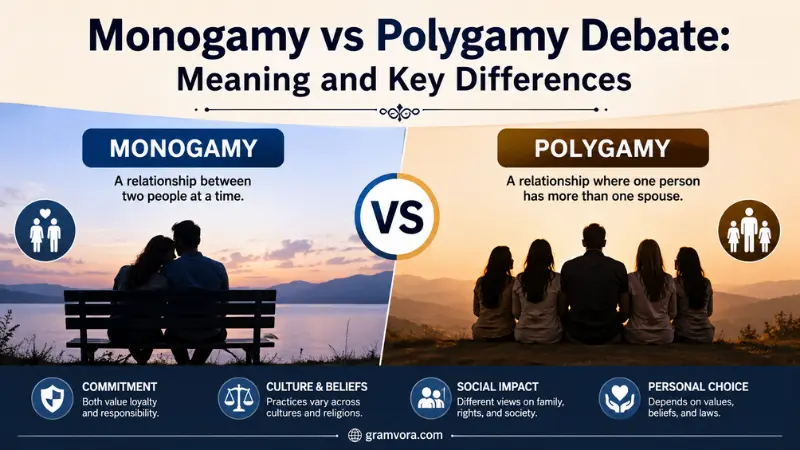
The monogamy vs polygamy debate is partly about relationships and partly about using the right words. The two terms are both standard English nouns, but they describe different relationship or marriage structures.
Monogamy generally means having one spouse or one romantic or sexual partner at a time. Polygamy generally means being married to more than one person at the same time.
The important point is that this is not a question of which word is grammatically correct. Both are correct. The choice depends on what you mean.
Quick Answer
Use monogamy when you mean a relationship or marriage involving one partner at a time.
Use polygamy when you mean marriage involving more than one spouse at the same time.
For example:
- “They chose monogamy because they wanted an exclusive relationship.”
- “The book examines polygamy as a form of marriage.”
So, if you are asking which word is correct, the answer is: both are correct, but they do not mean the same thing.
Why People Confuse Them
The words look almost like opposites because their prefixes suggest different numbers. Mono- relates to one, while poly- relates to many.
The confusion becomes greater because everyday discussions sometimes use relationship terminology loosely. Someone may use polygamy to describe having several romantic partners, even though the word specifically centers on having multiple spouses in its standard definition.
That distinction matters when you want your writing to be precise.
Key Differences At A Glance
| Feature | Monogamy | Polygamy |
|---|---|---|
| Core meaning | One partner or spouse at a time | More than one spouse at the same time |
| Main grammatical role | Noun | Noun |
| Marriage context | One spouse at a time | Multiple spouses at the same time |
| Relationship context | Often one romantic or sexual partner | Primarily multiple-spouse marriage |
| Standard US English | Correct | Correct |
| Basic contrast | One | More than one |
The simplest distinction is one at a time versus more than one spouse at the same time.
Meaning and Usage Difference
Monogamy has a somewhat broader everyday relationship use. Dictionaries define it in terms of marriage to one person at a time and, in some definitions, a sexual relationship with one partner at a time.
For example:
“They decided that monogamy was important to their relationship.”
Here, the word describes an expectation of having one partner at a time.
Polygamy is more specifically associated with marriage to multiple people at the same time.
For example:
“The documentary examines the history of polygamy.”
The word does not simply mean “dating several people.” Its standard meaning is connected to multiple-spouse marriage.
Tone, Context, and Formality
Both words are neutral dictionary terms, but polygamy can appear in discussions involving law, religion, culture, history, and marriage.
Monogamy is common in everyday conversations about dating, marriage, commitment, and relationship expectations.
Neither word is inherently informal. The surrounding sentence determines the tone.
For example, a casual conversation might say:
“We’re looking for a monogamous relationship.”
A more academic sentence might say:
“The study examines social attitudes toward monogamy.”
Likewise, polygamy can appear in both ordinary and formal writing:
“The novel explores a family living in a polygamous marriage.”
Which One Should You Use?
Choose monogamy when the central idea is one partner at a time.
Choose polygamy when the central idea is multiple spouses at the same time.
| Context | Best Choice | Why |
|---|---|---|
| One spouse at a time | Monogamy | It describes a one-spouse marriage structure. |
| One romantic partner at a time | Monogamy | The word is also used for exclusive relationships. |
| Multiple spouses at once | Polygamy | This is the core meaning of the word. |
| Comparing one-spouse and multiple-spouse marriage | Both | Each term identifies one side of the comparison. |
| Writing about a multiple-spouse marriage system | Polygamy | The word directly names that system. |
The safest approach is to match the word to the structure you are actually describing.
When One Choice Sounds Wrong
Polygamy can sound inaccurate when the sentence only describes having multiple romantic relationships without marriage. Its standard definition centers on multiple spouses.
For example, saying:
“She practices polygamy because she is dating three people.”
may be misleading if marriage is not involved.
Similarly, monogamy may be the wrong choice when the sentence clearly describes simultaneous multiple-spouse marriage.
A useful correction is to ask: Am I describing one partner or multiple spouses, and am I talking specifically about marriage?
Common Mistakes (and Quick Fixes)
Mistake: Treating monogamy and polygamy as interchangeable.
Fix: Use monogamy for one partner or spouse at a time and polygamy for multiple spouses at the same time.
Mistake: Assuming polygamy simply means “dating more than one person.”
Fix: Reserve polygamy for its marriage-based meaning.
Mistake: Thinking one word is grammatically correct and the other is incorrect.
Fix: Both are standard nouns. The difference is meaning, not spelling or grammar.
Mistake: Using polygamy as though it automatically means one particular gender arrangement.
Fix: In its broad sense, polygamy refers to marriage involving more than one spouse; more specific terminology may be needed when the gender arrangement matters.
Everyday Examples
Here are natural examples of each word:
- “They agreed that monogamy was important before getting married.”
- “The couple described their marriage as monogamous.”
- “The course discussed monogamy and different marriage systems.”
- “The documentary examined polygamy in several societies.”
- “The article describes the legal and social debates surrounding polygamy.”
- “Their research compared attitudes toward monogamy and polygamy.”
Notice that the words are not interchangeable. The sentence determines which term communicates the intended meaning.
Dictionary-Style Word Details
Verb
- Monogamy: Not commonly used as a verb in standard US English. It is primarily a noun.
- Polygamy: Primarily a noun in standard US English. Verb forms are uncommon in ordinary writing.
The more natural construction is usually to use the noun with a verb:
“They practice monogamy.”
“The study examines polygamy.”
Noun
- Monogamy: A noun referring to the practice or condition of having one spouse or partner at a time.
- Polygamy: A noun referring to marriage involving more than one spouse at the same time.
Both are generally treated as uncountable nouns when discussing the general practice or relationship structure.
Synonyms
- Monogamy: There is no perfect one-word synonym. “One-partner relationship” or “one-spouse marriage” can serve as closest plain alternatives when the context is clear.
- Polygamy: “Plural marriage” is a close plain alternative when the discussion specifically concerns marriage involving multiple spouses.
The alternatives are not always exact replacements, so the original terms are often the clearest choices.
As opposites, monogamy and polygamy provide a direct contrast in their core meanings.
Example Sentences
Monogamy
“Monogamy was important to them when they discussed marriage.”
“She prefers a monogamous relationship.”
Polygamy
“The documentary examined polygamy from a historical perspective.”
“The class discussed different attitudes toward polygamy.”
Word History
Both words contain the Greek-root element -gamy, associated with marriage.
Monogamy is built around the idea of one, while polygamy uses the idea of many. Their histories therefore help explain why the words function as contrasting terms.
The exact historical development is less important for modern usage than the distinction the words retain today: one versus multiple spouses or partners, depending on context.
Phrases Containing
Common expressions include:
- practice monogamy
- monogamous marriage
- monogamy in relationships
- monogamy and marriage
- practice polygamy
- polygamous marriage
- polygamy and marriage
- polygamous family
These phrases make the intended meaning clear without changing the basic definitions of the two words.
FAQs
1. What is the difference between monogamy and polygamy?
Monogamy generally means having one spouse or romantic partner at a time. Polygamy generally refers to marriage involving more than one spouse at the same time.
2. Is monogamy the opposite of polygamy?
Yes, in their basic meanings, they contrast with each other. Monogamy involves one spouse or partner at a time, while polygamy involves multiple spouses at the same time.
3. Which is more common, monogamy or polygamy?
Monogamy is more common in contemporary US marriage and relationship culture. Polygamy is much less common.
4. Is polygamy the same as having multiple romantic partners?
Not necessarily. Polygamy specifically relates to marriage involving multiple spouses. Having multiple romantic partners does not automatically mean a person is practicing polygamy.
5. Is monogamy only about marriage?
No. The term can also describe a romantic or sexual relationship involving one partner at a time, depending on the context.
6. Are monogamy and polygamy nouns?
Yes. Monogamy and polygamy are primarily nouns. They name different relationship or marriage structures.
7. Can monogamy and polygamy be used interchangeably?
No. They have different meanings. Use monogamy for one-partner or one-spouse relationships and polygamy for multiple-spouse marriage.
8. Why do people debate monogamy and polygamy?
The debate can involve personal values, relationship expectations, cultural practices, and beliefs about marriage. The words themselves, however, have distinct meanings.
9. Is polygamy the same as an open relationship?
No. Polygamy specifically concerns marriage involving multiple spouses. An open relationship can involve consensual relationships outside a primary partnership without involving multiple marriages.
10. Which word should I use: monogamy or polygamy?
Use monogamy when you mean one spouse or partner at a time. Use polygamy when you mean marriage involving multiple spouses at the same time.
Conclusion
The monogamy vs polygamy debate involves more than choosing between two similar-looking words. The terms describe different relationship structures.
Monogamy refers to having one spouse or partner at a time, while polygamy refers primarily to marriage involving more than one spouse at the same time.
So, neither word is “more correct.” Use monogamy for the one-partner structure and polygamy for the multiple-spouse structure. Keeping that distinction clear will make your writing more accurate and easier to understand.


