
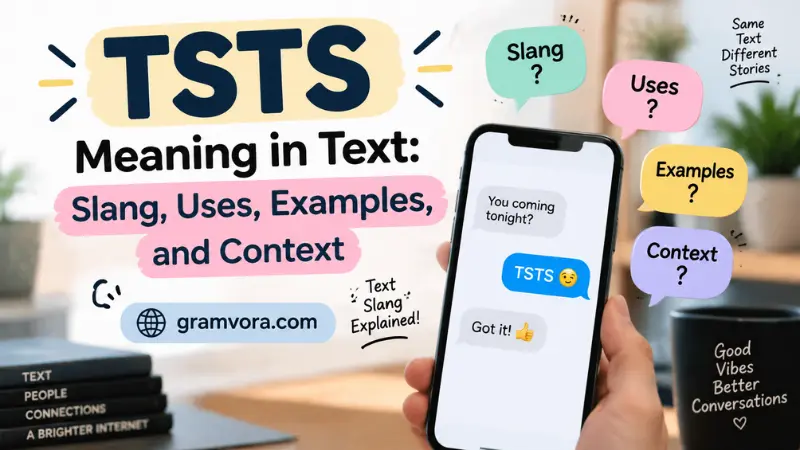
If someone sends you “TSTS,” the meaning may not be obvious. This short expression appears in texts, group chats, comments, and direct messages.
Unlike common abbreviations, TSTS does not have one widely accepted definition. Different online communities can use the same letters for different phrases.
One current slang use expands TSTS as “type shit, type shit.” In that use, it usually signals agreement, approval, or a shared attitude.
The lowercase form can also resemble “tsk tsk.” That reading can express teasing, mild disapproval, or playful judgment.
Other sources report expansions such as “too smart to talk stupid” and “too soon to say.” These meanings are less dependable without context.
This guide explains TSTS in plain English. You will learn the main meanings, common uses, examples, tone, pronunciation, and ways to avoid misunderstanding it.
Quick Answer
TSTS meaning in text is context-dependent. A current slang use is “type shit, type shit,” often showing agreement or approval.
It can also resemble “tsk tsk,” especially when it expresses playful disapproval. Always check the surrounding message before choosing a meaning.
TL;DR
• TSTS does not have one fixed meaning.
• “Type shit, type shit” is a current slang use.
• Lowercase “tsts” can suggest “tsk tsk.”
• Some users give TSTS other expansions.
• Tone depends heavily on the conversation.
• It is best for casual communication.
What Does TSTS Mean in Text?
TSTS is an uncommon texting expression with several reported meanings. Its interpretation depends on the people involved and the surrounding message.
A current slang use is “type shit, type shit.” Here, the repeated phrase acts as an emphatic reaction.
For example:
“I stopped arguing because it wasn’t worth my time.”
“TSTS.”
The reply can suggest agreement or shared understanding. It may carry a feeling similar to “Exactly” or “That’s the vibe.”
TSTS is not as standardized as familiar abbreviations such as “LOL” or “BRB.” Many readers may not recognize it immediately.
That makes context especially important. The same four letters can produce different interpretations in different conversations.
Other Meanings of TSTS
Several other meanings appear online, but they are not equally established. You should avoid treating every reported expansion as universal.
“Type Shit, Type Shit”
This is a current slang reading found in recent online usage. It works mainly as a casual reaction.
The phrase contains profanity, so it is very informal. It is more suitable for close friends than formal communication.
Example:
“That new song is exactly my style.”
“TSTS 🔥”
Here, TSTS reinforces the speaker’s reaction.
“Tsk Tsk”
Lowercase “tsts” can also represent a sound similar to “tsk tsk.” In English writing, “tsk” represents a sound associated with disapproval.
This interpretation is easier to recognize when the message includes teasing or criticism.
Example:
“You said you wouldn’t eat the last cookie.”
“Tsts 😂”
The sender may be playfully saying, “Tsk tsk.”
“Too Smart to Talk Stupid”
Some texting references use TSTS for “too smart to talk stupid.” This meaning suggests that someone does not want to join a silly or pointless conversation.
Example:
“Why didn’t you argue with him?”
“TSTS. I wasn’t wasting my time.”
This version can sound confident or dismissive. It may even sound arrogant if the relationship is not close.
“Too Soon to Say”
Some sources also report “too soon to say.” In this reading, the sender does not yet have enough information to answer.
Example:
“Are you moving next year?”
“TSTS. I haven’t decided.”
This expansion is possible, but the context must clearly support it.
How TSTS Is Used in Messages
TSTS usually appears in casual digital communication. You may see it in texts, group chats, comments, or direct messages.
It often functions as a short reaction. The sender may use it instead of writing a complete response.
For example:
“I’m staying home tonight.”
“TSTS.”
The response may express agreement with the choice.
It can also appear after an opinion:
“That movie was way better than I expected.”
“TSTS.”
In a different conversation, the same spelling may carry playful disapproval:
“I forgot my keys again.”
“Tsts 🙄”
The emoji and situation make the second interpretation more likely.
TSTS therefore adds tone more than precise information. The surrounding message often matters more than the four letters themselves.
How to Tell Which Meaning Is Intended
Start by reading the message immediately before TSTS. Ask what kind of response would make sense there.
| Context | Best Interpretation | Why |
|---|---|---|
| Reply to an opinion | “Type shit, type shit” | It can show agreement |
| Reaction to a mistake | “Tsk tsk” | It can signal playful disapproval |
| Discussion about a silly argument | “Too smart to talk stupid” | The context supports dismissal |
| Question about an undecided matter | “Too soon to say” | The response signals uncertainty |
Punctuation can provide another clue. “Tsts…” may feel more teasing or doubtful than “TSTS 🔥.”
Emojis can also change the tone. Laughing, rolling-eyes, or smirking emojis can suggest playful intent.
Capitalization is less reliable. Uppercase letters may look like an abbreviation, while lowercase letters may look like a sound.
When the message still makes no sense, ask the sender. A simple question is better than confidently choosing the wrong meaning.
Pronunciation and Part of Speech
TSTS does not have one standard pronunciation because it is an uncommon internet expression.
When treated as an abbreviation, many readers would simply say the letters individually: “T-S-T-S.” However, people may also read it silently when texting.
If the writer means “tsk tsk,” the related English sound is commonly pronounced like “tisk tisk.”
Cambridge identifies “tsk” as an exclamation used in writing to represent a sound of disapproval. Merriam-Webster likewise treats “tsk” as an interjection expressing disapproval.
In sentence function, TSTS is usually a texting abbreviation or reaction. It can behave similarly to an interjection when it stands alone.
Example:
“TSTS. I totally agree.”
Here, it acts as a short reaction before the main statement.
It is not normally used as a standard noun, verb, adjective, or adverb in formal English.
TSTS Examples in Real Messages
Here are practical examples showing different possible readings.
Agreement or Shared Reaction
“I’m deleting the app for a while.”
“TSTS. Same.”
The sender is supporting the previous statement.
Strong Approval
“We finally got tickets for the concert!”
“TSTS 🔥”
Here, TSTS works as an enthusiastic reaction.
Playful Disapproval
“I ate the last slice of pizza.”
“Tsts 😂”
The writer may be teasing rather than expressing serious anger.
Dismissive Tone
“Why didn’t you argue with that random comment?”
“TSTS. Not worth it.”
Here, the intended expansion may relate to avoiding pointless conversation.
Uncertainty
“Do you think they’ll approve it?”
“TSTS. We’ll have to wait.”
In this situation, “too soon to say” may fit better than a slang reaction.
These examples show why a dictionary-style expansion alone cannot solve every TSTS message.
Is TSTS Rude or Appropriate?
TSTS can be harmless among friends. Its tone depends on the meaning, relationship, and surrounding conversation.
The “type shit, type shit” interpretation contains profanity. Even when used casually, it may not suit professional or formal communication.
The “tsk tsk” interpretation can sound playful. However, it may also sound judgmental when the relationship is distant.
The “too smart to talk stupid” interpretation carries another risk. It can make the sender sound superior or dismissive.
For school, work, customer communication, or formal writing, use clearer words instead.
Instead of TSTS, you could write:
• “I agree.”
• “Exactly.”
• “I’m not sure yet.”
• “That’s not worth arguing about.”
• “Are you serious?”
Clear wording removes the uncertainty that comes with TSTS.
Common Mistakes and Confusions
Mistake 1: Assuming TSTS has one fixed meaning
There is no universal definition that works in every message.
Better approach: Read the surrounding conversation first.
Mistake 2: Treating every TSTS expansion as equally common
Online sources report many different meanings. Some have stronger current evidence than others.
Better approach: Use context to decide which interpretation fits.
Mistake 3: Assuming it always means “tsk tsk”
The spelling can resemble “tsk tsk,” but that is only one possible reading.
Better approach: Look for signs of teasing, criticism, or disappointment.
Mistake 4: Using TSTS in professional messages
The reader may not know what it means. Some interpretations can also sound crude or dismissive.
Better approach: Write the intended message clearly.
Mistake 5: Assuming gender changes the definition
Some websites claim TSTS has a special meaning when sent by a man or woman. There is no reliable basis for treating gender as the deciding factor.
Better approach: Focus on the actual conversation and the sender’s wording.
FAQs
What does TSTS mean in text?
TSTS has several reported meanings in texting. A current slang use is “type shit, type shit,” which can show agreement or shared understanding.
It can also resemble “tsk tsk” when used as a playful reaction. Context is essential.
Does TSTS always mean “type shit, type shit”?
No. TSTS is not a standardized texting abbreviation.
Some users use it for other phrases, while lowercase “tsts” can represent “tsk tsk.” The surrounding conversation should guide your interpretation.
Can TSTS mean “tsk tsk”?
Yes, in some informal messages. The spelling can imitate the written sound “tsk tsk,” which expresses mild disapproval or playful judgment.
An emoji or punctuation can make this reading easier to identify.
Is TSTS rude or offensive?
It can be, depending on the intended meaning. The “type shit, type shit” interpretation contains profanity and is strongly informal.
Other interpretations may sound dismissive or judgmental. It is safest among people who already understand the expression.
What does TS TS mean in text?
“TS TS” can represent a repeated slang expression related to “type shit type shit.” However, “TS” has several meanings by itself.
Always consider the full message before interpreting the repeated form.
How do you reply to TSTS?
If it appears to show agreement, you can continue the conversation normally. “Exactly,” “same,” or a simple emoji may work.
If the meaning is unclear, ask, “What do you mean by TSTS?” That avoids an awkward misunderstanding.
Can TSTS be a typo?
Yes, context can reveal that “tsts” was typed accidentally. For example, someone discussing school may have intended to write “tests.”
Do not assume every occurrence is slang.
Conclusion
The TSTS meaning in text is not completely fixed. “Type shit, type shit” is a current slang reading, while “tsk tsk” can explain some lowercase uses.
Other expansions also appear online, including “too smart to talk stupid” and “too soon to say.” When the context is unclear, asking the sender is the safest choice.

[…] For example, Fn can refer to a keyboard function key, while lowercase fn can appear as texting slang. […]