
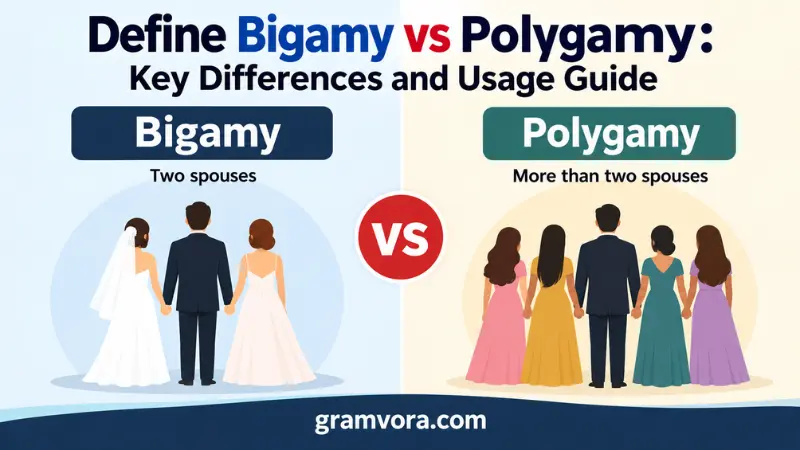
Bigamy and polygamy are closely related words, but they are not exact synonyms in everyday US English.
Both involve marriage to more than one person at the same time. The important difference is what each word emphasizes.
Bigamy focuses on entering another marriage while an existing legal marriage is still in effect. Polygamy is the broader term for the practice or condition of having more than one spouse at the same time.
That distinction makes the choice easier. If you are describing a specific second marriage that happens before an earlier legal marriage ends, bigamy is usually the more precise word. If you are discussing multiple-spouse marriage as a general practice or marital arrangement, polygamy is usually the better choice.
Quick Answer
The simplest distinction is:
- Bigamy: marrying another person while still legally married to someone else.
- Polygamy: having more than one spouse at the same time.
For example:
The man was accused of bigamy after marrying again before his divorce was finalized.
The book examines polygamy as a form of marriage found in different societies.
One important warning: do not assume that bigamy always means exactly two spouses and polygamy always means three or more. The real difference is more useful when understood as a specific act involving an existing legal marriage versus the broader practice of multiple-spouse marriage.
Why People Confuse Them
The confusion is understandable because both words describe simultaneous marital relationships.
The prefixes can also make the distinction seem easier than it really is. Bi- is associated with two, while poly- means many or multiple. However, relying only on those word parts can lead to an oversimplified definition of bigamy.
Another reason for the confusion is legal language. In US legal discussions, terminology can overlap. A particular law may use bigamy, polygamy, or related language when describing prohibited multiple marriages.
There is also a common assumption that bigamy must involve deception. Secrecy can occur in a bigamous situation, but it is not the basic meaning of the word.
The safest approach is to focus on the actual situation being described.
Key Differences At A Glance
| Context | Best Choice | Why |
|---|---|---|
| A person marries again while still legally married | Bigamy | It identifies the specific act of entering another marriage before the existing one ends |
| Discussing multiple-spouse marriage generally | Polygamy | It is the broader term for having more than one spouse |
| Describing a criminal allegation involving an existing marriage | Bigamy | The word commonly identifies the specific legal offense |
| Discussing a social or cultural marriage practice | Polygamy | It describes the broader marital arrangement |
| You need a broad term for multiple spouses | Polygamy | Its meaning covers the wider practice |
Compact comparison:
- Bigamy = a specific act involving another marriage while an existing legal marriage remains.
- Polygamy = the broader practice or condition of having multiple spouses.
- Overlap = a person in a polygamous arrangement may also commit bigamy if they enter another legally recognized marriage while already legally married.
Meaning and Usage Difference
Bigamy is a noun. In standard US usage, it refers to the act or crime of marrying someone while already legally married to another person.
The word commonly appears in legal or formal contexts:
The prosecutor charged him with bigamy.
The investigation uncovered evidence of bigamy.
Polygamy is also a noun. It refers to the practice or condition of having more than one spouse at the same time.
It has a wider range of contexts:
The class discussed polygamy in different cultures.
The documentary examines the history of polygamy.
Both words therefore relate to multiple spouses, but they do different jobs in a sentence.
Bigamy highlights the additional marriage while another legal marriage remains. Polygamy highlights the broader multiple-spouse arrangement.
Pronunciation is useful because the words look similar but sound different:
- bigamy: BIG-uh-mee
- polygamy: puh-LIG-uh-mee
Tone, Context, and Formality
Both terms are standard English, but their usual contexts are somewhat different.
Bigamy often has a legal or negative tone because it frequently appears in discussions of charges, crimes, investigations, court cases, or unlawful marriages.
Common combinations include:
- bigamy charge
- bigamy case
- bigamy offense
- accused of bigamy
- convicted of bigamy
Polygamy is broader and can be neutral in descriptive writing. It can appear in discussions of anthropology, history, religion, culture, marriage, and law.
For example:
The historian studied polygamy as a form of marriage.
That sentence does not necessarily focus on a particular criminal act.
The distinction should not be exaggerated, though. Polygamy can also appear in legal discussions, and bigamy can be used outside a courtroom. Context determines which word sounds most natural.
Which One Should You Use?
Choose bigamy when your sentence is about a person entering another marriage while an existing legal marriage has not ended.
She was accused of bigamy after marrying again without first ending her existing marriage.
Choose polygamy when you are discussing multiple-spouse marriage as a general practice, system, or condition.
The documentary explores polygamy and its place in different societies.
A useful question is:
Am I describing the specific act of marrying again while already legally married, or am I discussing multiple-spouse marriage more broadly?
If the first answer is yes, bigamy is usually the better choice.
If the second answer is yes, polygamy is usually the better choice.
When One Choice Sounds Wrong
Consider this sentence:
The article explains the bigamy practiced by some societies.
This can sound awkward if the writer simply means multiple-spouse marriage as a social or cultural practice. Polygamy would usually be more natural.
A better version is:
The article explains polygamy practiced by some societies.
Now consider:
He was accused of polygamy after secretly marrying another woman while his first marriage was still legally valid.
The sentence is understandable, but bigamy is more precise if the focus is specifically on the second marriage during an existing legal marriage.
A clearer version is:
He was accused of bigamy after marrying another woman while his first marriage was still legally valid.
The key is not simply the number of spouses. It is the situation the writer wants to describe.
Common Mistakes (and Quick Fixes)
Mistake 1: Treating the words as exact synonyms
Not every use of polygamy should be replaced with bigamy.
Fix: Use polygamy for the broader multiple-spouse practice and bigamy for the specific additional marriage during an existing legal marriage.
Mistake 2: Saying bigamy always means exactly two spouses
The word’s history may suggest “two,” but modern usage is better understood from its actual definition and legal context.
Fix: Focus on the existence of an additional marriage while an earlier legal marriage remains.
Mistake 3: Assuming bigamy always means secrecy
Secrecy may be present, but it is not required by the ordinary definition.
Fix: Do not add secrecy unless the facts of the situation support it.
Mistake 4: Using polygamy for every form of non-monogamous relationship
Polygamy specifically concerns multiple spouses.
Fix: Use polygamy when marriage is the subject.
Mistake 5: Assuming the two words have identical legal meanings everywhere
Legal terminology can vary by jurisdiction.
Fix: When discussing a specific law, use the terminology found in that law and distinguish it from general English usage.
Everyday Examples
Here are practical examples showing the difference:
- Bigamy:
The man faced a bigamy charge after investigators discovered that his first marriage was still legally valid. - Polygamy:
The documentary examines polygamy as a form of plural marriage. - Bigamy:
She learned that her new husband had never legally ended his previous marriage, raising a possible bigamy issue. - Polygamy:
The sociology class discussed how polygamy has been viewed in different societies. - Bigamy:
The court case centered on whether he knowingly entered a second marriage while the first remained valid. - Polygamy:
The author uses the term polygamy when discussing multiple-spouse marriage generally. - Bigamy:
His second marriage became the central issue in the bigamy investigation. - Polygamy:
The article compares monogamy and polygamy as different marriage systems.
These examples show why the words should not simply be swapped whenever multiple spouses are involved.
Dictionary-Style Word Details
Verb
- Bigamy: Not commonly used as a verb in standard US English. The related verb phrase is commit bigamy or practice bigamy.
- Polygamy: Not commonly used as a verb in standard US English. Natural constructions include practice polygamy or practice a polygamous marriage.
Noun
- Bigamy: A noun referring to marrying another person while already legally married to someone else, especially as a legal offense.
- Polygamy: A noun referring to the practice or condition of having more than one spouse at the same time.
Both are generally used as uncountable nouns when referring to the practice itself.
Synonyms
- Bigamy: There is no perfect everyday synonym. Illegal multiple marriage can serve as a closest plain alternative when the legal context is clear.
- Polygamy: Plural marriage is a close plain alternative in contexts where multiple-spouse marriage is the intended meaning.
The two words themselves should not automatically be treated as exact synonyms. Their meanings overlap, but their normal emphasis differs.
Example Sentences
- Bigamy: The man was investigated for bigamy after his previous marriage was discovered.
- Bigamy: The second marriage raised questions about possible bigamy.
- Polygamy: The course examined polygamy from a historical and cultural perspective.
- Polygamy: The writer used polygamy to describe a system involving multiple spouses.
Word History
Bigamy comes through Middle English and Medieval Latin, ultimately combining elements associated with “two” and “marriage.” Modern dictionaries record its use for the situation of marrying while already legally married.
Polygamy comes from French and Late Latin, ultimately from Greek elements meaning “many” and “marriage.” Modern dictionaries use it for having more than one spouse at the same time.
The historical roots help explain why the words look related, but modern usage should be determined by their established definitions rather than by their prefixes alone.
Phrases Containing
Common phrases with bigamy include:
- commit bigamy
- accused of bigamy
- charged with bigamy
- bigamy case
- bigamy law
- bigamy offense
Common phrases with polygamy include:
- practice polygamy
- polygamy debate
- polygamy laws
- polygamy as a marriage system
- polygamous marriage
- history of polygamy
These combinations reflect the different contexts in which the two words are most often used.
FAQs
What is the difference between bigamy and polygamy?
Bigamy generally means marrying another person while you are still legally married to someone else. Polygamy is the broader term for having more than one spouse at the same time. The words overlap, but they are not exact synonyms.
Is bigamy the same as polygamy?
No. Bigamy and polygamy are related but have different focuses. Bigamy describes the act of entering another marriage while an existing legal marriage remains in effect. Polygamy describes the broader practice or condition of having multiple spouses.
Does bigamy always mean having two spouses?
Not necessarily. Although the word contains a historical element associated with “two,” modern usage is better understood as referring to an additional marriage entered while an earlier legal marriage is still valid. The key issue is the overlapping legal marriages, not simply counting spouses.
What is an example of bigamy?
A person who is still legally married to one spouse and then enters another legally recognized marriage may be described as committing bigamy. For example, someone who marries again before their divorce is legally finalized could face a bigamy issue, depending on the applicable law.
What is an example of polygamy?
Polygamy can describe a marriage arrangement in which one person has multiple spouses at the same time. The word is often used when discussing marriage systems, cultural practices, historical societies, or social issues involving multiple spouses.
Which word should I use: bigamy or polygamy?
Use bigamy when the focus is on a person entering another marriage while an existing legal marriage is still in effect. Use polygamy when discussing multiple-spouse marriage as a broader practice, condition, or marriage system.
Is bigamy always illegal in the United States?
Bigamy is generally prohibited under US law, but the exact legal rules and consequences depend on the jurisdiction and circumstances. For a specific legal situation, the applicable state or federal law should be checked rather than relying only on the general meaning of the word.
Does bigamy require secrecy or deception?
No. Secrecy or deception may occur in some cases, but they are not part of the basic meaning of bigamy. The central idea is entering another marriage while an existing legal marriage remains in effect.
Can someone practice polygamy without committing bigamy?
The answer depends on what kind of marriage arrangement and legal recognition are involved. Polygamy is a broader term, while bigamy specifically concerns overlapping legal marriages. Therefore, the two concepts can overlap, but they should not automatically be treated as identical.
Is polygamy a broader term than bigamy?
Yes. Polygamy is the broader term because it describes the practice or condition of having multiple spouses. Bigamy is more specific and focuses on entering another marriage while an existing legal marriage remains.
Are bigamy and polygamy nouns?
Yes. Both bigamy and polygamy are nouns. They normally refer to practices, conditions, or situations rather than functioning as ordinary verbs.
What is the easiest way to remember bigamy vs polygamy?
Remember this simple distinction: bigamy focuses on another marriage while an existing legal marriage remains; polygamy focuses on having multiple spouses as a broader marital practice.
Conclusion
Bigamy and polygamy are related, but they are not interchangeable in every sentence.
Use bigamy when you mean the specific act of entering another marriage while an existing legal marriage is still in effect. Use polygamy when you mean the broader practice or condition of having more than one spouse at the same time.
The easiest way to remember the distinction is:
Bigamy focuses on the additional marriage. Polygamy focuses on the broader multiple-spouse practice.
When legal terminology is involved, remember that a particular jurisdiction may use the terms differently. For ordinary US-English word choice, however, this distinction gives you a clear and reliable starting point.


