The word business appears in everyday conversations, school assignments, job applications, company websites, and professional emails. Because its pronunciation does not closely match its spelling, writers sometimes add an extra letter and write bussiness instead.
This is a spelling error, not a difference between two accepted forms. Standard American English uses business, with no extra s after the first three letters.
The correct spelling works in every ordinary context, whether you are discussing a company, commercial activity, professional work, or a personal matter. Learning the correct letter order makes it easier to write confidently and avoid mistakes in important documents.
Quick Answer
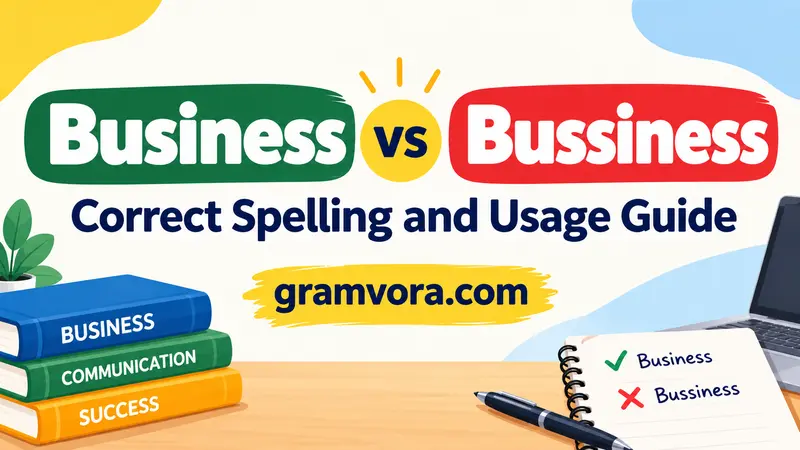
Business is correct. Bussiness is incorrect.
- Correct: She started a small business from home.
- Incorrect: She started a small bussiness from home.
The standard spelling contains eight letters: B-U-S-I-N-E-S-S.
The word has one s immediately after bu and two s letters at the end. Do not add another s after the first three letters.
Why People Confuse Them
One reason for this mistake is pronunciation. In American English, business is commonly pronounced approximately “BIZ-niss” or “BIZ-nəs.” The middle vowel is reduced, so the spoken word may not sound like its written form.
When people spell a word from memory or sound alone, they may place letters incorrectly. Some writers also add an extra s because they associate the word with the ending -ness, as in kindness or darkness.
Typing quickly can cause the same problem. A writer may repeat a letter without noticing, particularly when preparing a long email or entering text into a website.
The solution is to remember the established spelling rather than trying to recreate it from sound.
Memory tip: Think of the word as BUSINESS, with the letters s-i-n-e between the first s and the final double s.
Key Differences At A Glance
There is no difference in meaning between the two forms because bussiness is not a standard spelling of the word. Only business is accepted in ordinary English writing.
| Feature | Business | Bussiness |
|---|---|---|
| Standard spelling | Correct | Incorrect |
| American English | Accepted | Not standard |
| British English | Accepted | Not standard |
| Meaning | Has several established meanings | No standard meaning as this word |
| Grammatical role | Noun; also modifies other nouns | No standard grammatical role |
| Professional writing | Appropriate | Should be corrected |
The important point is simple: the extra s does not create a new word or a different meaning.
Are They the Same Word?
No. Business is a recognized English word, while bussiness is a misspelling of it.
The correct word has several common uses:
- A company: “Her business sells handmade furniture.”
- Commercial activity: “Online business has become an important part of retail.”
- Professional work: “He traveled to Chicago on business.”
- A matter or concern: “We need to discuss an important business issue.”
- A person’s concern: “That is none of your business.”
These meanings share the same spelling. The writer does not need to change the number of s letters based on the context.
For example, a small business, a business meeting, and a business owner all use the same spelling.
By contrast, bussiness does not have a separate accepted meaning in standard English. If you see it in an article, application, advertisement, or message, it is usually an error that should be corrected.
US vs UK Preference
There is no American-versus-British spelling difference here. Business is the standard spelling in both American and British English.
American writers use it in schoolwork, workplace communication, financial reports, and everyday messages. British writers use the same spelling in equivalent contexts.
For example:
- US: The business opened a new office in Texas.
- UK: The business opened a new office in London.
The locations differ, but the spelling does not.
If you are writing for an American audience, use business consistently. You do not need to choose between regional spelling conventions, and using bussiness is not a British alternative.
Which Spelling Should You Use?
Use business whenever you intend to write the standard English word.
In professional communication, correct spelling helps readers focus on your message instead of noticing avoidable errors. It is particularly important in résumés, cover letters, proposals, business plans, invoices, and company descriptions.
Consider these examples:
- Correct: I am interested in studying business management.
- Correct: Our business provides reliable customer support.
- Correct: Thank you for your business.
- Incorrect: Our bussiness provides reliable customer support.
The same rule applies to websites and online publications. If a page contains the misspelling, correct it in the heading, body text, image text, and any other visible wording where it appears.
When One Spelling Looks Wrong
Bussiness may look familiar because it resembles the correct word, but familiarity does not make it an accepted spelling.
A quick way to check is to compare the letter sequence:
- BUSINESS: B-U-S-I-N-E-S-S
- BUSSINESS: B-U-S-S-I-N-E-S-S
The incorrect form inserts an extra s before the i.
Be careful not to confuse spelling with a deliberately chosen business name or username. A company could choose an unusual spelling as part of its branding, but that would be a proper-name choice, not a standard spelling of the ordinary English word.
In regular writing, the correct choice remains business.
Common Mistakes (and Quick Fixes)
Writers can avoid this spelling error by learning the correct form and checking the word before publishing.
Mistake 1: Adding an extra s
Incorrect: She wants to start her own bussiness.
Correct: She wants to start her own business.
Mistake 2: Leaving out a letter
Incorrect: He owns a busines downtown.
Correct: He owns a business downtown.
Mistake 3: Reversing the i and u
Incorrect: They created a buisness plan.
Correct: They created a business plan.
Mistake 4: Misspelling the plural
Incorrect: Several bussinesses opened near the mall.
Correct: Several businesses opened near the mall.
Mistake 5: Repeating the mistake in a professional email
Incorrect: We appreciate your bussiness and support.
Correct: We appreciate your business and support.
A useful proofreading habit is to check the entire word rather than focusing only on the ending. The correct form is always business in standard usage, and the plural is businesses.
Everyday Examples
Here are realistic examples showing how to use business correctly in modern American English.
At work
- Our business meeting starts at 10 a.m.
- The manager discussed the company’s business goals.
- Please send the revised business proposal by Friday.
- She handles customer service for a local business.
At school
- I plan to study business administration in college.
- The students worked together on a business project.
- Our teacher explained the basics of business management.
- He wrote an essay about starting a small business.
Online and in everyday life
- My friend runs a successful online business.
- The business updated its website last week.
- She wants to turn her hobby into a business.
- Thank you for supporting our small business.
In personal conversations
- That’s none of your business.
- We have some important business to discuss.
- He went out of town on business.
- Let’s get down to business and finish the project.
Each example uses the same spelling. The meaning changes according to the sentence, but the spelling does not.
Dictionary-Style Word Details
Verb
Business: Business is not normally used as a standard verb in modern American English. It functions primarily as a noun, although it can appear before another noun, as in business meeting or business owner.
Bussiness: This is not a standard English word and is not an accepted verb form.
Noun
Business: A standard noun that can refer to a company, commercial activity, professional work, an affair, or a matter requiring attention.
Examples:
- The business employs 25 people.
- Her business focuses on home design.
- We need to discuss this business before making a decision.
Bussiness: Not a standard noun spelling. Use business instead.
Synonyms
The appropriate synonym for business depends on the intended meaning.
Business — closest plain alternatives:
- Company: An organization that conducts commercial activity.
- Enterprise: A business undertaking or organization.
- Commerce: The activity of buying and selling goods or services.
- Trade: The exchange of goods or services.
- Work: Activity or tasks, depending on the sentence.
- Matter: A concern or issue, when business refers to a particular affair.
These words are not exact substitutes in every context.
Bussiness: No established synonyms exist for this misspelling. Choose the correct word, business, and then select a synonym if it fits the sentence.
Example Sentences
Business
- The family opened a new business in their neighborhood.
- She hopes to expand her business next year.
- We discussed the company’s business strategy.
- He traveled to New York on business.
- Customer satisfaction is important to our business.
Bussiness
There are no standard example sentences using bussiness as a correctly spelled English word. Replace it with business.
Word History
The word business developed from Middle English bisynesse, related to bisy, an earlier form of busy, combined with the noun-forming ending -ness. Its historical development helps explain its connection with activity, occupation, and matters requiring attention.
Modern English preserves the established spelling business. The spelling bussiness is not an accepted historical or regional alternative in standard American English.
Phrases Containing
The word business appears in many common English expressions.
- Business owner: A person who owns a company or commercial enterprise.
- Business plan: A document describing a business’s goals and approach.
- Business meeting: A meeting about professional or commercial matters.
- Business partner: A person who shares ownership or responsibility in a business.
- Business as usual: The normal way of operating or behaving.
- Get down to business: Begin focusing on the important task at hand.
- Mind your own business: Avoid interfering in someone else’s personal affairs.
- None of your business: Something that does not concern another person.
All these expressions use business, never bussiness in standard spelling.
FAQs
Is it business or bussiness?
Business is the correct spelling. Bussiness is a misspelling and is not accepted in standard American English.
Why is bussiness incorrect?
Bussiness contains an extra s after the first three letters. The correct spelling is B-U-S-I-N-E-S-S.
What does business mean?
Business can mean a company, commercial activity, professional work, or a matter that needs attention. For example, “She owns a small business.”
Is business the correct spelling in American English?
Yes. Business is the standard spelling in American English. Bussiness is not an accepted American spelling variant.
Is business spelled the same way in British English?
Yes. Both American and British English use business. There is no regional spelling difference between these varieties.
What is the plural of business?
The plural is businesses. For example, “Several small businesses opened in the neighborhood.”
Why do people misspell business as bussiness?
People may add an extra s because they are unsure of the word’s letter order or rely on its pronunciation. Remembering the sequence B-U-S-I-N-E-S-S can help prevent this mistake.
How do you use business in a sentence?
Example: “My family started a small business last year.” Here, business refers to a company or commercial activity.
What are common phrases that use business?
Common phrases include business meeting, business owner, business plan, business partner, business as usual, and get down to business.
Is bussiness ever correct as a company name?
A company might deliberately use Bussiness as a brand name, username, or stylized spelling. However, that does not make it the standard spelling of the English word. In ordinary writing, use business.
Conclusion
Business is the correct spelling; bussiness is incorrect. The two forms are not competing spelling variants, and the extra s does not create a different meaning.
Remember the correct letter order: B-U-S-I-N-E-S-S. Use business in American English for companies, commercial activities, professional matters, and other established meanings.
Whether you are writing a school assignment, a professional email, a business proposal, or a website article, the same spelling applies. A quick proofreading check can help you catch the error before your writing reaches readers.