
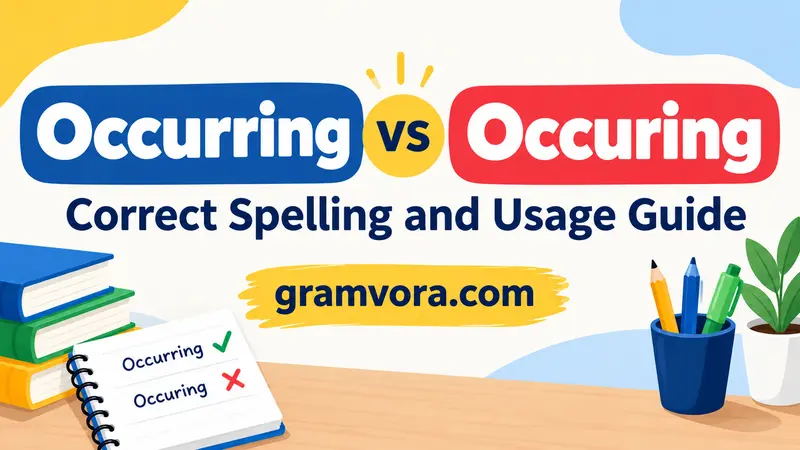
English spelling can be confusing, especially when a word changes after adding an ending. One example is occurring vs occuring. These two forms look almost identical, but only one is correct in standard English.
The correct spelling is occurring, with two r’s after the letter u. The spelling occuring, with only one r in that position, is a common mistake.
This confusion often happens because writers remember the base verb occur but forget that its final consonant doubles when the ending -ing is added. The correct transformation is simple: occur becomes occurring.
Understanding this pattern helps students, professionals, bloggers, and anyone who writes in English avoid an unnecessary spelling error. It also makes related forms, such as occurred and occurrence, easier to remember.
Whether you are preparing a school assignment, writing a workplace email, editing a report, or publishing an article, choosing the correct spelling makes your writing clearer and more professional.
This guide explains the difference between the two forms, shows why the extra r matters, and provides practical examples to help you use occurring confidently.
Quick Answer
Occurring is correct. Occuring is incorrect.
The word occurring is the present participle of the verb occur. It describes something that is happening, taking place, or existing in a particular situation.
The spelling occuring is a misspelling of occurring. It is not an accepted alternative in standard American or British English.
Compare these examples:
- Correct: Several problems are occurring during the installation.
- Incorrect: Several problems are occuring during the installation.
The difference is one letter, but standard spelling requires both r’s.
Remember this pattern:
Occur + ing = occurring
The same verb also forms occurred when referring to something that happened in the past.
Why People Confuse Them
The main reason people confuse occurring and occuring is that the difference is small and easy to overlook. Both forms contain the same letters except for one r.
Writers may also assume that adding -ing simply means attaching the ending to the base word without changing its spelling. However, English sometimes requires a final consonant to double before a suffix is added.
The base verb occur already contains two c’s and ends with r. When the suffix -ing is added, the final r doubles, producing occurring.
Another source of confusion is the way people learn spelling. Some writers memorize words by sight, while others depend on pronunciation. Unfortunately, pronunciation cannot help distinguish these two forms because they are intended to be pronounced the same way.
For example, someone might write, “The issue is occuring again,” because the word looks familiar. The intended meaning is understandable, but the spelling remains incorrect.
Typing quickly can also lead to this mistake. When someone writes a long email or report, a missing letter may go unnoticed during a quick review.
The best solution is to connect the word to its base form. Instead of memorizing occurring as an isolated word, remember the relationship between occur and occurring.
That small habit can prevent the same mistake in future writing.
Key Differences At A Glance
The comparison below summarizes the essential difference.
| Context | Best Choice | Why |
|---|---|---|
| American English | Occurring | Standard spelling |
| British English | Occurring | Standard spelling |
| Formal writing | Occurring | Accepted spelling of the verb form |
| Everyday messages | Occurring | Correct in both formal and informal contexts |
| Using one r before -ing | Not occuring | Missing the required doubled r |
| Describing something happening now | Occurring | Correct present participle form |
The two forms do not have separate meanings. The issue is spelling rather than vocabulary or grammar.
| Feature | Occurring | Occuring |
|---|---|---|
| Spelling status | Correct | Incorrect |
| Relationship to occur | Correct present participle | Misspelling of the present participle |
| Double r | Yes | No |
| Standard US usage | Accepted | Not accepted |
| Standard UK usage | Accepted | Not accepted |
| Example | Changes are occurring. | Changes are occuring. |
These distinctions apply regardless of whether you are writing a casual message or a formal document.
Are They the Same Word?
The two forms are intended to represent the same word, but they do not have equal spelling status.
Occurring is a legitimate grammatical form of occur. It can describe an action that is happening or identify something that takes place within a particular setting.
For example:
“The same problem is occurring every morning.”
In this sentence, occurring describes an ongoing or repeated situation.
The word can also appear before a noun in a descriptive phrase:
“Researchers studied the changes occurring in the region.”
Here, occurring helps identify the changes being discussed.
By contrast, occuring has no separate standard meaning or grammatical function. When writers use it, they generally intend to write occurring.
It is important not to treat this as a difference between two accepted spellings. Some English words have regional alternatives, but this is not one of those cases.
The correct approach is to recognize occuring as a spelling error and replace it with occurring.
US vs UK Preference
American and British English use the same standard spelling: occurring.
There is no accepted US-versus-UK distinction that makes occuring correct in either variety.
Writers sometimes encounter words that use different consonant patterns across English-speaking regions. However, those regional differences do not apply to this particular word.
For example, an American writer and a British writer can both use the following sentence:
“Unexpected changes are occurring throughout the year.”
The spelling remains the same regardless of the intended audience.
This matters when writing for an international readership. You do not need to change occurring to match a British or American publication style. Instead, focus on spelling the word correctly.
If you see occuring in a document, it should be corrected even when the document follows British English conventions.
Which Spelling Should You Use?
Use occurring whenever you need the present participle of occur.
The word works in several common situations, including describing an event in progress, discussing repeated problems, explaining a process, or identifying changes within a particular period.
Consider these examples:
- The error is occurring during the final stage of testing.
- Several important changes are occurring in the company.
- Unusual weather patterns are occurring across the region.
- The problem keeps occurring despite regular maintenance.
- New developments are occurring in the local community.
In each sentence, occurring is the correct form.
The word is suitable for everyday communication, school assignments, business reports, scientific writing, and online publications.
When editing a document, search for occuring and replace each incorrect instance with occurring. However, check the surrounding sentence before making a correction to ensure that the intended word is actually a form of occur.
A simple memory technique can also help. Think of the spelling in two parts:
OCCUR + RING = OCCURRING
This visual reminder emphasizes the double r before -ing. It is a spelling aid rather than a literal division of the word into separate meaningful parts.
With regular use, the correct form becomes easier to recognize.
When One Spelling Looks Wrong
At first glance, occuring may look reasonable because it follows the base word occur with the ending -ing. Nevertheless, appearance alone does not determine whether a spelling is correct.
The extra r in occurring follows an established English spelling pattern. When occur takes the ending -ing, the final r doubles.
The same pattern appears in occurred, the past tense and past participle of occur.
Compare:
- Correct: The incident occurred yesterday.
- Incorrect: The incident occured yesterday.
- Correct: The incident is occurring now.
- Incorrect: The incident is occuring now.
Notice that both correct forms contain two r’s at the end of the base word before the suffix.
This pattern is particularly useful because writers sometimes make the same mistake in several related words. Correcting occuring but leaving occured or occurence in the same document would leave other spelling errors behind.
The correct noun is occurrence, which also contains double r.
When a spelling looks uncertain, check the complete word rather than relying on how familiar it appears. A quick review can prevent a small mistake from appearing in a finished document.
Common Mistakes (and Quick Fixes)
Writers can avoid this spelling problem by learning a few common patterns.
Mistake 1: Writing occuring
Incorrect: A technical issue is occuring during the update.
Correct: A technical issue is occurring during the update.
Quick fix: Remember that the final r doubles before -ing.
Mistake 2: Writing occured
Incorrect: The delay occured without warning.
Correct: The delay occurred without warning.
Quick fix: The past-tense form also requires double r.
Mistake 3: Writing occurence
Incorrect: This is an unusual occurence.
Correct: This is an unusual occurrence.
Quick fix: Memorize occurrence as the standard noun form.
Mistake 4: Removing a letter while typing quickly
Incorrect: The same error keeps occuring in the report.
Correct: The same error keeps occurring in the report.
Quick fix: Review words containing occur- before submitting your work.
Mistake 5: Assuming that British English permits the alternative
Incorrect assumption: Occuring is acceptable in British writing.
Correct understanding: Occurring is the standard spelling in both American and British English.
Quick fix: Do not change the spelling based on regional preference.
Mistake 6: Depending only on pronunciation
Both forms are intended to sound alike, so listening carefully will not reveal the missing r.
Quick fix: Check the written form and remember the base verb.
A reliable editing habit is to review the word family together: occur, occurs, occurred, occurring, and occurrence. Learning these forms as a group helps reinforce their correct spelling.
Everyday Examples
Realistic examples make it easier to recognize the correct spelling in different contexts.
In everyday conversation
- Strange things are occurring in the neighborhood.
- The same problem keeps occurring whenever I restart my computer.
- Several changes are occurring at home this month.
In school and education
- Important changes are occurring in the education system.
- Students should identify errors occurring in the passage.
- New opportunities are occurring as the program expands.
In the workplace
- Technical problems are occurring during the software update.
- Several delays are occurring because of the weather.
- A similar issue is occurring in another department.
In news and public information
- Changes are occurring across the local transportation network.
- Unexpected events are occurring throughout the region.
- New developments are occurring as the investigation continues.
In science and research
- Chemical reactions are occurring inside the container.
- Researchers observed changes occurring over several hours.
- The process is occurring under controlled conditions.
In formal writing
- The changes occurring within the organization require careful review.
- Multiple errors are occurring during the final testing stage.
- The event is occurring as scheduled.
All these examples use occurring correctly. The word remains unchanged whether the sentence describes a personal experience, a scientific process, or a professional situation.
When editing your own writing, focus on the double r rather than the length of the sentence or the formality of the context.
Dictionary-Style Word Details
Verb
Occurring: The present participle of occur. It means happening, taking place, or coming about. It can appear with forms of be, as in “The problem is occurring again.”
It can also describe a noun, as in “events occurring during the summer.”
Occuring: An incorrect spelling of occurring. It is not the standard present participle of occur and should not be used in edited English.
The base verb occur can describe an event taking place or an idea coming to mind. For example, “An unexpected problem occurred” and “A new idea occurred to me.”
Noun
Occurring: This is a verb form, not the ordinary noun form of occur. The related noun is occurrence, which refers to an event, incident, or instance of something happening.
Example: “The occurrence of the error surprised the team.”
Occuring: This is not a standard noun. It does not have a separate accepted noun meaning.
When you need to name an event or instance, use occurrence rather than either spelling in this comparison.
Synonyms
Occurring: Depending on the sentence, useful alternatives include happening, taking place, arising, developing, and coming about. These expressions are not interchangeable in every context, so select the one that best preserves your intended meaning.
Examples:
- “Changes are occurring” can become “Changes are happening.”
- “An issue is occurring” may become “An issue is arising.”
- “An event is occurring” can become “An event is taking place.”
Occuring: It has no separate standard meaning and therefore has no independent synonym list. Correct the spelling to occurring before choosing an alternative.
There is no single antonym that works in every context. Depending on the sentence, an expression such as not happening or ceasing may communicate an opposite idea, but neither is a universal antonym.
Example Sentences
Occurring — correct examples
- Several unexpected changes are occurring in the department.
- The problem is occurring more often than before.
- New developments are occurring throughout the industry.
- Scientists are examining the reactions occurring in the sample.
- Errors occurring during installation can delay the project.
- The event is occurring at the scheduled time.
- Similar problems are occurring in other locations.
- A change in temperature is occurring inside the room.
Occuring — incorrect examples
- Incorrect: Several unexpected changes are occuring in the department.
- Incorrect: The problem is occuring more often than before.
- Incorrect: New developments are occuring throughout the industry.
- Incorrect: Errors are occuring during installation.
Each incorrect example should use occurring instead.
Word History
Occurring is formed from the verb occur and the suffix -ing. Its spelling reflects the standard consonant-doubling pattern used when this verb takes the ending.
The important point for modern writers is the relationship between the base form and its derived forms:
- Occur: base form
- Occurs: third-person singular present form
- Occurred: past tense and past participle
- Occurring: present participle
- Occurrence: noun
The incorrect form occuring does not represent a separate historical or regional spelling tradition in standard modern English. There is no need to invent a different origin or meaning to explain the mistake.
Phrases Containing
Occurring: The correct spelling appears in many everyday phrases, including:
- currently occurring
- frequently occurring problems
- events occurring today
- changes occurring over time
- errors occurring during testing
- naturally occurring substances
- problems occurring repeatedly
- incidents occurring in public places
Examples:
“Frequently occurring problems should be documented.”
“Researchers studied naturally occurring substances.”
“Several changes are occurring over time.”
Occuring: This spelling should not be used in these phrases. Replace it with occurring whenever you mean something that is happening or taking place.
FAQs
Is it occurring or occuring?
Occurring is the correct spelling. Occuring is a misspelling because it leaves out one r. For example, “Several changes are occurring in the company” is correct.
Why does occurring have two r’s?
The verb occur doubles its final r before the suffix -ing. Therefore, the correct spelling is occurring, not occuring.
Is occuring ever correct?
No. Occuring is not an accepted standard spelling in American or British English. Use occurring in formal writing, schoolwork, emails, and everyday communication.
Is occurring correct in American English?
Yes. Occurring is the standard spelling in American English. It is used to describe something happening, taking place, or developing.
Is occurring correct in British English?
Yes. British English also uses occurring. The spelling does not change between American and British English, so occuring is incorrect in both varieties.
What does occurring mean?
Occurring means happening or taking place. For example, “The problem is occurring again” means that the problem is happening again.
What is the difference between occur and occurring?
Occur is the base form of the verb, while occurring is its present participle. For example, “Errors may occur” uses the base form, while “Errors are occurring” describes errors that are happening.
Is it occurred or occured?
Occurred is correct, while occured is a misspelling. The final r doubles when occur takes the ending -ed, just as it does before -ing in occurring.
Is it occurrence or occurence?
Occurrence is the correct spelling. It is a noun referring to an event, incident, or instance of something happening. The spelling occurence is incorrect.
How can I remember the correct spelling of occurring?
Remember the pattern occur + ing = occurring. The final r doubles before the ending. You can also memorize the related forms occurred and occurrence, which contain double r as well.
Conclusion
The choice between occurring and occuring is straightforward: occurring is correct, while occuring is a misspelling.
Both forms may look similar, but only occurring is accepted in standard American and British English. The correct spelling contains two c’s and two r’s.
Remember the simple pattern: occur becomes occurring when -ing is added. The related forms occurred and occurrence also contain double r.
This small spelling detail can improve the clarity and professionalism of schoolwork, emails, reports, and published content. Before submitting a document, check for the missing r and correct any instances of occuring.