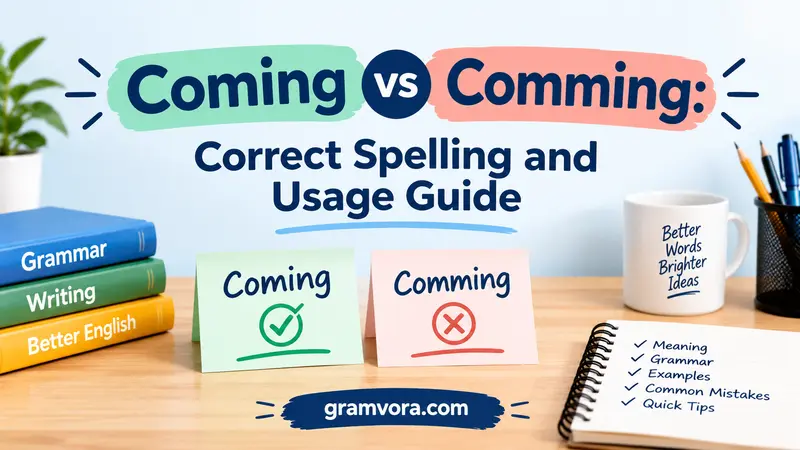
The correct modern spelling is coming. The spelling comming is not accepted in standard contemporary American or British English, although it appears in historical records as an obsolete form.
The confusion often comes from the way English words change when writers add -ing. Some verbs double their final consonant, while others drop a silent e. Because both patterns exist, it can be tempting to write comming by mistake.
For example, you would write, “She is coming home,” not “She is comming home.”
Understanding the difference helps you avoid spelling mistakes in emails, school assignments, work documents, social media posts, and website articles.
Quick Answer
Coming is the correct spelling for modern English. Comming is an obsolete historical spelling and an error in ordinary modern writing.
Use coming when describing someone arriving, moving toward a place, participating in an event, or something approaching in time.
Examples:
- My friends are coming over tonight.
- The new store is coming soon.
- The coming year will bring new opportunities.
The key rule is simple: start with come, remove the final e, and add -ing. The result is coming, with one m.
Why People Confuse Them
Writers may confuse coming and comming because English does not use one simple pattern for every verb ending in -ing.
Some verbs double their final consonant. For instance, run becomes running, and sit becomes sitting. Other verbs drop a final silent e before adding the ending. For example, make becomes making and write becomes writing.
The verb come follows the second pattern. Its final e disappears, and the ending -ing is added.
Compare these forms:
- Come → coming
- Make → making
- Write → writing
- Run → running
- Sit → sitting
The first three examples do not double their final consonant. The last two do. Seeing these different patterns side by side helps explain why coming does not need a second m.
Another reason for confusion is that the two forms look similar when typed quickly. A writer may know the word perfectly well but still add an extra letter by accident.
The best solution is to remember the base word and its spelling pattern rather than guessing from other verbs.
Key Differences At A Glance
| Context | Best Choice | Why |
|---|---|---|
| Everyday modern writing | Coming | Standard modern spelling |
| School assignments | Coming | Follows standard English spelling |
| Work emails and reports | Coming | Appropriate for professional writing |
| Phrases such as “coming soon” | Coming | The standard form in this expression |
| Discussion of historical spelling | Comming may be mentioned | It can be discussed as an obsolete historical form, not as a modern alternative |
A compact comparison makes the distinction clear:
- Coming: The standard modern spelling; used as a verb form and in noun and adjective uses.
- Comming: An obsolete historical spelling; incorrect as a substitute for coming in modern standard writing.
Are They the Same Word?
The forms are historically related, but they do not have the same status in modern writing.
Coming is the present participle of come. It also appears as a gerund, noun, or adjective, depending on the sentence. For example, “They are coming” uses a verb form, while “the coming holiday” uses an adjective.
Comming is recorded as an obsolete spelling of coming. A historical spelling can appear in older texts without being an acceptable choice in modern everyday writing.
For contemporary readers, the practical distinction is straightforward: use coming in ordinary sentences. Reserve comming for a specific historical discussion or a faithful quotation in which the original spelling must be preserved.
Neither form represents a separate modern word with a different everyday meaning. The extra m does not create a standard alternative.
US vs UK Preference
American and British English both use coming as the standard modern spelling. There is no regular US-versus-UK spelling difference between these two forms.
For example, an American writer would say, “Are you coming to the meeting?” A British writer would use the same spelling in the same question.
Some English words do have recognized regional spelling differences, such as color and colour. However, coming is not one of them.
The spelling pattern is the same in both varieties: remove the final e from come and add -ing.
You may encounter comming in an old text, a typo, or an informal online message. Its appearance does not make it an accepted regional spelling. If you are writing for a US or UK audience today, choose coming.
Which Spelling Should You Use?
Use coming in almost every modern writing situation.
Choose it when you are talking about someone arriving, moving toward a place, joining an activity, or something expected in the near future.
Correct examples include:
- I am coming to your house after work.
- Thank you for coming to the event.
- The next update is coming soon.
- The coming months will be busy.
- Are you coming with us?
Avoid writing comming in these sentences. The form may be understandable to a reader, but it is not the standard modern spelling.
If you are editing a historical document, preserve an original spelling only when accuracy to the source requires it. Otherwise, follow modern spelling conventions.
For websites, reports, applications, and educational writing, consistency matters. Check every occurrence and use coming throughout unless you have a clear reason to reproduce a historical source exactly.
When One Spelling Looks Wrong
In modern English, comming looks wrong in ordinary sentences because it does not follow the standard spelling of the verb come plus -ing.
Consider this example:
Incorrect in modern writing: “She is comming to the office.”
Correct: “She is coming to the office.”
The correct form removes the final e from come before adding -ing. It does not double the m.
The historical record deserves a small qualification. Comming has been documented as an obsolete spelling, so it would be too broad to claim that the sequence of letters has never appeared in English. However, historical use does not make it a suitable modern substitute.
When proofreading a current document, treat comming as a spelling error unless you are intentionally reproducing an older text or discussing historical spelling.
Common Mistakes (and Quick Fixes)
The easiest way to correct this mistake is to identify the base verb before adding an ending.
Mistake 1: Doubling the m
Incorrect: “I am comming home now.”
Correct: “I am coming home now.”
Quick fix: Start with come. Remove the final e and add -ing.
Mistake 2: Keeping the final e
Incorrect: “Are you comeing to dinner?”
Correct: “Are you coming to dinner?”
Quick fix: The final silent e in come is removed before -ing is added.
Mistake 3: Using the wrong spelling in a phrase
Incorrect: “Our new website is comming soon.”
Correct: “Our new website is coming soon.”
Quick fix: Remember the complete phrase as coming soon.
Mistake 4: Assuming every verb doubles its final letter
Some verbs double a consonant before -ing, but others do not. Compare running with coming. The spelling of the base verb determines the correct form.
Mistake 5: Repeating the error in published content
A single typo can be copied into headings, captions, image text, and article paragraphs. Search the complete draft for comming before publishing and correct any unintended uses.
Everyday Examples
The following sentences show how coming works in natural American English.
Arrival and movement
- “My brother is coming over after dinner.”
- “The delivery driver is coming up the driveway.”
- “Are you coming with us to the game?”
Events and plans
- “Thank you for coming to my graduation.”
- “Several new employees are coming to the office on Monday.”
- “She said she was coming to the meeting.”
Something approaching in time
- “The holidays are coming up quickly.”
- “We have a busy week coming.”
- “The coming year will be important for the company.”
Announcements
- “Our new collection is coming soon.”
- “More details are coming next week.”
- “A new episode is coming this Friday.”
In every example, coming uses one m. Replacing it with comming would create a spelling error in modern standard English.
Dictionary-Style Word Details
Verb
Coming: The -ing form of the verb come. It can appear in continuous verb forms, such as “They are coming,” and in other constructions, such as “Thank you for coming.”
Comming: Not the standard modern spelling of this verb form. It is recorded as an obsolete historical spelling and should not replace coming in contemporary writing.
Noun
Coming: Can function as a noun, often referring to an arrival or an approach. For example, “We welcomed the coming of spring.”
Comming: Not a standard modern noun spelling. If an old text uses this form, interpret it in its historical context rather than treating it as a current spelling option.
Synonyms
Coming: The closest alternatives depend on the sentence. When referring to arrival, approach or arrival may fit. When describing a future event, upcoming or forthcoming may work in some contexts.
These words are not interchangeable in every sentence. For example, “Thank you for coming” cannot always be replaced naturally with “Thank you for approaching.”
Comming: It has no separate set of modern synonyms because it is not a distinct standard word in contemporary English. Choose an alternative based on the intended meaning of coming.
Example Sentences
Coming:
- “I am coming to the library after class.”
- “The next payment is coming due soon.”
- “Thank you for coming to the celebration.”
- “The coming season will be exciting.”
Comming:
- In modern writing, replace “I am comming home” with “I am coming home.”
- If comming appears in an older historical text, retain it only when preserving the source’s original spelling is necessary.
Word History
Coming: This is the established modern form built from come and the ending -ing. The final e is dropped before the ending is added.
Comming: Historical references record it as an obsolete spelling of coming. That evidence supports describing it as a former spelling, not as an accepted modern US or UK variant. Avoid assigning a specific date to a spelling change unless a reliable historical source supports that claim.
Phrases Containing
Coming: Common phrases include:
- Coming soon
- Coming home
- Coming up
- Coming to the meeting
- The coming year
- The coming months
- Thank you for coming
- Coming of age
Comming: These are not standard modern phrases with this spelling. Use coming soon, coming home, and the other forms with one m.
FAQs
Is it coming or comming?
Coming is the correct modern spelling. Comming is an obsolete historical spelling and is incorrect in ordinary modern English writing.
Why is coming spelled with one m?
The word coming comes from come. To form the -ing form, remove the final e and add -ing. The result is coming, with one m.
Is comming ever correct?
Comming is recorded as an obsolete historical spelling, but it is not accepted as a standard alternative in modern American or British English. Use coming in contemporary writing.
Is coming the correct spelling in American English?
Yes. Coming is the standard spelling in American English. Use it in school assignments, work emails, articles, and everyday messages.
Do British English speakers spell it coming or comming?
British English also uses coming. There is no standard American-versus-British spelling difference for this word.
What does coming mean?
Coming can describe someone arriving or moving toward a place. It can also describe something approaching in time.
Examples:
- My friends are coming over tonight.
- The holidays are coming soon.
- The coming year will be busy.
How do you spell coming soon?
The correct phrase is coming soon, with one m in coming.
Correct: Our new website is coming soon.
Incorrect: Our new website is comming soon.
How do you remember the spelling of coming?
Remember the base word come. Drop its final e and add -ing:
Come − e + ing = coming
This pattern helps you avoid adding an unnecessary second m.
Is coming a verb or a noun?
Coming can serve different grammatical roles. In “She is coming home,” it is part of a verb phrase. In “the coming of spring,” it functions as a noun. It can also describe a future event, as in “the coming months.”
What is the difference between coming and upcoming?
Coming has several uses, including describing arrival or something approaching. Upcoming usually describes an event or situation expected in the near future.
Examples:
- “My cousin is coming over.”
- “We discussed the upcoming event.”
The words overlap in some contexts, but they are not interchangeable in every sentence.
Conclusion
Coming is the correct modern spelling in American and British English. Comming is documented as an obsolete historical spelling, but it is not an accepted alternative for everyday modern writing.
To remember the correct form, start with come, drop the final e, and add -ing. That gives you coming, with one m.
Whether you are writing a school assignment, a work email, or an article for your website, use coming and check for accidental extra letters before publishing.