English spelling can be confusing, especially when a word contains repeated letters. One common example is disappoint vs disapoint. Both forms may look understandable, and both may appear in online searches or informal writing. However, only one is the standard spelling used in correct American English.
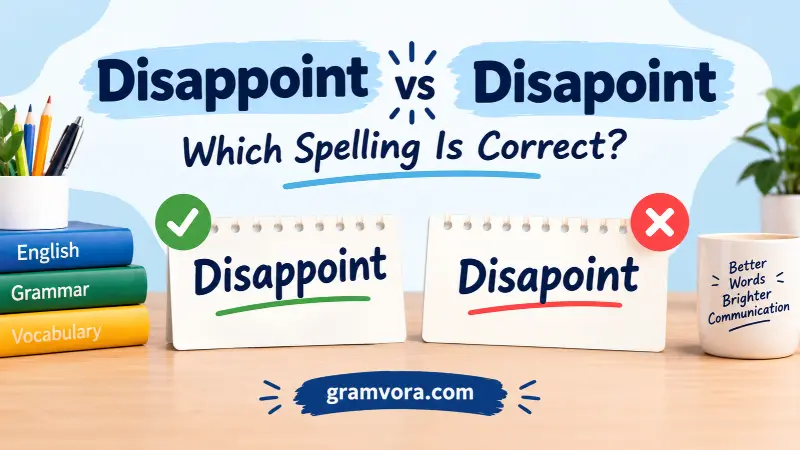
The correct spelling is disappoint, with two p’s. The spelling disapoint, with only one p, is a misspelling and should not be used in formal writing, school assignments, professional emails, or published articles.
The word disappoint is useful in everyday conversations. People use it when someone fails to meet expectations, a plan does not work out, or an experience is not as good as expected. For example, a student may disappoint a teacher by missing an important deadline, or a movie may disappoint viewers who expected a better story.
Learning the correct spelling helps you communicate clearly and avoid mistakes that can make your writing appear less polished. It also helps you recognize related forms, such as disappointed, disappointing, and disappointment.
This guide explains the correct spelling, meaning, pronunciation, grammar, word forms, common mistakes, and practical examples. By the end, you will know how to use disappoint confidently in everyday and professional English.
Quick Answer
Disappoint is the correct spelling. Disapoint is incorrect because it leaves out one of the two p’s.
- Correct: I do not want to disappoint my parents.
- Incorrect: I do not want to disapoint my parents.
The verb disappoint means to fail to meet someone’s hopes or expectations or to make someone feel unhappy because something did not happen as expected.
Easy rule: Always write disappoint with two p’s.
What Does Disappoint Mean?
Disappoint is a verb that describes the experience of failing to meet someone’s expectations. It can refer to a person, an action, a result, an event, or an experience.
For example, imagine that a student studies for several weeks but receives a lower grade than expected. The student may feel disappointed. Similarly, if a friend promises to attend a birthday party but never arrives, the friend may disappoint the person who was waiting.
The word can also describe something that does not meet expectations. A restaurant may disappoint its customers if the food is poor, or a new television show may disappoint viewers if its episodes are less interesting than they expected.
Here are several examples:
- The team disappointed its fans by losing the final match.
- I hope I do not disappoint my family.
- The hotel disappointed us because the rooms were not clean.
- Her performance did not disappoint the audience.
- The final chapter disappointed readers who expected a stronger ending.
In each sentence, the word communicates a gap between what someone expected and what actually happened.
Why Is Disappoint the Correct Spelling?
The accepted spelling contains the prefix dis- followed by appoint. When these parts form the word, the spelling is disappoint.
The two p’s are important. Removing one creates the incorrect form disapoint.
This mistake can happen because people often pronounce words without clearly noticing every written letter. In ordinary speech, the repeated p may not seem obvious. A writer may remember the sound of the word but forget the spelling pattern.
The word can also be difficult to spell because it contains more than one opportunity for error. Someone might write disapoint, dissapoint, or another incorrect variation.
The safest approach is to remember the word as:
dis + appoint = disappoint
The spelling retains the double p. You do not need to remove a letter or add another s.
Dictionaries recognize disappoint as the standard English verb. For American English writing, use this spelling consistently.
Disappoint vs Disapoint: Key Differences at a Glance
| Feature | Disappoint | Disapoint |
|---|---|---|
| Spelling status | Correct | Incorrect |
| Number of p’s | Two | One |
| Standard dictionary form | Yes | No |
| Meaning | To fail to meet expectations | No standard meaning as written |
| Suitable for formal writing | Yes | No |
| Example | The result may disappoint us. | The result may disapoint us. |
The main difference is spelling, not meaning. Disapoint is not a separate English word with a different definition. It is usually an accidental misspelling of disappoint.
How to Pronounce Disappoint
The word disappoint is commonly pronounced /ˌdɪs.əˈpɔɪnt/ in American English.
A simple way to break it into sounds is:
dis-uh-POINT
The main stress falls on the final part, point. Although the spelling includes two p’s, you do not pronounce the word as if it contained two separate p sounds.
Pronunciation can help you recognize the word, but it is not always enough to remember its spelling. That is why it is useful to learn the written form separately.
Practice saying and writing these examples:
- I do not want to disappoint you.
- The results might disappoint the team.
- She did not disappoint her supporters.
Repeating the correct spelling while reading the word aloud can help reinforce your memory.
Is Disappoint a Verb, Noun, or Adjective?
Disappoint is a verb. It describes an action or result that fails to satisfy someone’s expectations.
However, several related words belong to other parts of speech. Understanding these forms will help you use the word correctly in different sentences.
Verb: Disappoint
Use disappoint when someone or something fails to meet expectations.
Examples:
- I never want to disappoint my teacher.
- The product may disappoint some customers.
- Do not disappoint the people who trust you.
The verb changes form according to tense and grammar.
Adjective: Disappointed
Disappointed describes a person who feels unhappy because something did not meet expectations.
Examples:
- I was disappointed with the result.
- The children felt disappointed when the event was canceled.
- She looked disappointed after hearing the news.
Use disappointed to describe a feeling, not the action of causing that feeling.
Adjective: Disappointing
Disappointing describes something that causes disappointment or does not meet expectations.
Examples:
- The movie had a disappointing ending.
- We received disappointing news.
- His performance was disappointing.
A simple distinction can help:
- The movie disappointed me.
- I felt disappointed.
- The movie was disappointing.
All three sentences are correct, but each uses a different grammatical form.
Noun: Disappointment
Disappointment is the noun form. It refers to the feeling that follows an unmet expectation or to an event that causes that feeling.
Examples:
- Missing the concert was a disappointment.
- She expressed her disappointment calmly.
- The team experienced disappointment after the loss.
Remember that disappointment also contains the double p found in disappoint.
Correct Verb Forms of Disappoint
Learning the related forms makes it easier to avoid spelling mistakes.
| Form | Correct spelling | Example |
|---|---|---|
| Base form | Disappoint | I do not want to disappoint you. |
| Third-person singular | Disappoints | He disappoints his coach when he arrives late. |
| Past tense | Disappointed | The result disappointed everyone. |
| Past participle | Disappointed | She has never disappointed her supporters. |
| Present participle | Disappointing | The team is disappointing its fans. |
| Adjective | Disappointed | We were disappointed by the delay. |
| Adjective | Disappointing | It was a disappointing performance. |
| Noun | Disappointment | The cancellation caused disappointment. |
Notice that the double p remains in each related form. When you add endings such as -ed, -ing, or -ment, you do not remove one of the p’s.
Common Misspellings of Disappoint
Writers sometimes misspell disappoint in several ways. Recognizing these errors can help you correct them quickly.
1. Disapoint
This is the spelling in the keyword comparison. It contains only one p and is incorrect.
Incorrect: I did not mean to disapoint anyone.
Correct: I did not mean to disappoint anyone.
2. Dissapoint
Some writers add an extra s instead of remembering the correct structure.
Incorrect: I hope the results do not dissapoint us.
Correct: I hope the results do not disappoint us.
3. Disapointed
This form incorrectly drops one p from disappointed.
Incorrect: He was disapointed by the decision.
Correct: He was disappointed by the decision.
4. Disapointing
This spelling also leaves out one p.
Incorrect: The game was disapointing.
Correct: The game was disappointing.
5. Disapointment
The noun form is often misspelled when writers forget the double p.
Incorrect: The cancellation was a disapointment.
Correct: The cancellation was a disappointment.
The best solution is to memorize the base word first. Once you know that disappoint has two p’s, the correct spelling of its related forms becomes easier to remember.
Common Mistakes and Quick Fixes
Even writers with strong English skills can make spelling mistakes when typing quickly. The following habits can help you avoid them.
Mistake: Writing the word from memory without checking it.
Quick fix: Pause briefly and remember the structure dis + appoint.
Mistake: Removing a p when adding an ending.
Quick fix: Keep both p’s in disappointed, disappointing, and disappointment.
Mistake: Assuming that a frequently seen spelling must be correct.
Quick fix: Check a reliable dictionary when you are unsure. Repeated appearances online do not make a misspelling standard.
Mistake: Confusing disappointed with disappointing.
Quick fix: Use disappointed for the person experiencing the feeling and disappointing for the thing causing it.
For example, “I was disappointed by the disappointing result” correctly uses both forms.
Mistake: Relying only on pronunciation.
Quick fix: Practice spelling the word as well as saying it aloud. Pronunciation does not always reveal the number of letters in a word.
Everyday Examples of Disappoint
The verb disappoint appears in conversations about school, work, family, entertainment, and personal goals.
School and Education
- I do not want to disappoint my teacher by submitting the assignment late.
- The low test score disappointed the student.
- She worried that she might disappoint her parents.
- The class did not disappoint its teacher during the presentation.
- He felt disappointed when he did not receive the scholarship.
Work and Professional Life
- We do not want to disappoint our customers.
- The project disappointed the manager because it missed its deadline.
- The company promised reliable service and did not disappoint.
- I would rather explain a delay than disappoint a client with an unrealistic promise.
- The disappointing results encouraged the team to review its plan.
Family and Friendships
- I never want to disappoint the people who trust me.
- He disappointed his friend by forgetting their agreement.
- She was disappointed when her brother canceled the visit.
- Good communication can prevent unnecessary disappointment.
- They did not want to disappoint their children.
Entertainment and Sports
- The film disappointed viewers who expected an exciting ending.
- The players did not disappoint their supporters.
- The concert was disappointing because several songs were cut.
- The team disappointed its fans with a poor performance.
- The final episode did not disappoint longtime viewers.
These examples show how the word works in different situations. It can describe a person’s actions, an event, a result, or an experience.
Synonyms and Related Words
Several words have meanings similar to disappoint, although they are not always interchangeable.
- Let down: To fail someone who depends on or trusts you.
- Dishearten: To reduce someone’s confidence, hope, or enthusiasm.
- Dismay: To cause worry, sadness, or disappointment.
- Frustrate: To prevent someone from achieving a goal or satisfying a desire.
- Fail: To fall short of a requirement, goal, or expectation.
- Dissatisfy: To leave someone unhappy with a result or experience.
For example, “I do not want to disappoint my team” can sometimes be rewritten as “I do not want to let my team down.”
However, context matters. Disappoint is often the best choice when the main idea is that an outcome did not match someone’s hopes.
Word History
The history of disappoint helps explain its spelling. The word entered English through older French forms related to appoint. Historically, disappoint was associated with removing someone from an appointment or position. Over time, its meaning developed toward frustrating plans or failing to meet expectations.
Modern English uses the word much more broadly. People can disappoint friends, customers, teachers, supporters, or themselves. An event, product, performance, or result can also disappoint someone.
Although the meaning has developed over time, the standard modern spelling remains disappoint, with two p’s.
Which Spelling Should You Use?
For American English, the choice is straightforward: use disappoint.
Use it in schoolwork, essays, reports, professional emails, website content, social media posts, and personal messages. The correct spelling communicates the intended meaning clearly and helps your writing look polished.
Avoid disapoint unless you are specifically discussing the misspelling itself, such as in a spelling lesson or an article explaining common errors.
If you are editing a document, check the related forms as well. Correcting disappoint alone will not help if the same paragraph contains disapointed or disapointment.
A quick proofreading check can catch these mistakes before you publish or submit your writing.
FAQs
Is it disappoint or disapoint?
Disappoint is the correct spelling. Disapoint is a misspelling because it contains only one p instead of two.
What does disappoint mean?
Disappoint means to fail to meet someone’s expectations or hopes, causing them to feel unhappy or dissatisfied.
Why does disappoint have two p’s?
The standard spelling is formed from dis- and appoint. The double p remains in the correct spelling: disappoint.
Is disapoint a real English word?
No. Disapoint is not the standard spelling of an English word. It is generally an error for disappoint.
How do you spell disappoint correctly?
Spell it D-I-S-A-P-P-O-I-N-T. Remember that the word contains two p’s.
What is the past tense of disappoint?
The past tense is disappointed. For example: “The final result disappointed the team.”
Is it disappointed or disapointed?
Disappointed is correct. It contains two p’s, just like the base verb disappoint.
Is it disappointing or disapointing?
Disappointing is correct. Use it to describe something that fails to meet expectations, such as a disappointing performance.
What is the noun form of disappoint?
The noun form is disappointment. It describes the feeling caused by unmet expectations or an event that produces that feeling.
How can I remember the spelling of disappoint?
Remember the phrase “dis + appoint = disappoint.” Keeping the double p in mind will help you spell disappoint, disappointed, disappointing, and disappointment correctly.
Conclusion
The correct spelling is disappoint, not disapoint. The standard verb contains two p’s and means to fail to meet someone’s hopes or expectations.
Remember the related forms, too: disappoints, disappointed, disappointing, and disappointment. Each keeps the double p.
The easiest way to remember the spelling is to think of the word as dis + appoint. When you write the word in a sentence, check that both p’s are present.
With regular practice, you can avoid this common spelling mistake and use disappoint confidently in everyday conversations and formal writing.