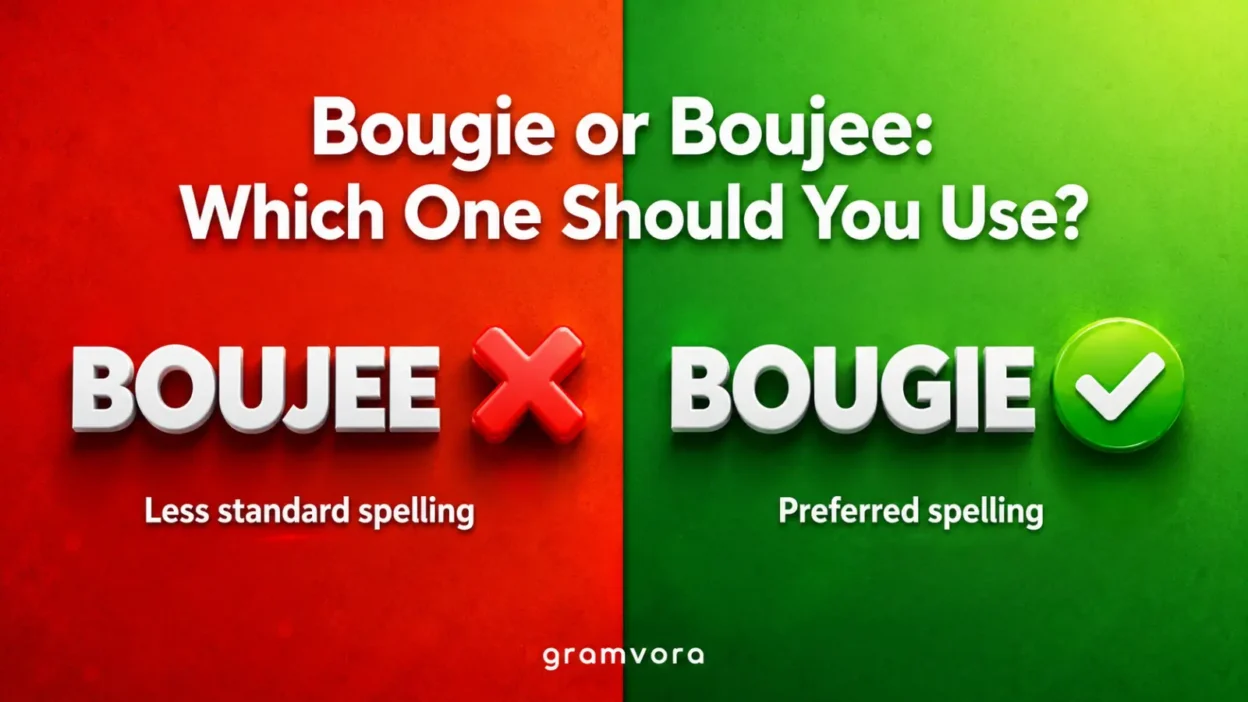
Bougie or boujee can both describe something fancy, upscale, or linked with expensive taste. The better choice depends on your tone.
Use bougie when you want the safer, more established spelling. Use boujee when you want a more playful, slangy, pop-culture feel.
Neither word belongs in very formal writing unless you are discussing slang, dialogue, style, or culture.
Quick Answer
Bougie is usually the better default in US English. It is the more common dictionary-style spelling for the slang adjective.
Boujee is also recognized, especially in casual writing. It often feels more playful, trendy, and expressive.
So the simple choice is this: write bougie for general use, and write boujee when the fun slang feel is part of the message.
Why People Confuse Them
People confuse them because they sound almost the same and share the same basic idea.
Both words point to fancy taste, luxury, status, or someone acting a little high-class. A person might call a restaurant bougie because it has tiny plates, high prices, and dramatic lighting. Someone else might call a weekend trip boujee because it includes a nice hotel, spa day, and brunch.
The confusion is also spelling-based. Slang often spreads through speech before people settle on spelling. That is why both forms show up in captions, texts, jokes, and casual articles.
Key Differences At A Glance
| Feature | bougie | boujee |
|---|---|---|
| Best basic use | Safer general spelling | More playful slang spelling |
| Tone | Can sound teasing or critical | Often sounds fun, proud, or flashy |
| Formality | Informal, but more established | Very informal |
| Common role | Mostly adjective; sometimes noun | Mostly adjective |
| Best setting | Articles, dialogue, casual comments | Captions, jokes, music-style wording |
Meaning and Usage Difference
Bougie means fancy, upscale, or concerned with class, comfort, or expensive taste. It can also suggest pretension. For example, “That café is too bougie for me” means the café feels fancy in a way that may be overpriced or showy.
Boujee has the same core meaning, but it usually sounds more playful. “We had a boujee brunch” often means the brunch felt stylish, extra, and fun.
The difference is not a hard grammar rule. It is a tone difference. Bougie is the safer everyday spelling. Boujee adds more personality.
A useful plain-English pronunciation guide is: BOO-zhee or BOO-jee. In everyday speech, many people do not make a strong difference between the two.
Tone, Context, and Formality
Both words are informal. Use them with care in school papers, business writing, resumes, reports, or serious articles.
Bougie can sound slightly judgmental:
“She refuses to drink office coffee now. So bougie.”
But it can also be playful:
“I bought the fancy candles. I’m feeling bougie.”
Boujee often sounds more celebratory:
“We booked the rooftop table. Very boujee.”
Still, do not assume boujee is always a compliment. Tone, speaker, and context decide whether either word feels warm, funny, rude, or critical.
Which One Should You Use?
| Context | Best Choice | Why |
|---|---|---|
| General casual writing | bougie | It is the safer, more established spelling. |
| Social captions | boujee | It sounds playful and expressive. |
| Mild criticism | bougie | It often fits teasing about pretension. |
| Fun luxury moment | boujee | It fits a proud, stylish mood. |
| Formal writing | neither | Use words like upscale, expensive, or pretentious instead. |
| Dialogue | depends | Match the speaker’s voice. |
| Clear reader understanding | bougie | More readers will recognize it as the default form. |
When One Choice Sounds Wrong
Boujee can sound wrong when the sentence needs a calmer, more standard slang spelling.
Awkward: “The report described the neighborhood as boujee.”
Better: “The report described the neighborhood as upscale.”
Casual: “That neighborhood feels bougie now.”
Bougie can sound less right when the whole point is a fun, flashy vibe.
Less natural: “Feeling bougie in my birthday outfit.”
More natural for that tone: “Feeling boujee in my birthday outfit.”
The words overlap, but the mood changes.
Common Mistakes (and Quick Fixes)
A common mistake is saying boujee is the only correct spelling. It is not. Bougie is often the better default.
Another mistake is saying bougie and boujee have totally separate meanings. They overlap. The real difference is usually tone, spelling style, and context.
Do not use either word when you need a neutral word. If you mean “expensive,” say expensive. If you mean “stylish,” say stylish. If you mean “snobbish,” say snobbish or pretentious.
Also, do not confuse these words with boogie, which means to dance. That is a different word.
Everyday Examples
“Let’s skip the bougie restaurant and get tacos.”
“She called my oat milk order bougie.”
“This hotel is bougie, but I love it.”
“We got dressed up for a boujee dinner downtown.”
“He posted one beach photo and started acting bougie.”
“That rooftop brunch was a little boujee, but it was worth it.”
“I’m not too bougie for a coupon.”
“She wanted a boujee birthday with flowers, candles, and a private room.”
Dictionary-Style Word Details
Verb
• bougie: Not commonly used as a verb in standard US English. Say “act bougie” instead.
Example: “Don’t act bougie just because you got a raise.”
• boujee: Not commonly used as a verb in standard US English. Say “feel boujee” or “look boujee” instead.
Example: “She looks boujee in that coat.”
Noun
• bougie: Can be used as a slang noun for a person, as in “He’s such a bougie,” but this can sound awkward or insulting. It also has unrelated noun meanings in medicine and older candle use, which are not the focus here.
• boujee: Not commonly used as a standard noun. It works best as an adjective before a noun or after a linking verb.
Synonyms
• bougie: closest plain alternatives: fancy, upscale, high-end, pretentious, snobbish, status-conscious.
Helpful opposites: plain, simple, down-to-earth, low-key.
• boujee: closest plain alternatives: fancy, flashy, luxurious, stylish, high-end, extra.
Helpful opposites: basic, simple, casual, low-key.
These are not perfect swaps. Choose the alternative that matches your tone.
Example Sentences
• bougie: “That grocery store is too bougie for my budget.”
• bougie: “He got bougie about hotels after one business trip.”
• boujee: “We made boxed pasta feel boujee with candles and parmesan.”
• boujee: “Her birthday dinner was boujee in the best way.”
Word History
• bougie: The slang adjective is linked to bourgeois and bourgeoisie, words connected with the middle class and class identity. Over time, the slang sense moved toward fancy taste, status, and sometimes pretension.
• boujee: This spelling reflects a newer slang style based on sound and popular use. Its exact path is best described carefully: it is a recognized casual spelling, not a separate formal word with a completely different meaning.
Phrases Containing
• bougie: bougie coffee shop, bougie brunch, bougie taste, bougie neighborhood, acting bougie.
• boujee: boujee dinner, boujee on a budget, feeling boujee, boujee vibe, boujee birthday.
Conclusion
For most US writing, bougie is the safer choice. It is informal, but it is the more established spelling.
Use boujee when you want a playful, casual, stylish feel. It works well in captions, jokes, and relaxed conversation.
The real difference is not strict meaning. Both words point to fancy or high-class taste. The choice comes down to tone: bougie is steadier and can sound critical; boujee is more playful and expressive.