Choosing between “yea” and “nay” often creates hesitation for many Americans. These two terms carry centuries of tradition in formal decision-making, yet they rarely appear in everyday conversation. In the United States, you will most often encounter them during official votes in Congress, city council meetings, corporate boardrooms, or community organizations that follow parliamentary procedure.
Understanding the precise roles of yea and nay helps writers and speakers communicate with clarity and confidence in professional settings. This guide breaks down their meanings, explains why they differ from casual alternatives, and shows exactly when each word fits best. By the end, you will feel comfortable deciding which term to use without second-guessing yourself.
Quick Answer
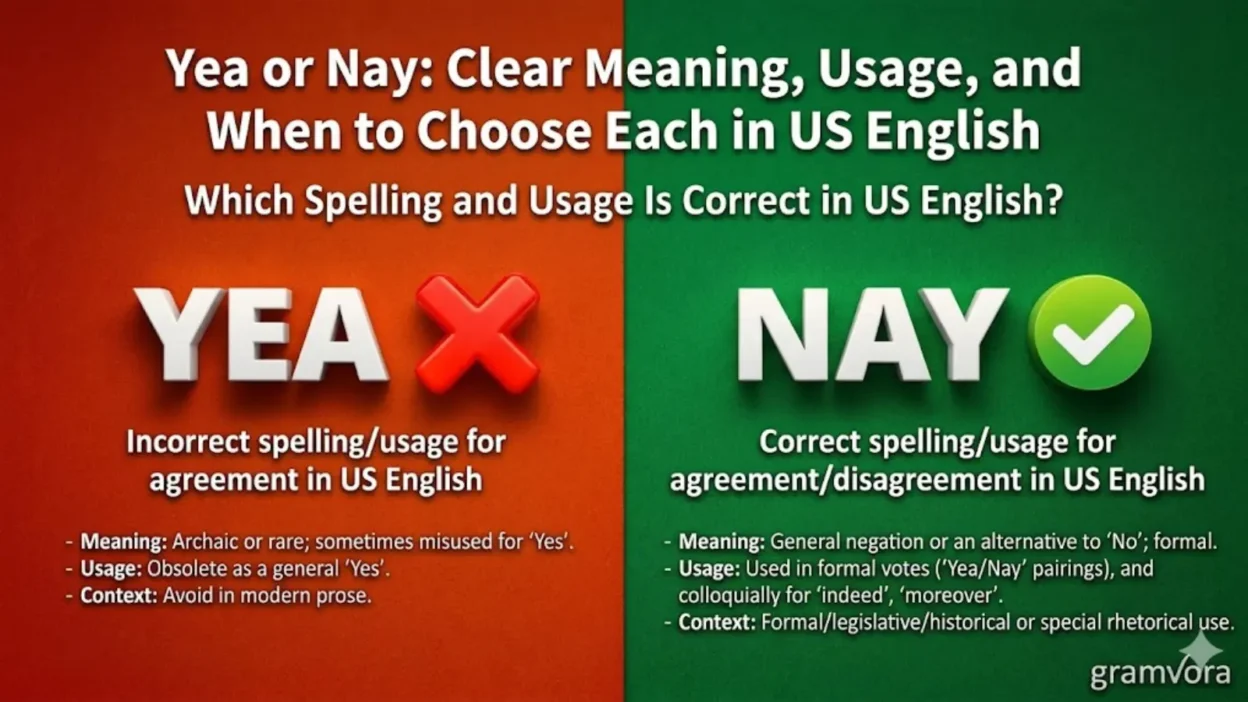
Yea means yes or an affirmative response, particularly in formal voting. Nay means no or a negative response in the same structured contexts.
They form the classic pairing “yea or nay” when seeking a clear yes-or-no decision. These terms are not everyday replacements for “yes” and “no.” Reserve them for situations that require formality and official record-keeping. Using them correctly signals attention to traditional protocol in American professional and governmental environments.
Why People Confuse Them
Confusion around yea and nay stems from several common factors in modern American life. First, the pronunciation of “yea” sounds exactly like the celebratory “yay,” leading many people to write “yay or nay” by mistake. Second, both words feel old-fashioned compared to the simple “yes” and “no” that dominate daily speech and texting.
Younger professionals and non-native English speakers often encounter these terms for the first time in news coverage of congressional votes or legal proceedings. Without regular exposure, it becomes easy to treat them as interchangeable with more common words. Social media comments frequently debate the correct spelling, especially during elections or public polls. Additionally, movies and historical dramas sometimes use these terms dramatically, which adds to the perception that they sound overly formal or theatrical in regular situations. This mix of limited daily use and similar-sounding alternatives creates ongoing uncertainty for many US writers and speakers.
Key Differences At A Glance
| Context | Best Choice | Why |
|---|---|---|
| Official legislative votes | Yea / Nay | Required for accurate parliamentary records in Congress and state assemblies |
| Business board meetings | Yea / Nay | Maintains formal tone and creates clear documentation |
| Casual conversations | Yes / No | Sounds natural and approachable in daily American English |
| Expressing enthusiasm | Yay | Conveys celebration, not voting |
| Written surveys or polls | Yea / Nay | Adds traditional weight to formal feedback requests |
| Text messages with friends | Yes / No | Avoids sounding stiff or outdated |
Feature Comparison
- Yea: Expresses agreement or approval with a formal, traditional tone
- Nay: Expresses disagreement or rejection with the same level of formality
- Shared trait: Both function best in structured decision-making processes
- Key distinction: They maintain a ceremonial quality that plain yes and no lack
Meaning and Usage Difference
Yea primarily serves as an adverb indicating affirmation or consent. In practice, it signals support for a motion, proposal, or question. You will see it most frequently in recorded votes where precision matters for official minutes.
Nay acts as the direct counterpart, functioning as an adverb that indicates opposition or refusal. It can also appear as a noun referring to a negative vote itself. For example, officials might announce that the nays have prevailed in a close decision.
The core difference lies in their polarity: yea affirms while nay denies. Both terms maintain a neutral, factual quality rather than emotional weight. In US English, they appear most naturally in contexts governed by Robert’s Rules of Order or similar parliamentary guidelines. Unlike “yes” and “no,” which work across all situations, yea and nay feel specialized for group decision-making where votes need clear tracking.
Pronunciation plays a role in the confusion. “Yea” is pronounced like “yay” (/jeɪ/), rhyming with words such as day, hay, and pay. “Nay” is pronounced /neɪ/, sharing the same ending sound. This similarity in sound contributes to spelling mix-ups, particularly with the informal “yay” that people use for excitement.
Tone, Context, and Formality
Yea and nay carry a distinctly formal and traditional tone in American English. They evoke images of structured governance and deliberate decision-making rather than relaxed conversation. This formality makes them appropriate for government bodies, nonprofit boards, professional associations, and any group that values clear procedural records.
In context, they excel in settings where decisions must be documented accurately. A city council using yea and nay creates an official record that stands up in legal reviews. Corporate boards might use them during high-stakes shareholder votes to maintain a sense of gravitas. However, the same words would feel out of place in a casual team brainstorming session or friendly neighborhood gathering.
The level of formality also affects audience perception. Using yea and nay demonstrates respect for established procedures and attention to detail. At the same time, overusing them in informal situations can make the speaker sound distant or pretentious. American English favors “yes” and “no” for warmth and approachability in most daily interactions. The choice between these pairs ultimately depends on the environment and the need for official precision versus conversational ease.
Which One Should You Use?
Choose yea whenever you need to express agreement or support within a formal voting process. This applies to legislative sessions, board meetings, committee decisions, or any structured poll that follows traditional rules.
Select nay when registering opposition or rejection in the same formal environments. The decision becomes simple once you identify the context: Is this an official vote requiring clear documentation? If yes, yea and nay serve as the proper tools.
For all other situations — emails to colleagues, conversations with family, social media posts, or quick text replies — default to “yes” and “no.” These everyday terms maintain clarity without adding unnecessary formality. The guiding principle remains matching the word to the setting. Professional and governmental contexts call for yea and nay, while personal and casual communication calls for their simpler counterparts.
When One Choice Sounds Wrong
Certain combinations create an awkward or incorrect impression in American English. Responding with “nay” to a friend’s casual dinner invitation sounds overly dramatic and cold. Similarly, answering a quick work question with “yea” instead of “yes” can make you seem stiff or old-fashioned.
Writing “yay or nay” in a professional document represents a frequent error that mixes celebration with voting. Using “yea” to cheer good news, rather than “yay,” confuses readers who expect the enthusiastic spelling. In legal or official writing, substituting plain “yes” and “no” where yea and nay are expected can make the document appear less precise or professionally prepared.
Another mismatch occurs when someone uses these terms sarcastically in casual speech. The formal weight of yea and nay clashes with lighthearted or ironic tones, often resulting in confusion rather than humor. Recognizing these situations helps maintain appropriate communication across different American social and professional settings.
Common Mistakes (and Quick Fixes)
Several recurring errors appear when Americans use yea and nay.
One frequent mistake involves spelling “yay or nay” instead of the correct “yea or nay.” The fix is straightforward: remember that voting uses “yea” while celebration uses “yay.”
Another common slip is treating yea and nay as completely interchangeable with yes and no in all contexts. Reserve the formal pair strictly for voting situations to avoid sounding pretentious.
Pronunciation confusion also causes issues. Some speakers pronounce “yea” like “yeah,” which can create misunderstandings in spoken votes. Practice the clear /jeɪ/ sound that rhymes with “day” for accuracy.
Writers sometimes use nay as a casual negative response, which can come across as overly harsh. The quick fix involves saving nay for official records and using “no” in regular conversation.
Finally, forgetting to pair the terms properly creates incomplete phrases. Always consider using “yea or nay” together when seeking a binary decision in formal settings. These corrections help maintain professional standards in US communication.
Everyday Examples
Consider a corporate board meeting where directors discuss a major acquisition. The chair states, “All those in favor of proceeding with the merger, please say yea. All those opposed, please say nay.” The secretary then records, “The motion passed with 8 yeas and 3 nays.”
In a local town hall meeting, residents debate a new park proposal. After discussion, the moderator calls for a voice vote: “Shall we approve the funding? All in favor, yea. All opposed, nay.” Later, the minutes reflect the outcome: “The measure received 45 yeas and 22 nays.”
A nonprofit organization holds an annual election for new board members. The president asks, “Does the membership give its yea or nay on accepting these candidates?” Members respond accordingly, creating a clear record of the group’s decision.
In a university committee reviewing curriculum changes, the chair says, “We need your yea or nay on implementing the new requirements by next semester.” Faculty members state their positions clearly during the recorded vote.
For contrast, imagine casual scenarios where these terms would feel wrong. A friend texts about weekend plans: “Want to catch the game Saturday?” The natural reply is “Yes” or “No,” not yea or nay. Similarly, in a family discussion about dinner options, “yes” and “no” maintain warmth and ease that formal terms would disrupt.
These examples show how yea and nay enhance clarity in structured US settings while feeling mismatched in personal interactions. The context always determines the best choice.
Dictionary-Style Word Details
Verb
Yea: Not commonly used as a verb in standard US English. It does not function in verb form in modern contexts. Nay: Not used as a verb in contemporary American English.
Noun
Yea: Functions as a noun when referring to an affirmative vote or the person casting such a vote. Example: “The yeas carried the motion forward.” Nay: Commonly used as a noun for a negative vote or the person who casts it. Example: “The proposal failed due to a majority of nays.”
Synonyms
Yea: Closest plain alternatives include yes and aye (particularly in naval or traditional contexts). Nay: Closest plain alternative is no. Antonyms: Yea and nay function as direct opposites of each other in voting contexts.
Example Sentences
- The senator cast a yea vote on the education funding bill during the late-night session.
- Despite strong support, the nays ultimately blocked the proposed constitutional amendment.
- Members, please indicate your yea or nay on the revised bylaws by the end of this meeting.
- The committee announced that the yeas had it, and the motion passed unanimously.
- Several representatives registered their nay during the roll call vote on healthcare reform.
- In the historic session, the count showed 218 yeas and 212 nays on the landmark legislation.
Word History
Both terms trace back to early forms of English used in parliamentary and voting traditions. They continue in American usage primarily due to established conventions in legislative bodies and formal organizations. Specific origin details remain rooted in historical language development without additional unsupported claims.
Phrases Containing
- Yea or nay: The standard pairing used when seeking a binary decision in formal settings.
- The yeas and nays: Refers to the collective affirmative and negative votes in a recorded decision.
- Yea and amen: An older reinforcing phrase that occasionally appears in formal or religious contexts.
- All yeas and nays: Used when summarizing complete voting results in official records.
FAQs
Q: What is the main difference between yea and nay? A: Yea expresses agreement or approval in formal votes, while nay expresses disagreement or rejection.
Q: Is “yea or nay” still appropriate in 2026? A: Yes, particularly in government, corporate boards, and organizations following formal procedures.
Q: Should I use yea and nay in business emails? A: Only in highly formal contexts. Most business emails work better with yes and no for a natural tone.
Q: How do you pronounce yea correctly? A: It sounds like “yay,” rhyming with day, hay, and pay.
Q: Can nay be used positively? A: No. Nay consistently signals a negative position or vote.
Q: Why does Congress still use yea and nay? A: Tradition and the need for clear, official voting records support continued use.
Q: Is it ever acceptable to write “yay or nay”? A: Only in very casual, non-professional contexts where humor or informality is intended.
Q: How do I record votes using these terms? A: Use phrases like “12 yeas and 7 nays” for accurate, professional documentation.
Conclusion
Yea and nay remain valuable tools in American English for formal decision-making. While they may feel somewhat old-fashioned compared to everyday yes and no, they provide precision and tradition in legislative, corporate, and organizational contexts. Understanding their specific roles helps professionals navigate meetings, votes, and official communications with greater confidence.
The next time you face a formal vote or need to document a group decision, you can choose yea or nay with clarity. For most daily situations, however, the simpler yes and no continue to serve American English speakers best. This distinction ultimately comes down to matching your language to the formality and purpose of each situation. With this knowledge, you can communicate more effectively across professional and personal settings in the United States.