Many English learners and native speakers alike wonder whether they should write laid or layed. The two words look similar, sound related, and often appear in discussions about grammar and spelling. Because English contains many verbs that form their past tense by simply adding -ed, it is easy to assume that layed follows the same pattern.
However, English does not always follow predictable rules. Some verbs develop irregular past-tense forms that must be memorized rather than built by adding a standard ending. The verb lay belongs to that group. As a result, many writers use layed when they actually mean laid.
The good news is that the answer is straightforward. In standard American English, laid is the correct form, while layed is generally considered a spelling error in ordinary writing. Understanding this distinction can help you write with more confidence and avoid a very common mistake.
This guide explains the difference between laid and layed, why people confuse them, when to use laid, and how to avoid errors in everyday communication.
Quick Answer
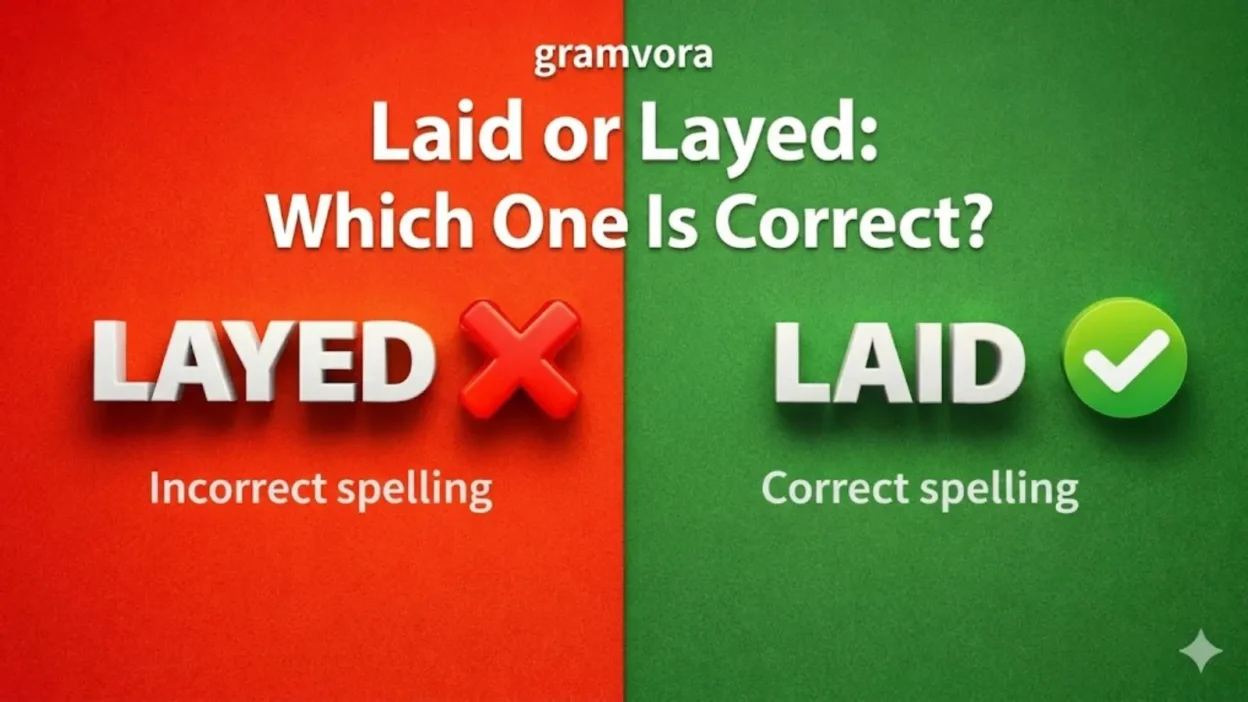
If you are deciding between laid and layed, choose laid.
Laid is the correct past tense and past participle of the verb lay.
Examples:
- She laid the book on the desk.
- They laid new carpet in the office.
- The workers have laid the foundation.
In standard American English, layed is generally incorrect.
Incorrect examples:
- She layed the book on the desk.
- They layed new carpet in the office.
- The workers have layed the foundation.
For school assignments, business writing, professional communication, publishing, and everyday writing, laid is the accepted choice.
Why People Confuse Them
The confusion between laid and layed comes from several factors.
First, English speakers learn that many verbs create the past tense by adding -ed.
For example:
- jump → jumped
- paint → painted
- walk → walked
- clean → cleaned
Following that pattern, some people naturally assume:
- lay → layed
While this seems logical, it is not how the verb works in standard English.
Second, the verb lay is part of a group of irregular verbs. Irregular verbs do not follow the normal -ed pattern. Instead, they change form in unique ways.
Examples include:
- say → said
- pay → paid
- make → made
- lay → laid
Because the spelling changes unexpectedly, many writers mistakenly create the regularized form layed.
Another reason for confusion is the relationship between lay and lie.
Many people already struggle with these two verbs because they are closely related but behave differently.
Consider these forms:
- lay → laid
- lie → lay
Since lay can itself be a form of another verb, confusion increases quickly.
Even experienced writers occasionally pause to check which form is correct.
Key Differences At A Glance
| Context | Best Choice | Why |
|---|---|---|
| Past tense of “lay” | Laid | Correct standard form |
| Past participle of “lay” | Laid | Accepted grammar |
| Business writing | Laid | Professional and correct |
| Academic writing | Laid | Standard usage |
| Everyday writing | Laid | Normal American English |
| Published content | Laid | Recognized spelling |
| Use of “layed” | Usually neither | Generally considered incorrect |
The practical rule is simple:
Whenever you need the past form of lay, use laid.
Meaning and Usage Difference
The difference between these two words is not really a difference in meaning. Instead, it is a difference in correctness.
What Does “Laid” Mean?
Laid is the correct past tense and past participle of the verb lay.
The verb lay generally means:
- to put something down
- to place something somewhere
- to set something in position
Examples:
- She laid her keys on the counter.
- He laid the package by the door.
- They laid blankets across the grass.
In all these examples, someone placed or positioned something.
What Does “Layed” Mean?
In standard American English, layed is generally considered a misspelling when writers intend to use the past tense of lay.
Most grammar references and dictionaries do not accept it as the standard form in ordinary usage.
When readers encounter layed, they typically view it as an error rather than an alternative spelling.
Understanding the Correct Pattern
The correct pattern is:
| Present | Past | Past Participle |
|---|---|---|
| Lay | Laid | Laid |
Examples:
- I lay the book on the shelf.
- Yesterday I laid the book on the shelf.
- I have laid the book on the shelf.
Notice that layed never appears in the standard pattern.
Tone, Context, and Formality
One important point is that laid works in every context.
You can use it in:
- text messages
- emails
- business reports
- academic papers
- news articles
- books
- presentations
Examples:
Casual:
- I laid my jacket on the chair.
Professional:
- The team laid the groundwork for implementation.
Academic:
- Researchers laid out the methodology in detail.
Because laid is the accepted standard form, it sounds natural everywhere.
What About Layed?
Using layed can create problems regardless of context.
In professional settings, readers may view it as a spelling mistake.
In academic writing, it may be marked incorrect.
In published content, editors generally replace it with laid.
Even in casual writing, many readers recognize layed as an error.
For that reason, there is little advantage in using it.
Which One Should You Use?
You should use laid whenever you need the past tense or past participle of lay.
Examples:
- She laid the baby in the crib.
- We laid the boxes near the wall.
- The contractor laid the tile carefully.
- They have laid a strong foundation.
- The company laid plans for expansion.
These examples all follow standard English usage.
A Helpful Memory Trick
One of the easiest ways to remember the correct spelling is to compare it with another common word.
Consider:
- pay → paid
- lay → laid
Most people never write payed when they mean the normal past tense of pay.
Likewise, they should use laid rather than layed.
This pattern helps many writers remember the correct spelling instantly.
When One Choice Sounds Wrong
Interestingly, many people feel that laid looks unusual.
That feeling often comes from exposure to regular verbs.
Since many verbs end with -ed in the past tense, writers sometimes think layed looks more natural.
For example:
Correct:
- She laid the documents on my desk.
Some writers instinctively prefer:
- She layed the documents on my desk.
Although the second sentence may seem logical, standard English grammar recognizes only the first version.
Why Laid Can Feel Unusual
English contains many irregular spellings.
Consider:
- say → said
- pay → paid
- make → made
- hear → heard
These forms do not follow the standard -ed pattern.
The verb lay works the same way.
Because irregular verbs are common in English, unusual spelling changes are normal.
Trust the Standard Form
If laid looks strange to you, remember that dictionaries, style guides, schools, publishers, and professional writers all use laid.
When in doubt, choose laid.
Common Mistakes (and Quick Fixes)
Many errors involving laid and layed follow predictable patterns.
Mistake 1: Adding -ed Automatically
Incorrect:
- She layed the book down.
Correct:
- She laid the book down.
Quick fix:
Remember that lay is irregular.
Mistake 2: Using Layed in Professional Writing
Incorrect:
- The company layed the groundwork for expansion.
Correct:
- The company laid the groundwork for expansion.
Quick fix:
Use laid in all formal writing.
Mistake 3: Using Layed After Have or Has
Incorrect:
- They have layed new flooring.
Correct:
- They have laid new flooring.
Quick fix:
The past participle is also laid.
Mistake 4: Assuming Spell Check Will Catch Everything
Some writers rely completely on software.
While many programs flag layed, not all systems do so consistently.
Quick fix:
Memorize the correct form rather than depending entirely on automated correction.
Mistake 5: Copying Incorrect Online Usage
The internet contains many examples of nonstandard spelling.
Just because you see layed online does not mean it is accepted standard English.
Quick fix:
Follow established dictionary usage.
Everyday Examples
Real-life examples often make grammar rules easier to remember.
At Home
- She laid the groceries on the kitchen counter.
- He laid his wallet beside the keys.
- We laid clean towels in the bathroom.
At School
- The teacher laid the worksheets on each desk.
- Students laid their backpacks near the wall.
- The coach laid out the practice schedule.
At Work
- The manager laid the proposal on the conference table.
- The team laid plans for the new project.
- Engineers laid the cables before testing began.
Outdoors
- Workers laid fresh concrete this morning.
- They laid a path through the garden.
- The crew laid pipes underground.
Family Conversations
- Grandma laid the photo album on the table.
- Dad laid the tools back in the garage.
- Mom laid the blankets on the couch.
Business Communication
- The organization laid out its long-term strategy.
- Executives laid the foundation for future growth.
- The company laid off several employees.
These examples all use laid correctly.
Dictionary-Style Word Details
Verb
Laid:
The standard past tense and past participle of lay.
Meaning:
- placed
- positioned
- set down
- arranged
Examples:
- She laid the notebook on the desk.
- They laid new flooring throughout the house.
Layed:
Not commonly used as a verb in standard American English.
In most cases, it is treated as an incorrect spelling of laid.
Noun
Laid:
Not commonly used as a noun in standard American English.
Layed:
Not commonly used as a noun in standard American English.
Synonyms
Laid
Closest plain alternatives include:
- placed
- set
- positioned
- arranged
- deposited
- located
- established
Depending on context:
- installed
- spread
- put
Possible opposite ideas may include:
- removed
- lifted
- picked up
Layed
No separate standard meaning exists that requires its own synonym set.
Example Sentences
Laid
- She laid the invitation on the table.
- They laid the foundation last spring.
- The hen laid an egg this morning.
- We laid our bags by the entrance.
- The company laid out a new strategy.
- Firefighters laid hoses across the road.
- The architect laid the plans before the committee.
- He laid the phone beside the bed.
Layed
- Incorrect: She layed the invitation on the table.
- Correct: She laid the invitation on the table.
- Incorrect: They have layed new flooring.
- Correct: They have laid new flooring.
Word History
Laid
The word developed as the established past tense and past participle form of lay. It has long been the accepted standard form in English and remains the preferred form in modern American usage.
Layed
The spelling appears occasionally in nonstandard writing and as a common misspelling. Modern standard American English generally does not recognize it as the correct past tense of lay.
Phrases Containing
Laid
Common expressions include:
- laid back
- laid off
- laid out
- laid down
- laid the foundation
- laid plans
- laid claim
- laid eyes on
- laid groundwork
- laid the table
Examples:
- The company laid off workers.
- She laid eyes on the house and loved it.
- They laid the foundation for future success.
Layed
No widely accepted standard phrases exist.
Conclusion
The choice between laid and layed is much simpler than many people expect. Although layed may look logical because many English verbs form their past tense by adding -ed, standard American English does not follow that pattern for the verb lay.