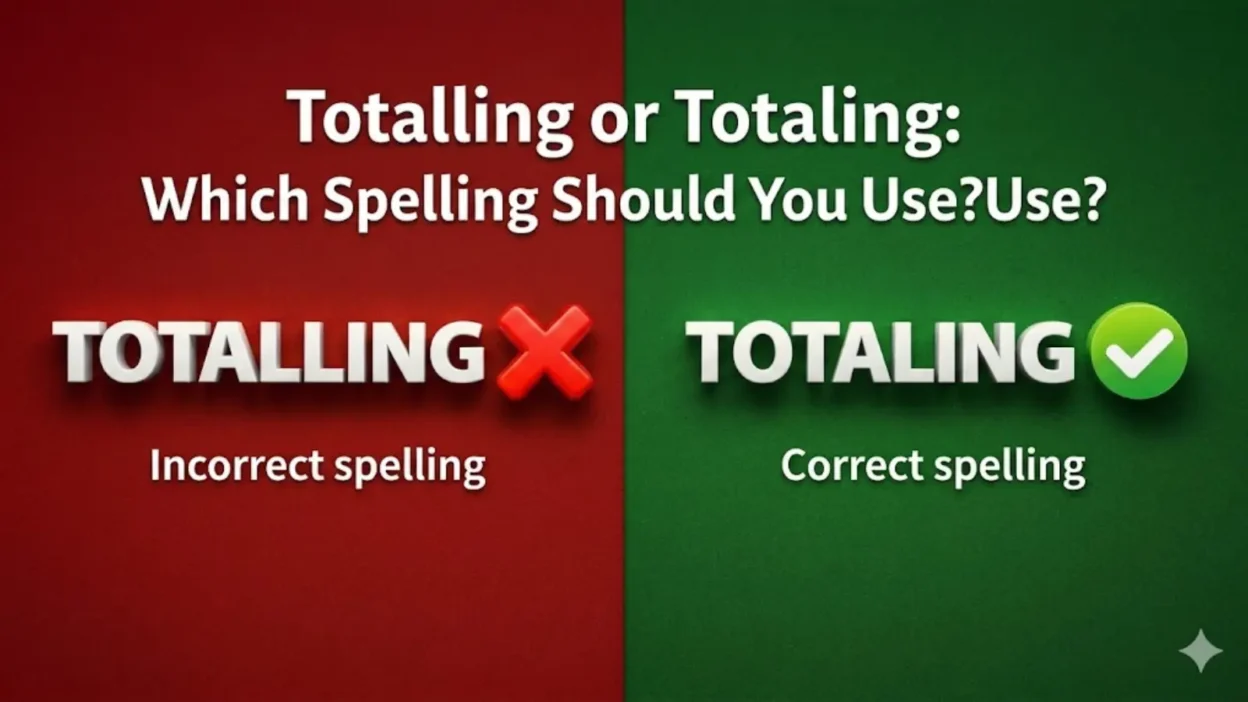
If you have ever written a sentence involving numbers, expenses, budgets, scores, or financial calculations, you may have stopped and wondered whether the correct spelling is totalling or totaling.
The confusion is understandable. Both spellings appear online, both are used by native English speakers, and both come from the same verb: total.
The good news is that this is not a case where one word is correct and the other is wrong. Instead, the difference comes from regional spelling conventions.
For readers and writers in the United States, totaling is the standard spelling. In the United Kingdom and some other English-speaking countries, totalling is more common.
Understanding this distinction can help you write more confidently and keep your spelling consistent with your audience’s expectations.
Quick Answer
If you write primarily for an American audience, use:
✓ totaling
If you write primarily for a British audience, use:
✓ totalling
Both words mean exactly the same thing.
The only real difference is the spelling convention being followed.
Examples:
- The expenses are totaling $4,500.
- The expenses are totalling £4,500.
The meaning does not change.
Why People Confuse Them
People often confuse these spellings because English has several verbs that behave similarly.
When a verb ends in the letter l, American and British English sometimes handle word endings differently.
Consider these examples:
| American English | British English |
|---|---|
| traveling | travelling |
| canceled | cancelled |
| counseling | counselling |
| totaling | totalling |
Many writers learn one spelling style at school but regularly encounter the other online. As a result, they may assume one version is a typo or mistake.
The reality is much simpler: both spellings are accepted within their respective regional systems.
Another reason for confusion is that many international websites combine American and British contributors. Readers often see both forms used in different articles and begin to wonder whether there is a hidden meaning difference.
There is not.
The distinction is spelling-based rather than meaning-based.
Key Differences At A Glance
| Feature | Totalling | Totaling |
| Meaning | Same | Same |
| Verb form | Yes | Yes |
| American English | Less common | Preferred |
| British English | Preferred | Less common |
| Professional US writing | Usually avoided | Standard |
| Professional UK writing | Standard | Less common |
| Pronunciation | Same | Same |
| Formality | Same | Same |
The table highlights the most important point: the difference is primarily regional spelling.
Meaning and Usage Difference
The words totalling and totaling have the same meaning because they are simply alternative spellings of the same verb form.
The base verb is total.
Common meanings include:
1. To Add Numbers Together
This is one of the most common uses.
Examples:
- We are totaling the receipts from last month.
- The accountant is totaling all expenses before preparing the report.
- She spent the afternoon totaling the quarterly sales figures.
2. To Reach a Specific Amount
The word can also describe a final sum.
Examples:
- The repairs are totaling nearly $3,000.
- Donations are totaling more than expected.
- Their combined earnings are totaling six figures annually.
3. To Equal a Final Quantity
Sometimes the word means that multiple parts add up to a final number.
Examples:
- The team scored points totaling 120 over two games.
- Purchases are totaling more than the original budget.
- The project costs are totaling several million dollars.
4. To Render a Vehicle a Total Loss
In North American usage, the verb can also describe severe vehicle damage.
Examples:
- The storm ended up totaling dozens of vehicles.
- The accident nearly totaled the truck.
- Insurance declared the car totaled after the collision.
In all of these situations, the spelling difference does not affect the meaning.
The only question is whether your audience expects American or British spelling.
Tone, Context, and Formality
One common misconception is that one spelling sounds more professional than the other.
That is not the case.
Here’s a cleaner version that fixes the repetition while keeping your meaning intact:
Neither spelling is more formal, more educated, or more modern.
Or, if you want a slightly more natural flow:
Neither spelling is more formal. It also isn’t more educated or more modern.
Both versions remove the repeated sentence starters and sound smoother for readers.
Instead, each spelling aligns with a different variety of English.
In American English
You will usually see:
- totaling
- totaled
Examples:
- The report shows expenses totaling $18,000.
- The crash resulted in a totaled vehicle.
American newspapers, businesses, universities, and publishers overwhelmingly prefer this spelling.
In British English
You will usually see:
- totalling
- totalled
Examples:
- The report shows expenses totalling £18,000.
- The collision resulted in a totalled vehicle.
British publishers typically follow this convention.
Formal Writing
In formal writing, consistency matters more than which spelling you choose.
For example:
Good:
- totaling
- totaled
or
- totalling
- totalled
Less effective:
- totaling
- totalled
Mixing spelling systems can distract readers and make a document appear inconsistent.
Informal Writing
In casual communication, many readers will not notice the distinction.
However, maintaining one style still creates a more polished appearance.
Which One Should You Use?
The answer depends almost entirely on your audience.
| Context | Best Choice | Why |
| US business writing | totaling | Matches American standards |
| US academic writing | totaling | Expected by most institutions |
| US journalism | totaling | Standard American spelling |
| US marketing | totaling | Familiar to American readers |
| UK publications | totalling | Follows British conventions |
| UK education | totalling | Matches local spelling rules |
| International projects | Either | Follow the chosen style guide |
For most American writers, the safest option is simple:
Use totaling.
If your audience is primarily located in the United States, this spelling will look natural and familiar.
When One Choice Sounds Wrong
Although both spellings are correct, they can sometimes appear unusual when placed in the wrong regional context.
Imagine reading a financial report from a major American corporation.
You would probably expect:
- totaling
- totaled
Seeing totalling might look slightly unusual because it conflicts with the spelling style most Americans expect.
Likewise, British readers may notice totaling in a UK publication and view it as an Americanized spelling.
Again, this is not about grammar.
It is about reader expectations.
The same principle applies to many other spelling differences:
- color vs colour
- organize vs organise
- traveled vs travelled
- totaling vs totalling
Consistency is usually more important than the specific choice.
Common Mistakes (and Quick Fixes)
Mistake #1: Assuming One Form Is Wrong
Many people think only one spelling is legitimate.
Incorrect assumption:
- Totalling is wrong.
Correct understanding:
- Totalling is accepted in British English.
- Totaling is accepted in American English.
Mistake #2: Mixing Regional Styles
Example:
- The expenses are totaling $5,000.
- The company later totalled the annual costs.
This combines American and British spellings.
Better:
- The expenses are totaling $5,000.
- The company later totaled the annual costs.
Or:
- The expenses are totalling £5,000.
- The company later totalled the annual costs.
Mistake #3: Believing the Meaning Changes
Some writers assume each spelling carries a different definition.
It does not.
The meaning remains identical.
Mistake #4: Overcorrecting
After learning that British English often doubles the letter L, some writers begin doubling it everywhere.
That can create inconsistency when writing for American audiences.
Always consider the style you are following.
Mistake #5: Switching Mid-Document
A report that uses both spellings may appear unedited.
Choose one style and keep it throughout the document.
Everyday Examples
The best way to understand usage is through real-world examples.
Business
- Quarterly sales are totaling more than projected.
- Revenue is totaling nearly $2 million this quarter.
- The audit revealed expenses totaling $45,000.
Personal Finance
- My monthly bills are totaling about $1,800.
- Vacation costs are totaling more than we expected.
- Household spending is totaling less this year.
Education
- The student earned points totaling 95 percent.
- Scholarship awards are totaling thousands of dollars.
- Course fees are totaling more than last semester.
Sports
- The team finished with scores totaling 250 points.
- Combined statistics are totaling record numbers.
- Their playoff run included victories totaling ten wins.
Insurance
- The accident ended up totaling the vehicle.
- Flood damage nearly totaled the truck.
- Severe impact resulted in a totaled SUV.
British-Style Examples
- Costs are totalling more than anticipated.
- Donations are totalling record amounts.
- Repairs are totalling several thousand pounds.
Notice that the meaning remains unchanged.
Only the spelling differs.
Dictionary-Style Word Details
Verb
Totalling
Present participle form of the verb total using the double-L spelling convention commonly associated with British English.
Examples:
- The figures are totalling more than expected.
- They are totalling the final results.
Totaling
Present participle form of the verb total using the single-L spelling convention preferred in American English.
Examples:
- The figures are totaling more than expected.
- They are totaling the final results.
Noun
Totalling
Not commonly used as a noun in standard English.
Totaling
Not commonly used as a noun in standard English.
Both function primarily as verb forms rather than nouns.
Synonyms
Totalling
Closest plain alternatives:
- adding up
- summing
- calculating
- aggregating
- amounting to
Totaling
Closest plain alternatives:
- adding up
- summing
- calculating
- aggregating
- amounting to
For the vehicle-damage meaning:
Closest plain alternatives:
- destroying
- wrecking
- rendering a total loss
There is no meaningful synonym difference between the two spellings.
Example Sentences
Totalling
- The invoices are totalling more than originally estimated.
- Repairs are totalling several thousand pounds.
- The department is totalling all expenses before approval.
- Donations are totalling record amounts.
- Costs are totalling more than expected.
Totaling
- The invoices are totaling more than originally estimated.
- Repairs are totaling several thousand dollars.
- The department is totaling all expenses before approval.
- Donations are totaling record amounts.
- Costs are totaling more than expected.
Word History
Both spellings come from the verb total, which developed from the adjective and noun meaning an entire amount or complete sum.
Over time, English spelling conventions evolved differently in various regions.
American English generally favors the single-L form in words like totaling, while British English often retains the doubled-L form totalling.
The meanings have remained the same.
Phrases Containing
Totalling
- totalling up expenses
- totalling the figures
- totalling more than
- totalling the costs
- totalling the final amount
Totaling
- totaling up expenses
- totaling the figures
- totaling more than
- totaling the costs
- totaling the final amount
These phrases carry the same meaning regardless of spelling style.
Conclusion
When comparing totalling and totaling, there is no difference in meaning, tone, or grammatical function.
The distinction comes down to regional spelling conventions.
For American English:
Totaling is the preferred spelling.
For British English:
Totalling is the preferred spelling.
If your audience is in the United States, schools, universities, businesses, publishers, and most style guides will expect totaling.
The most important rule is consistency. Choose the spelling style that matches your audience and use it throughout your writing.
Once you understand that both forms mean the same thing, the choice becomes much easier.