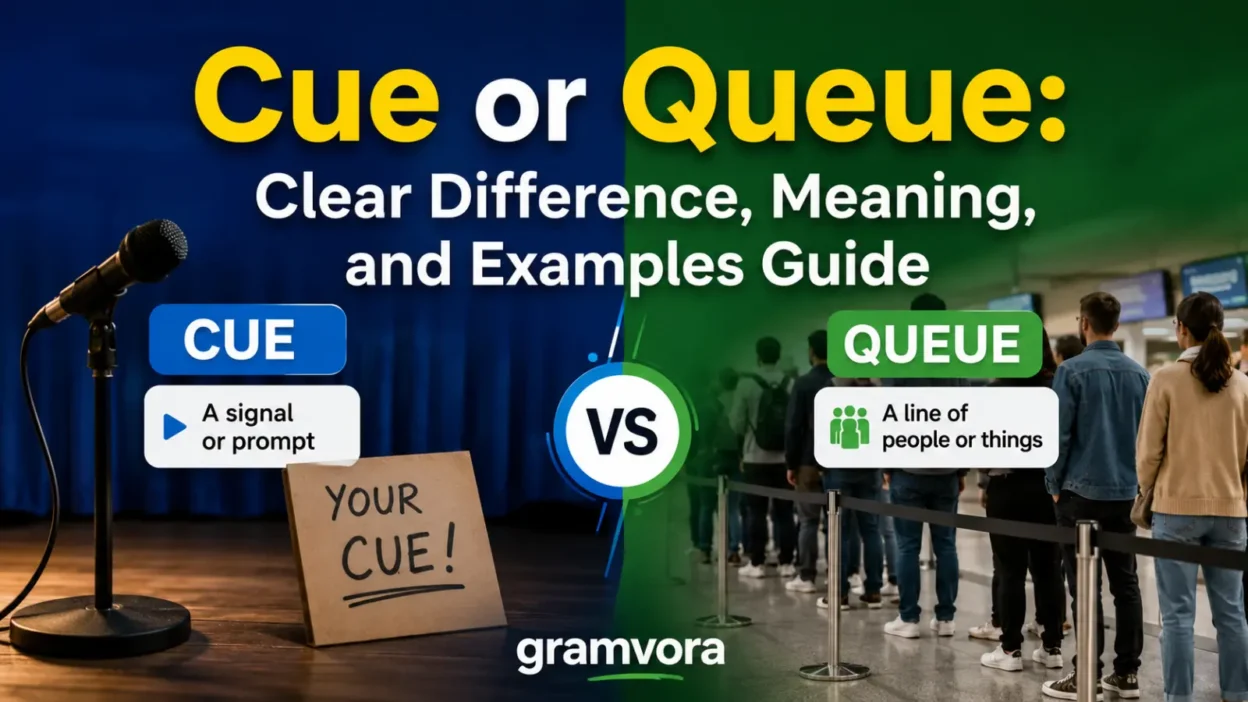
Cue or queue is a common word-choice problem because both words sound exactly alike. Still, they do not usually mean the same thing.
Use cue when you mean a signal, hint, prompt, or pool stick. Use queue when you mean a line of people, items, tasks, calls, songs, or jobs waiting in order. In everyday US English, people often say line instead of queue for people waiting, but queue remains normal in technical and service contexts.
Quick Answer
Use cue for a signal or prompt: “That was my cue to leave.” Use queue for a waiting line or ordered list: “The call is in the support queue.” The words are homophones, so they sound like the letter Q, but their meanings are different.
Why People Confuse Them
People confuse cue and queue because the pronunciation is the same. Both words sound like Q, so the difference disappears in speech. The spelling must carry the meaning.
Another reason is that both words can appear near action. A cue can tell someone when to act. A queue can hold people or items before action happens. For example, a host may give a cue to start the show, while guests may wait in a queue to enter.
The spelling also makes queue look unusual. It has five letters, but readers pronounce it as one sound. That makes some writers second-guess it, especially when they only hear the word.
Key Differences At A Glance
| Context | Best Choice | Why |
|---|---|---|
| A signal to begin | cue | A cue tells someone when to act. |
| A hint or clue | cue | A cue can point someone toward a response. |
| A pool stick | cue | A cue is the stick used in pool or billiards. |
| A line of people waiting | queue | A queue is an ordered waiting line. |
| A list of calls or tasks waiting | queue | A queue can hold items until they are handled. |
| A song ready to play next | queue | A song can wait in an ordered list. |
| Something happens at the perfect time | cue | The phrase is “on cue.” |
| People wait to enter a place | queue | Queue means the people are waiting in order. |
Meaning and Usage Difference
Cue usually means a signal that tells someone to do something. It can be a word, sound, gesture, event, or situation. For example, a teacher’s nod can be a cue to begin. A phone ringing on stage can be an actor’s cue to speak.
Cue can also mean a hint. If someone looks bored during a meeting, that may be your cue to wrap up. In sports and games, a cue is also the stick used in pool, billiards, or similar games.
Queue means a line or ordered group waiting for something. In US English, people usually say line when they mean people waiting at a store, airport, or event. However, queue is still common in customer service, call centers, playlists, apps, printers, and computer systems.
Both words can be nouns and verbs. Cue as a verb means to signal, prompt, or get something ready. Queue as a verb means to put something in a line or ordered list, or to wait in one.
Pronunciation matters here because the words are homophones. Say both like the letter Q. The sound is the same, but the spelling changes the meaning.
Tone, Context, and Formality
Cue sounds natural in conversation, school writing, theater, media, sports, and workplace communication. It is not too formal. It simply names a signal, hint, or prompt.
Queue can sound slightly British when it means a line of people waiting. In the United States, line often sounds more natural in everyday speech. For example, most US speakers would say, “We waited in line for coffee,” not “We waited in a queue for coffee.”
However, queue does not sound odd in technical or service contexts. A customer can wait in a support queue. A printer can have a document queue. A streaming app can add a movie to your queue. In those cases, queue is clear and standard.
So the tone depends on the setting. Cue feels broad and everyday. Queue feels more specific, especially when order and waiting matter.
Which One Should You Use?
Choose cue when something tells someone to start, stop, respond, enter, leave, speak, or act.
Examples:
“Her smile was my cue to relax.”
“The director cued the music.”
“That question is your cue to explain the next step.”
Choose queue when people, calls, songs, files, or tasks are waiting in order.
Examples:
“There are five calls in the queue.”
“Add that show to my queue.”
“The printer queue is full.”
For everyday US writing about people waiting, line may sound more natural than queue. Still, if the comparison is cue or queue, choose queue when the meaning is an ordered waiting line.
When One Choice Sounds Wrong
Cue sounds wrong when you mean a waiting line. “We stood in a cue for tickets” does not work in standard modern use. The reader may picture a signal, not a line.
Queue sounds wrong when you mean a signal. “That was my queue to speak” is incorrect in normal writing. The sentence means someone received a prompt, so the correct word is cue.
The phrase on cue also needs cue. It means something happened at exactly the expected moment. “Right on queue” is a common mistake, but it does not fit the meaning.
Be careful with cue up and queue up. Cue up can mean to get music, video, or sound ready to play. Queue up can mean to line up, or to add items to an ordered list. The meaning changes with the spelling.
Common Mistakes (and Quick Fixes)
Mistake: “That was my queue to leave.”
Fix: “That was my cue to leave.”
Why: A signal to leave is a cue.
Mistake: “The song is next in the cue.”
Fix: “The song is next in the queue.”
Why: A waiting list is a queue.
Mistake: “The actor missed his queue.”
Fix: “The actor missed his cue.”
Why: An actor follows a cue.
Mistake: “Customers waited in a cue outside.”
Fix: “Customers waited in a queue outside.”
More natural in US English: “Customers waited in a line outside.”
Mistake: “Cue the documents for printing.”
Fix: “Queue the documents for printing.”
Why: The documents are being placed in an ordered list.
Everyday Examples
“I took her silence as my cue to change the subject.”
“The coach gave the cue, and the runners started the drill.”
“Right on cue, the rain started as we left the restaurant.”
“The server placed my call in a queue.”
“She added three episodes to her queue before the flight.”
“The printer queue stopped moving after the network issue.”
“His nervous laugh was a cue that he needed help.”
“There was a long queue at the ticket counter, though most Americans would call it a line.”
“Cue the lights when the speaker walks onstage.”
“Queue the next song so it plays after this one.”
| Feature | cue | queue |
| Main idea | signal, hint, prompt, or pool stick | ordered waiting line or list |
| Sound | like Q | like Q |
| Common noun use | “That is your cue.” | “The file is in the queue.” |
| Common verb use | “Cue the music.” | “Queue the next video.” |
| US everyday note | common and natural | common in service and technical contexts; line is common for people waiting |
Dictionary-Style Word Details
Verb
• cue: To signal, prompt, or get something ready. Example: “The producer cued the intro music.”
• queue: To place in an ordered line or list, or to wait in one. Example: “The system queued the request.” In US speech, “line up” is more common than “queue up” for people waiting.
Noun
• cue: A signal, hint, prompt, or pool stick. Example: “The final line was her cue.”
• queue: A waiting line or ordered list. Example: “Your request is in the queue.”
Synonyms
• cue: Closest plain alternatives include signal, prompt, hint, sign, clue, and indication. For a pool stick, “pool stick” is the plain alternative.
• queue: Closest plain alternatives include line, waiting line, list, sequence, file, and backlog. In US everyday speech, line is often the best plain alternative for people waiting.
Clear antonyms do not always fit these words well. For cue, silence or lack of signal may work in some contexts. For queue, disorder or no line may work only when the context is about arrangement.
Example Sentences
Cue
• “The host gave me a cue to start speaking.”
• “When her hand went up, I took it as a cue that she had a question.”
• “For his pool league, he bought a new cue.”
Queue
• “The request moved to the front of the queue.”
• “Next, please queue the track.”
• “Before the doors opened, a long queue formed.”
Word History
• cue: The signal meaning is connected with stage use, where a performer needed a sign to begin a line or action. The pool-stick meaning developed separately through cue sports use.
• queue: Queue came into English through French and is connected with the idea of a tail or line. Today, the word commonly refers to an ordered waiting line, an ordered list, or a computer-related sequence.
The exact history can become detailed, so modern writers should focus on current meaning first: cue signals; queue lines things up.
Phrases Containing
• cue: on cue, right on cue, take your cue from, cue up, cue in, visual cue, social cue, cue ball, pool cue.
• queue: queue up, in the queue, support queue, call queue, print queue, message queue, job queue, playlist queue, virtual queue.
FAQs
Is it cue or queue?
Use cue when you mean a signal, hint, prompt, or pool stick. Use queue when you mean a line or ordered list. For example, “That was my cue to speak” and “Your call is in the queue” are both correct.
Are cue and queue pronounced the same?
Yes. Cue and queue sound the same, like the letter Q. Because they are homophones, the spelling changes the meaning in writing.
Is “that’s my cue” correct?
Yes. That’s my cue is correct when something tells you to act, leave, speak, or begin. For example, “When the music started, that was my cue to walk onstage.”
Is “wait in cue” or “wait in queue” correct?
Use wait in queue if you mean people are waiting in order. In everyday US English, wait in line sounds more natural. “Wait in cue” is incorrect.
Is it “cue the music” or “queue the music”?
Use cue the music when you mean get the music ready or signal it to begin. Use queue the music when you mean add songs to a playlist or ordered list.
What is an easy way to remember cue vs queue?
A cue tells you what to do. A queue makes you wait your turn. Use cue for signals and queue for lines, lists, calls, songs, files, or tasks waiting in order.
Conclusion
Cue and queue sound the same, but they solve different writing problems. Use cue for a signal, hint, prompt, or pool stick. Use queue for a line or ordered list of people, calls, songs, files, or tasks.
For US readers, line often sounds more natural than queue when people are waiting in person. Still, queue is the right word when the meaning is an ordered waiting list. The easiest memory trick is simple: a cue tells you what to do; a queue makes you wait your turn.